Shanghai Attractions

The Peninsula Shanghai
The Peninsula Shanghai is one of the most luxury 5 star hotels in Shanghai.It locates at the historical famous Bund area.And it is the only one new building in this area during the past 60 years. The hotel is well-furnished by recreating the heyday of Shanghai in 1920s and 1930s when Shanghai was...
The Peninsula Shanghai is one of the most luxury 5 star hotels in Shanghai.It locates at the historical famous Bund area.And it is the only one new building in this area during the past 60 years. The hotel is well-furnished by recreating the heyday of Shanghai in 1920s and 1930s when Shanghai was hailed as the Oriendtal Paris.
Waldorf Astoria Shanghai on the Bund
Waldorf Astoris Shanghai On the Bund is one of the most luxury hotels in Shanghai China. Combining the history andd culture of the celebrated Shanghai Bund with a taste of 21st Century sophistication. Waldorf Astoria Shanghai on the bund offers a heritage ambiance, legendary service an...
Waldorf Astoris Shanghai On the Bund is one of the most luxury hotels in Shanghai China. Combining the history andd culture of the celebrated Shanghai Bund with a taste of 21st Century sophistication. Waldorf Astoria Shanghai on the bund offers a heritage ambiance, legendary service and timeless amenities to make clients stay memorable and distinct.
it is worthy to stay when you are young since you will know more about LUXURY and it is still worthy to stay when you get older since you will know more about ENJOY.
Shanghai Articles
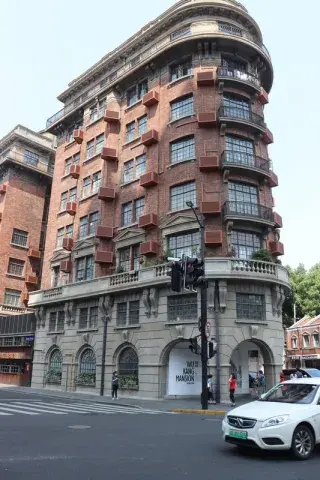
Normandy Apartments Building
This is a series of pictures of the Normandy apartments or the Wukang Building. This famous Shanghai building is also known as the International Savings Society Apartments is considered one of the architectural treasures of the city....
This is a series of pictures of the Normandy apartments or the Wukang Building. This famous Shanghai building is also known as the International Savings Society Apartments is considered one of the architectural treasures of the city. It is located in the French Concession area, at the southern end of Wukang Road, on the corner with Middle Huaihai Road, in Shanghai's Xuhui District.
The Normandy building was designed by the legendary Hungarian-Slovak architect László Hudec. For almost three decades (1918-1945) he was one of Shanghai’s master architects. The Normandy building was finished in the year 1924 and now, almost 100 years old, the design and structure still look modern and unique. Other masterpieces designed by László Hudec are the Park Hotel, the Grand Theater, the combined Baptist Publications and Christian Literature Society buildings, the American club, Huadong Hospital and the post-modern "Green House".
For people who are interested to see the work of László Hudec I do offer a special tour the see several of the building he made.
Xu Jin
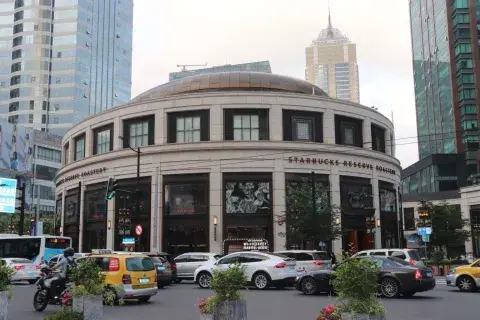
Second largest Starbuck in the world.
In December 2017, Starbucks opened its big coffee restaurant in Shanghai. At that time, it was the biggest in the world, but in 2019 they opened an even bigger one in Chicago. ...
In December 2017, Starbucks opened its big coffee restaurant in Shanghai. At that time, it was the biggest in the world, but in 2019 they opened an even bigger one in Chicago.
But he restaurant in Shanghai which is called the ‘Reserve Roastery’ and it’s located on West Nanjing Road (Nanjing Xi Lu) is still a marvellous place to drink a coffee or eat a bite.
The brand defines it as “a coffee theatre with a Chinese Spirit”. It is a venue with 2 700 square meter’s shop, which is 15 times bigger than a classic Starbucks’s shop (around 200 m2). This shop has 400 employees and can serve around 500 persons at the same time!
The store concept :
It is an up-market store with premium quality of products and services. There is an in-house artisanal bakery, a long coffee bar, a Teavana bar, a shop with clothes, goodies, food, Italian catering (in collaboration with Prince Bakery), cooking utensils and professional tools for coffee or tea making. The coffee Aficionado will also find rare products, such as « grand crus » unfindable elsewhere, such as Yunnan, a region best known for its teas.
TaoBao & Alibaba :
To create a real buzz Starbucks cooperates with TaoBao and Alibaba. They launched a special app that offers customers a nice and interactive way to learn about coffee and the process of coffee roasting. And it really worked because nowadays there are more than 4500 Starbuck in China.
The ‘Reserve Roastery’ in Shanghai is a very nice place to drink a coffee or to enjoy some nice food.
Xu Jin
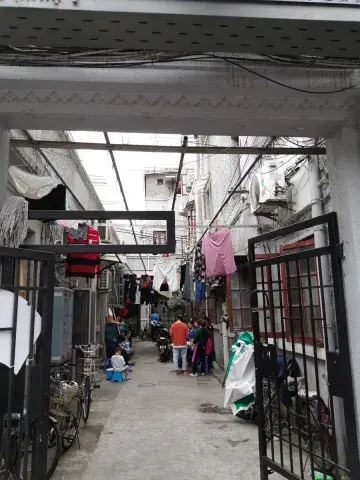
Narrow Streets o Shanghai
Narrow streets of Shanghai
...Narrow streets of Shanghai
Like in Beijing, Shanghai also has a tightly packed alleyways structure called longtangs (弄堂, lòngtáng). In Beijing, these areas are called hutongs. The main differences between the two are strikingly visible. Hutongs are short, while longtangs are taller, with two or three stories, towering above the mazes within. Here we often talk about The Narrow Streets of Shanghai.
The real-life of Shanghai is in these longtangs. They are like the capillary vessels of the city. Life pulses through these narrow streets, there is a rhythm here. If you want to understand Shanghai, you first must understand the longtangs, they are an integral part of the cities history. They are a representation of the real Shanghai. Each resident of Shanghai has its own story to tell.
Shanghai has long been a city of immigrants. The first explosion came in the 1840s when the Qing Dynasty was forced to sign Britain’s “Treaty of Nanking.” Under this agreement, China opened five ports for foreign trade with low tariffs. Shanghai was one of these five cities. The result was that Westerner people flooded the city and started to build their own neighbourhoods. And also a lot of Chinese also moved to Shanghai, taking advantage of the new work opportunities. The sudden influx of Westerners and rural Chinese, and their cultural mixing, was the starting point of the unique architecture of the longtangs.
The original longtangs were miniature, compact neighbourhoods, made up of small wood buildings. Inside one longtang, there were many alleyways, labyrinth-like, but only one exit: a single metal gate, which led to the main street.
By 1863, there were almost 9,000 such communities in Shanghai. But because they were all made of wood, and so tightly packed, they were also highly flammable. Ten years later, most of the neighbourhoods had burned down and been replaced by a newer style of longtangs called shikumen (石库门, shíkùmén), built using a mixture of Western and southern Chinese styles.
You can recognize the shikumen style by the stone doorframe (shikumen literally means “stone gate”), a black door and a wooden window. Inside, there are usually front and back courtyards, plus several living rooms and a kitchen. Stairs to the second story, from the back yard, leading up to bedrooms. Because of the little light that reaches the sides of the longtang, most have skylights, called 老虎窗 (lǎohǔ chuāng)—because the English word “roof” sounds like “老虎” (lǎohǔ, tiger) in Shanghai dialect.
You’ll often see longtang houses missing their ground floors. They will be wedged between two streets, connecting two rows of houses; this type of house is called a 过街楼 (guòjiēlóu? literally “cross street house”). Another way that more people were crammed into the neighbourhood was by renting out a shabby room between the kitchen and flat roof called 亭子间 (tíngzijiān). As a lot of famous writers start their career as a writer, this is also the name of an important literary style known as “Tingzijian Literature.”
Shanghai always have been very crowded. Years ago, you’d be lucky to share a house with others. A family would all live in the same room together. Four could live in a room with less than 10 square meters of space. This was normal.”
There was no privacy in the longtangs. Neighbours cooked together, and usually ate dinner outside, where they could see what other families were eating. Toilets were shared. If there were quarrels between families, everyone in the neighbourhood got involved. No privacy at all, but everyone looked out for one another. When it rained, your neighbours helped you bring your clothes inside from the clothesline. Now more and more young people move away to the outside of Shanghai to live in a separate apartment.
Especially a lot of the older stay to live in the longtangs. They like this lifestyle, to live with their friends. They feel at home—the whole longtang is one big family.
II also lived with my mum in a longtang. It was a nice time but also had a lot of inconveniences. We were lucky that out longtang was demolished and the government gave us a nice apartment elsewhere in Shanghai as compensation.
In area’s like Xintiandi and Tianzifang, they have restored a lot of the original houses. But this is commercial replicas housing glitzy entertainment, high-end boutiques, and classy art centres. These are fun to visit, but it is more a touristic version. To see the real longtangs, the real Shanghai life, you need to dig deeper into Shanghai—places like Fuxing West Road and Xinzha Road. I can also recommend you to visit any of the following streets: Jianguo West Road, Fuxing West Road, Hefei Road, Dongtai Road, Huaihai Zhong Road, Huashan Road, Shaanxi South Road, Yan’an Zhong Road, Yuyuan Road, Xinzha Road, Changsha Road, Xinchang Road, Guling Road, Xiamen Road and Yunnan Zhong Road.
You can go by yourself and get lost in these alleyways and learn more about Shanghai lifestyle. Or you ask me to be your guide. I can show you the really interesting places and help you to communicate with the local people. In the Narrow Street of Shanghai, you will not find many people who can speak English with you.
Xu Jin
Top Shanghai Tours
$238 Per Day
Private Hangzhou Day Trip from Shanghai by Bullet Train
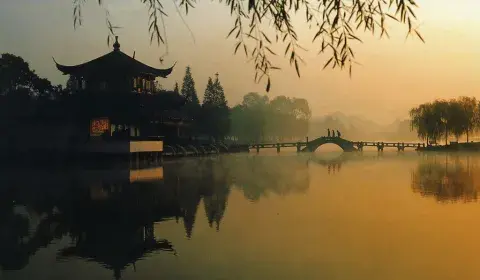
Take in the highlights of beautiful Hangzhou on a private full-day tour from Shanghai. After hotel pickup and transfer by high-speed train to Hangzhou, your private guide takes you to see some city attractions, such as Faxi temple. Moreover, enjoy a tasty lunch at a local restaurant before heading to Longjing village. There, learn about the process of farming and producing dragonwell tea, the region’s most famous product. Finally, enjoy a scenic boat cruise on UNESCO World Heritage-listed West Lake before returning to Shanghai.
...Read more
Take in the highlights of beautiful Hangzhou on a private full-day tour from Shanghai. After hotel pickup and transfer by high-speed train to Hangzhou, your private guide takes you to see some city attractions, such as Faxi temple. Moreover, enjoy a tasty lunch at a local restaurant before heading to Longjing village. There, learn about the process of farming and producing dragonwell tea, the region’s most famous product. Finally, enjoy a scenic boat cruise on UNESCO World Heritage-listed West Lake before returning to Shanghai.
This is a private, full-day trip from Shanghai to Hangzhou. After you are picked up in your hotel lobby in the early morning, you will take a bullet train to Hangzhou. This is the fastest way to Hangzhou and you can experience train speeds of up to 300 kilometers per hour. Your tour begins at one of Hangzhou's signature sites, the West Lake. Enjoy a lake cruise to see the top ten West Lake scenic views. You will then be taken to experience the wonderful cuisine of Hangzhou at a local restaurant. After lunch, you will visit Faxi temple, a well-known Temple dating back to the Jin Dynasty. See its famous wooden Buddha. Here, you will see fewer tourists and more locals. Finally, enjoy a cup of green tea when you visit the famous Longjing village to see wild fields of Longjing tea bushes where the locals produce the world famous green tea- Longjing Tea. In the village, all locals are tea farmers and you will see the entire procedure of making the famous tea and will get the chance to taste the best quality emperor tea. Afterwards, you will take the bullet train back to Shanghai and you will be returned to your hotel.
$70 Per Day
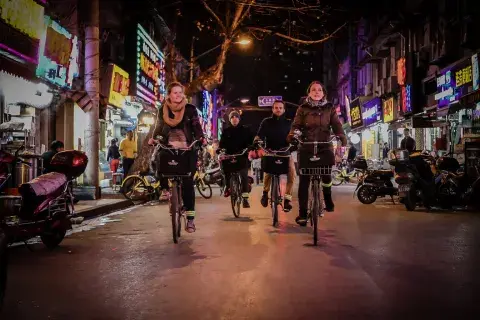
Bike Tour - "Shanghai by Night"
What would be a better way to experience the “City That Never Sleeps” than hopping on one of our vintage Forever bicycles and explore a whole New World after dark?...Read more
What would be a better way to experience the “City That Never Sleeps” than hopping on one of our vintage Forever bicycles and explore a whole New World after dark? Follow our foreign expert Tour Leader on a multi-themed route from the narrow streets of the Old Town all the way to the dazzling lights of the Bund. Meanwhile, cycle around the famous landmark Yu Garden, learn about Ghost Wedding rituals, visit a Traditional Chinese Medicine outlet and get to learn more about the "Paris of the East". Finally, tickle your taste buds with some delicious street food in order to immerse yourself deeper into local life. In just one evening, we'll explore the many faces of Shanghai that make this city so unique. Easy and accessible ride for all!
USEFUL INFORMATION
- English-speaking (for other languages, please contact us)
- About 9 km ride, easy ride for all.
- From 18:15pm to 21:30pm
- Up to 6 participants
- Departure and arrival at our Culture Shock Office in Xintiandi district.
- Minimum height is 1.50m. Tandem bikes are available for kids below 12
- Prices are all inclusive (Snack food, a bottle of water, a foreign experienced guide, a helmet and single-gear vintage bike rental with all lights)
- Join-in Group every Tuesday/Friday/Saturday (USD 70 per person)
- Private Tour possible every day (USD 210 in total for 2 participants)