Ephesus Attractions

No Frills Ephesus Tours

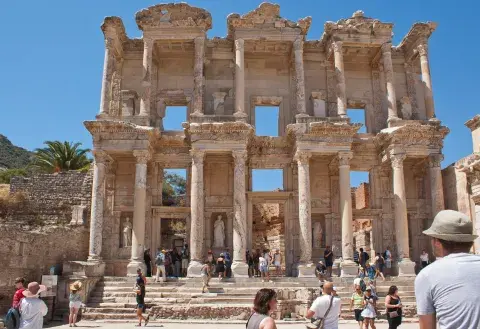
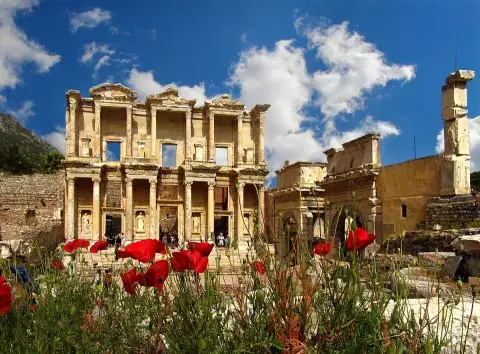
Ephesus (/ˈɛfəsəs/;Greek: Ἔφεσος Ephesos; Turkish: Efes; ultimately from Hittite Apasa) was an ancient Greek city on the coast of Ionia, three kilometres southwest of present-day Selçuk in İzmir Province, Turkey.

It was built in the 10th century BC ...

Ephesus (/ˈɛfəsəs/;Greek: Ἔφεσος Ephesos; Turkish: Efes; ultimately from Hittite Apasa) was an ancient Greek city on the coast of Ionia, three kilometres southwest of present-day Selçuk in İzmir Province, Turkey.

It was built in the 10th century BC on the site of the former Arzawan capital by Attic and Ionian Greek colonists.

During the Classical Greek era it was one of the twelve cities of the Ionian League. The city flourished after it came under the control of the Roman Republic in 129 BC. According to estimates, Ephesus had a population of 33,600 to 56,000 people in the Roman period, making it the third largest city of Roman Asia Minor after Sardis and Alexandria Troas.

The city was famed for the Temple of Artemis (completed around 550 BC), one of the Seven Wonders of the Ancient World.

In 268 AD, the Temple was destroyed or damaged in a raid by the Goths. It may have been rebuilt or repaired but this is uncertain, as its later history is not clear. Emperor Constantine the Great rebuilt much of the city and erected new public baths. Following the Edict of Thessalonica from Emperor Theodosius I, what remained of the temple was destroyed in 401 AD by a mob led by St. John Chrysostom.

The town was partially destroyed by an earthquake in 614 AD. The city's importance as a commercial center declined as the harbor was slowly silted up by the Küçükmenderes River.

Ephesus was one of the seven churches of Asia that are cited in the Book of Revelation. The Gospel of John may have been written here. The city was the site of several 5th century Christian Councils (see Council of Ephesus). It is also the site of a large gladiators' graveyard.

The ruins of Ephesus are a favourite international and local tourist attraction, partly owing to their easy access from Adnan Menderes Airport.

Ancient City of Ephesus

History of Ephesus

According to the old legends, Ephesus was founded by the female warriors known as the Amazons. The name of the city is thought to have been derived from "APASAS", the name of a city in the "KINGDOM OF ARZAWA" meaning the "city of the Mother Goddes...

History of Ephesus

According to the old legends, Ephesus was founded by the female warriors known as the Amazons. The name of the city is thought to have been derived from "APASAS", the name of a city in the "KINGDOM OF ARZAWA" meaning the "city of the Mother Goddess".

Ephesus was inhabited from the end of the Bronze Age onwards, but changed its location several times in the course of its long history in accordance with habits and requirements.

​Carians and Lelegians are to be have been among the city's first inhabitants. Ionian migrations are said to have begun in around 1200 B.C. According to legend, the city was founded for the second time by Androclus, the son of Codrus, king of Athens, on the shore at the point where the CAYSTER (Küçük Menderes) empties into the sea, a location to which they had been guided by a fish and a wild boar on the advice of the soothsayers.

The Ionian cities that grew up in the wake of the Ionian migrations joined in a confederacy under the leadership of Ephesus. The region was devastated during the Cimmerian invasion at the beginning of the 7th century B.C. Under the rule of the Lydian kings, Ephesus became one of the wealthiest cities in the Mediterranean world. The defeat of the Lydian King Croesus by Cyrus, the King of Persia, prepared the way for the extension of Persian hegemony over the whole of the Aegean coastal region.

At the beginning of the 5th century, when the Ionian cities rebelled against Persia, Ephesus quickly dissociated itself from the others, thus escaping destruction.

Ephesus remained under Persian rule until the arrival of Alexander the Great in 334 B.C., when it entered upon a fifty year period of peace and tranquillity. Lysimachus, who had been one of the twelve generals of Alexander the Great and became ruler of the region on Alexander's death, decided to embark upon the development of the city, which he called Arsineia after his wife Arsinoe. He constructed a new harbour and built defence walls on the slopes of the Panayır and Bülbül Mts., moving the whole city 2.5 km to the south-west. Realising, however, that the Ephesians were unwilling to leave their old city, he had the whole sewage system blocked up during a great storm, making the houses uninhabitable and forcing the inhabitants to move. In 281 B.C. the city was re-founded under the old name of Ephesus and became one of the most important of the commercial ports in the Mediterranean.

In 129 B.C. the Romans took advantage of the terms of the will left by Attalos, King of Pergamon, by which they were bequathed his kingdom, to incorporate the whole region into the Roman Empire as the province of Asia. Ancient sources show that at this time the city had a population of 200,000. In the 1st century B.C. the heavy taxes imposed by the Roman government led the population to embrace Mithridates as their savior and to support him in his mutiny against Roman authority and in 88 B.C. a massacre was carried out of all the Latin speaking inhabitants of the city, which was then stormed and sacked by a Roman army under Sulla, It was from the reign of Augustus onwards that the buildings we admire today were constructed. According to documentary sources, the city suffered severe damage in an earthquake in 17 A.D. After that, however, Ephesus became a very important centre of trade and commerce. The historian Aristio describes Ephesus as being recognised by all the inhabitants of the region as the most important trading centre in Asia. It was also the leading political and intellectual centre, with the second school of philosophy in the Aegean. From the 1st century onwards, Ephesus was visited by Christian disciples attempting to spread the Christian belief in a single God and thus forced to seek refuge from Roman persecution. Besides enjoying a privileged position between East and West coupled with an exceptionally fine climate, the city owed its importance to its being the centre of the cult of Artemis.

For the Christians, the city, with its highly advanced way of life, its high standard of living, the variety of its demographic composition and its firmly rooted polytheistic culture, must have presented itself as an ideal pilot region... From written sources we learn that St Paul remained in the city for three years from 65 to 68, and that it was here that he preached his famous sermons calling upon the hearers to embrace the faith in. one God. He taught that God had no need of a house made with human hands and that he was present in all places at all times. This was all greatly resented by the craftsmen who had amassed great wealth from their production of statues of Artemis in gold, silver or other materials. A silversmith by the name of Demetrius stirred up the people and led a crowd of thousands of Ephesians to the theatre, where they booed and stoned Paul and his two colleagues, chanting "Great is Artemis of the Ephesians! Great is Artemis of the Ephesians!" So turbulent was the crowd that Paul and his companions escaped only with great difficulty. From his Epistles to the communities it would appear that Paul spent some time as a prisoner in Ephesus.

Legend has it that St John the Evangelist came to Ephesus with the Virgin Mary in his care. Some also say that it was here that he wrote his Gospel and was finally buried. In 269 Ephesus and the surrounding country was devastated by the Goths. At that time there was still a temple in which the cult of Artemis was practised. In 381, by order of the Emperor Theodosius, the temple was closed down, and in the following centuries it lay completely abandoned, serving as a quarry for building materials.

The situation of the city, which had given it its privileged geographical position, was also the cause of its decline and fall. The prosperity of the city had been based on its possession of a sheltered natural harbour, but by the Roman period ships reached the harbour to the west of Mt Pion 1.5 km from the Temple of Artemis through a very narrow and difficult channel. The cause of this was the Meander (Cayster) River, which emptied into the Aegean a little to the west of the city of Ephesus, where it created a delta formed by the alluvium carried down by the river over thousands of years. By the late Byzantine era the channel had been so silted up as to be no longer usable. The sea gradually receded farther and farther, while the marshy lands around the harbour gave rise to a number of diseases, such as malaria. The new outlook that had arisen with the spread of Christianity led to the gradual abandonment of all buildings bearing witness to the existence of polytheistic cults and the construction in their place of Christian churches. In the year 431 the third Ecumenical council took place in Ephesus.

Emperor Theodosius convoked another council in Ephesus in 449, which came to be known as the "robber council". From the 6th century onwards the Church of St John was an important place of pilgrimage, and Justinian took measures to protect it by having.the whole hill on which it stood surrounded by defence walls. Shortly afterwards, the Church of the Virgin and other places of worship were destroyed and pillaged in Arab raids. In the 7th century the city was transferred to the site now occupied by the town of Selçuk and during the Byzantine era Ephesus grew up around the summit of Mt Ayasuluğ. The city enjoyed its last years of prosperity under the Selçuk Emirate of the Aydınoğulları. During the Middle Ages the city ceased to function as a port.

By the 20th century the silt carried down by the Meander had extended the plain for a distance of 5 km.

The House of Virgin Mary

The House of Virgin Mary

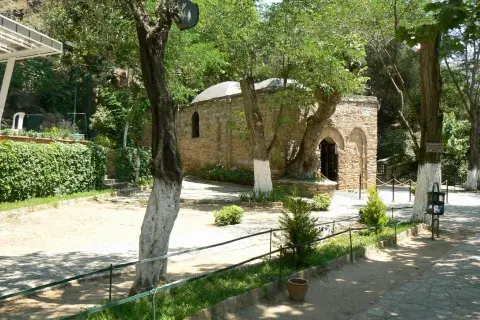
Located on the top of the "Bulbul" mountain 9 km from Ephesus, the shrine of the Virgin Mary enjoys a marvelous atmosphere hidden in the green. It is the place where Mary may have spent her last days. Indeed, she may hav...

The House of Virgin Mary

Located on the top of the "Bulbul" mountain 9 km from Ephesus, the shrine of the Virgin Mary enjoys a marvelous atmosphere hidden in the green. It is the place where Mary may have spent her last days. Indeed, she may have come in the area together with Saint John, who spent several years at Ephesus to spread Christianity. Mary preferred this remote place rather than living in the crowded town.

The house is a typical Roman architectural example, entirely made of stones. In the 4th century AD, a church, combining her house and grave, was built. The original two-story house consisted of an anteroom (where today candles are lit), bedroom and praying room (Christian church area) and a room with a fireplace (chapel for Muslims). A front kitchen fell into ruins and was restored in the 1940's. Today, only the central part and a room on the right of the altar are open to visitors. From there one can understand that this building looks more like a church than a house. Another interesting find is the "Water of Mary", a well source to be found at the exit of the church area and where a rather salty water, with curative properties, can be drunk by all.

Paul VI was the first pope to visit this place in the 1960's. Later, in the 1980's, during his visit, Pope John-Paul II declared the Shrine of theVirgin Mary as a pilgrimage place for Christians. It is also visited by Muslims who recognize Mary as the mother of one of their prophets. Every year, on August 15th a ceremony is organized to commemorate Mary's Assumption

Temple of Artemis

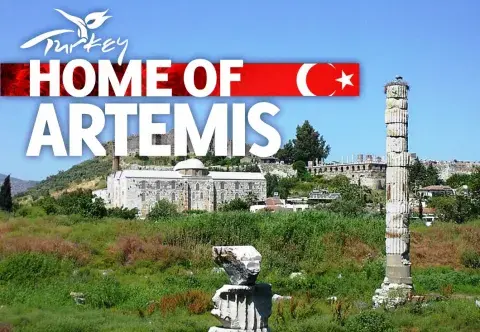
The temple of Artemision is known as one of the Seven Wonders of the Ancient world. It had been built in the vicinity of Ephesus on a flat area which has over the centuries turned into a swamp. Today one can only see the ruins of the foun...

The temple of Artemision is known as one of the Seven Wonders of the Ancient world. It had been built in the vicinity of Ephesus on a flat area which has over the centuries turned into a swamp. Today one can only see the ruins of the foundations of this marvelous construction of the Hellenistic Age, entirely made of marble and full of sculptured columns, capitals and shafts. The most beautiful remains of this temple are today exhibited in the London British Museum.


The oldest remains found date back to the 6th century BC. The structure originally consisted of 36 huge columns, later enlarged upon from the orders of the Lydian King, Kreisos, during the 6th century BC. Most of the exhibits in the London British Museum belong to this period.


A new Artemision was rebuilt in the 2nd century BC. Located on top of the previous one, it had tremendous dimensions: 125 columns each 17,5 meters high. Unfortunately this one was also destroyed by fire, reconstructed and again demolished by earthquakes, rebuilt and at last looted by Goths one year later.


The statue of the many-breasted Artemision was the symbol of the temple but also of abundance, hunting and wild life. The genuine statue of Artemision, removed during the fire, is today exhibited in the Selcuk Museum. Many copies of this statue were found during the latest excavations and date back to the Roman period. 


Aphrodisias was changed to Stayropolis and then to Caria which became Geyre years after. The ruins which are worth seeing inAphrodisias are listed below:


When the Greeks first arrived under the leadership of Androklos, Kybele (Rhea) was the major deity in all of Anatolia. The Greeks introduced the worship of Artemis and later Artemis and Kybele eventually became the same goddess. Artemis is the goddess of hunting, wild animals, childbirth, and nature.


According to the famous historian Strabon, the Temple of Artemis was built and destroyed seven times. It was always rebuilt on the same site. Some of the different architects were Theodoros from Samos, Chersiphon and his son Metagenes from Knossos of Crete, and Dinocrates.

The temple foundations date back to the 7th century BC. At first, it was a small shrine to Kybele. In around 550 BC Cretan Chersiphon, a Greek architect, designed the final temple. This initial building was sponsored by the Lydian king Croesus.

Seven Sleepers

Seven Sleepers 0f Ephesus
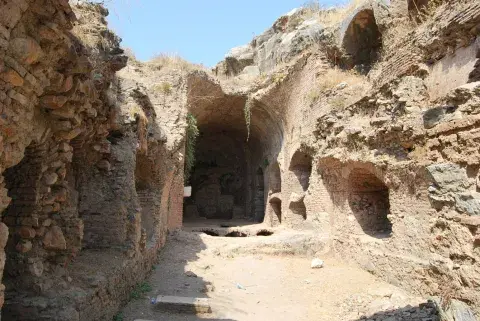
Located on the northern slopes of Mount Pion, near Ephesus, The Grotto of Seven Sleepers has been discovered by both Christians and Muslims with a growing interest. According to the Chris...
Seven Sleepers 0f Ephesus
Located on the northern slopes of Mount Pion, near Ephesus, The Grotto of Seven Sleepers has been discovered by both Christians and Muslims with a growing interest. According to the Christian legend seven young men were walled in during the reign of Decius (250) and yet were seen alive in the streets of Ephesus during the reign of Theodosius II some years after the Council of Ephesus (431). In the Koran, it is claimed that the sleepers slept 309 years in their tombs. 
 
During excavations in the area, the church and several tombs have been discovered. Some inscriptions of the Seven Sleepers have been discovered on the walls of the church.  

This cave is located to the east of Mount Pion and is an important site to the world of Christianity. In the  year 250AD seven Christian youths fled the city of Ephesus to avoid persecution and took refuge in this cave. They slept for two hundred years here. When they awoke after two hundred years they saw that Christianity was now the official religion. When the youths died it is believed they were buried in the same cave and a church was built at the site.


It is thought that the Christians  were in a dispute with the Roman state over the subject of an imperial cult where they refused to sacrifice animals at an imperial temple. The young men fled to a cave and after a while they fell asleep and when they woke up they went to city to buy food. To their amazement, they found out that they had slept not for one night but for two hundred years, and that Christianity had spread to every corner of the Roman Empire. When Emperor Theodosius II heard of the incident, he accepted it as evidence of resurrection which was being discussed in the churches at the time.

When these young men died, following an impressive funeral, they were buried in the cave on which a church was built later. The excavations carried on here during 1927-28 brought to light a church and several hundred graves which were dated to the 5th and 6th centuries. Inscriptions dedicated to the Seven Sleepers were found on the walls of the church and in the graves.

It is likely that the youths were tortured to death in various ways and buried in the cave. The resurrection story confusion came from the phrase “went to sleep in the Lord” which was used to describe the death of Christians, and 479 is when their relics were discovered. Their names were

  • Constantinus
  • Dionysius
  • Joannes
  • Malchus
  • Martinianus
  • Maximianus
  • Serapion

Church of Ephesus - Church of St. Mary

The Church of St. John &  The Church of Mary  

                      The Double Church


The Church of Mary not only counts among the most significant of the historical monuments at Ephesus, ...

The Church of St. John &  The Church of Mary  

                      The Double Church


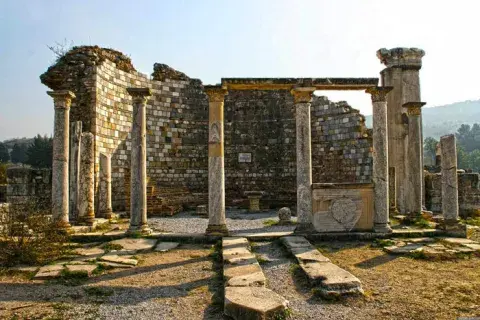
The Church of Mary not only counts among the most significant of the historical monuments at Ephesus, it is also visited by thousands of tourists and pilgrims annually.

This church was the site of the Third Ecumenical Council, convened by Emperor Theodosius II at Ephesus in 431 A.D. 
The Council was held to resolve a theological debate between two schools of thought about the nature of Christ and of His mother, Mary. 

One school, led by Nestorius, the Bishop of Constantinople, advocated that Christ was born human and became God, and that His mother should be called merely “Christ-bearer” or Christotokos (Χριστοτόκος).  The more popular view, however, was that Jesus was the Son of God, was born God and, therefore, Mary was deserving of the honor of being called the Mother of God, (Θεοτόκος) or “Theotokos.” 

This view was led by  Cyrill, Bishop of Alexandria, which united two natures – human and divine – in Christ.  Approximately 250 bishops journeyed to Ephesus from all over and took part in a heated debate over the divine nature of Jesus at birth.  In the end, the Council concluded that Jesus was God, born God and Mary was rightly called “Mother of God.”  Nestorius was denounced and excommunicated from the Church for his heresy.  A torch-light parade exited the church proclaiming Mary as “Theotokos” and it is from this place that today Christians pray, “Holy Mary, Mother of God, pray for us sinners.”
A lesser Council was held here in 449 A.D.  However, because of the controversial proceedings this second council was not accepted as ecumenical, and was labeled a “Robber Synod” and later repudiated at the Council of Chalcedon.  From the 5th Century on, the Church of Mary served without doubt as the seat of the Bishop of Ephesus. Baptismal ceremonies were held in the polygonal Baptistery where thousands of Pagans were converted. This building is without doubt one of the most important testimonials of Early Christianity.
The Church of St. Mary, named for the Blessed Virgin herself, was discovered early in the 20th century and is believed to be the very first church in the world named for Mary. A passage in the synodal letter of the first Council of Ephesus reads: “Wherefore also Nestorius, the renewer of the impious heresy, when he had come to the city of the Ephesians, where John the Theologian and the Virgin Mother of God, the Holy Mary . . . from the assembly of the Holy Fathers and Bishops.” Since St. John lived in Ephesus and was buried there (according to Eusebius), it has been inferred that the ellipsis of the synodal letter means either, “where John. . .and the Virgin. . . Mary lived,” or perhaps, “where John. . .and the Virgin. . . Mary lived and are buried.”  This passage gives witness to the oral tradition and belief held at that time that both St. John the Apostle and the Blessed Virgin Mary both lived and died at Ephesus.
The building received the canonical name of the “holiest church of the most holy, most honoured and eternal virgin Mary.” In later years, a complete alteration of the complex and a massive reconstruction was made necessary due to an earthquake which severely damaged the church. During this renovation, in the region in front of the apse, free-standing stone pilasters were erected instead of the columns; and the west part of the church was rebuilt as a vaulted dome church, with its own apse, using massive brick construction. The church was divided in two, with one part dedicated to St. John the Evangelist and the remainder to Mary, resulting in the name the “Double Church” by some.   The Church of St. Mary served as a cemetery church until at least the 11th century, and many graves can be found at the entry plaza.

Pope John XXIII (1958-1963) visited ancient Ephesus in 1931 on the 50th Centenary of the Council of Ephesus, held in 431 A.D. as the papal legate in Bulgaria.  During that visit, he toured the ruins of the Church of Mary, the site of the famous ecumenical council which declared Mary to be Theotokos, or “Mother of God.”

Sirince

Sirince
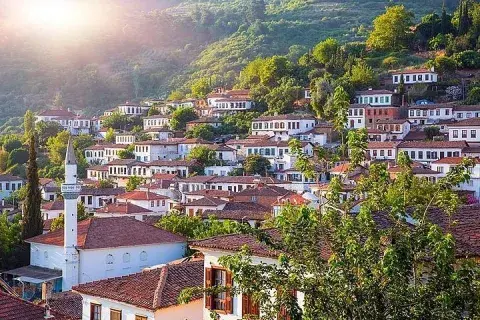
This pretty old Orthodox village, 12 km away from Ephesus and 30 km from Kusadasi, was once Cirkince ("ugly"). Indeed its habitants gave this name on purpose as they did not want to be bother...

Sirince
This pretty old Orthodox village, 12 km away from Ephesus and 30 km from Kusadasi, was once Cirkince ("ugly"). Indeed its habitants gave this name on purpose as they did not want to be bothered by foreigners nor to share the beauty of their village.Still after years, visitors understood that the village was not ugly at all and called it Sirince ("pretty"). As the village is located on the top of a mountain, anyone will enjoy the impressive wine yards' and peach trees' views on his way. Today the village is a perfect synthesis of Turk-Greek culture as of the 1920's: after the Independence War, people exchange between Greek and Turks has occurred and all those typical Greek houses, though they kept their original outside characteristics, have received the local layout inside.  And even in the courtyard of one of them, one will discover a nicely restorated Orthodox church.


All the narrow streets of the village belong to the women, selling handcrafts of all kinds. Sit in one of the small  terrace restaurants and enjoy some local gozleme ( turkish pancake). Another attraction of Sirince is its home grown fruit and grape wines. Enjoy some taste testing in the small cafés or in the beautifully restored former municipal school.

Saint John Basilica

Saint John Basilica

It is believed that the evangelist St. John had spent his last years in the region around Ephesus and was buried in the southern slope of Ayosolug Hill. Three hundred years after his death, a small chapel was constructed o...

Saint John Basilica

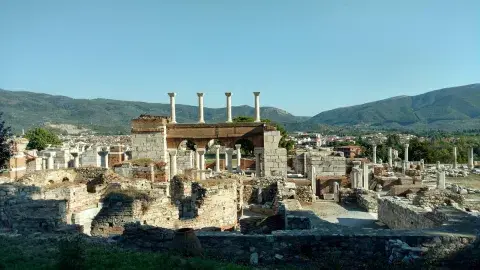
It is believed that the evangelist St. John had spent his last years in the region around Ephesus and was buried in the southern slope of Ayosolug Hill. Three hundred years after his death, a small chapel was constructed over the grave in the 4th century. The church was changed into a marvelous basilica during the region of Emperor Justinian (527 -565 AD).


The monumental basilica was in the shape of a cross and was covered with six domes. Its construction, being of stone and brick, is an extremely rare find amongst the architecture of its time. Raised by two steps and covered with marble, the tomb of St John was under the central dome, that was once carried by the four columns at the corners. The columns in the courtyard reveal the monograms of Emperor Justinian and his wife Theodora. Constructed in the 5th century AD, the baptistery is north of the nave, with its key hole shape. Rampart walls around the church were constructed for protection from the Arabian attacts in the 7th-8th centuries AD. The impressive 10thcentury AD frescoes representing St John, Jesus and a Saint, ornament the chapel. With the invasion of  the Turks, the chapel was used as a mosque in the 14th century. Unfortunately the Basilica of Saint John  became unusable due to a serious earthquake in the same century.


This church was built over the tomb of St. John. The presently-visible church is cruciform and roofed with six massive domes, and was donated by the Emperor Justinian and his wife Theodora. The capitals facing the nave (central aisle) bear their monograms.

Ephesus Articles

Top Ephesus Tours

$100 Per Day

Private Tour of Ephesus

After meeting your guide drive through the fertile lands. Your first stop will be the Temple of Artemis, one of the 7 wonders of the ancient world. Afterwards proceed to the mountain where Virgin Mary is believed to spent her 9 years. The house is approximately 1000 feet above sea level and running as an active chapel. Roman Catholics believe that Virgin Mary came to Ephesus with Saint. John 5 years after the crucification. At the age of 63 she is assumed to heaven. Altough there is no fact that Virgin Mary lived here approximately 1.5 million people visit the site each year. After 30 minutes visit to the House of Mary, drive to ancient city of Ephesus. You will be dropped at the upper gate of Ephesus with your tour guide. Start exploring the city. You will be walking down the hill approximately 1.5hrs. You will see the Odeon, the basilica, domitian square, fountain of Trajan, Celcus library, Terrace Houses (optional), Marble street, the Grand Theater of Ephesus and the Harbour Street. You will be endng your tour at the bottom gate. Your driver and tour guide will take you to another site or drop you at the desired location.

$50 Per Day

No Frills Ephesus Tours - Half Day

Merhaba (Hello) and Hosgeldiniz (Welcome) to Selcuk, Ephesus, Turkey.


We at No Frills Ephesus Tours offer a no nonsense tour experience without substituting on quality or service.
Our aim is to provide the visitor to Ephesus a unique cultural based tour experience with a professional English speaking guide, without the hassle of being taken to various factory outlets or shopping stops along the way.

If it is the Ancient City of Ephesus and the Ephesus Museum, the Temple of Artemis, St John's Basilica or the house of the Virgin Mary that you have come to see then that is what we aim to show you.


Our half day or full day NO FRILLS Ephesus Tours are the perfect way for you to absorb the history of Ephesus without the pressure of carpet, leather or jewellery sales spoiling your day.


GREAT VALUE FOR MONEY -
We understand that many holiday makers have limited time and budget. With this in mind we offer "no frills" Ephesus tours at a competitive price. We believe that many people miss out on the tours that they want to do on holiday because of the inconvenience of the many shopping stops along the way. The sights are what you have come to see and that is what we aim to show you. With our professional team of English speaking tour guides and staff our goal is to offer you an unforgettable tour experience of Ephesus.

NO FRILLS ADD ONS -
Want something extra that's not included on your tour? Ask us about the various add-ons you can choose from to make your sightseeing experience complete. We also have a list of other activities and excursions on offer in and around Ephesus.

$110 Per Day

Ephesus Tour Guide Only

Daily Ephesus Tour Guide options from Ephesus - Tour Ephesus hassle free with no shopping visits!
Perfect Ephesus Tour Option for the independent traveller.

Easy Ephesus Walking Tour 

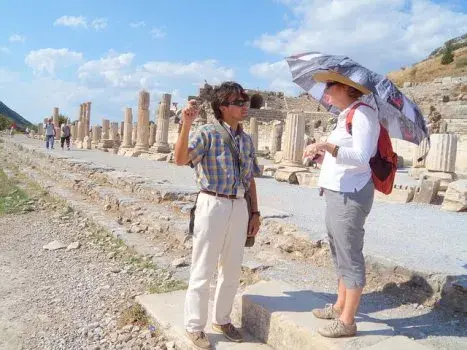
Your Private Guided Ephesus Tour departs from the top gate of the ancient city of Ephesus.
Meet your guide at the top gate and enter the Ephesus Archaeological Site (south gate) and have an easy walk down hill ​and finish at the bottom gate.

Ephesus Tour Guide - Daily Ephesus Tour - EVERYDAY - Minimum 1 person required for this tour to depart.

Ephesus Tour Guide Only - Your Private Guided Ephesus Tour

you will be visiting the following site/s

Ancient City of Ephesus 
Terrace Houses
110.00 USD - per group

​Add-ons
Ephesus Museum: 20.00 USD 
includes guiding

St. John's Basilica: 20.00 USD
includes guiding 

Tour Duration: 3 Hours

Includes : Licensed English speaking tour guide.

Excludes : Entry fees and Transport (Meeting Point Ephesus  South Top Gate)

Meeting location: Ephesus South (Top) Gate
End location: Ephesus Bottom Gate

Ephesus Tour Guide recommendation:
Ephesus can get very hot during the summer months and there is minimal shade so we advise you to take sunscreen, a hat, plenty of water and of course your camera!