Turkey Attractions

Hagia Sophia
Hagia Sophia is one of the most known religious sites in Istanbul. It has a long history full of transformations due to the political and religious changes that happened over time. It is important to emphasize that it was built as early as in 360 and at that time was dedicated and used as an East...
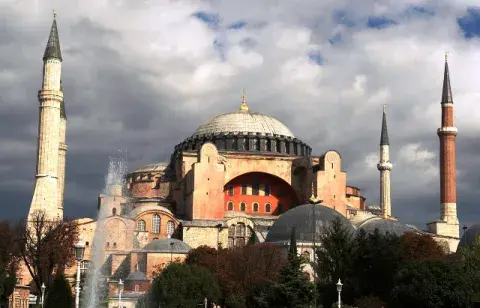
Hagia Sophia is one of the most known religious sites in Istanbul. It has a long history full of transformations due to the political and religious changes that happened over time. It is important to emphasize that it was built as early as in 360 and at that time was dedicated and used as an Eastern Orthodox cathedral. It was even used as a Roman Catholic cathedral during some fifty years in the first half of the 13th century. It was transformed into a mosque in 1453 and it was used as such until 1931. Since 1935 it is used as a museum.
As you can imagine, all these transformations and influences from different countries left its trace and today one can enjoy in seeing the magnificent blend. This is more important when you take into consideration that two great empires, Byzantine and Ottoman both left their characteristic architectural elements.

Topkapi Palace
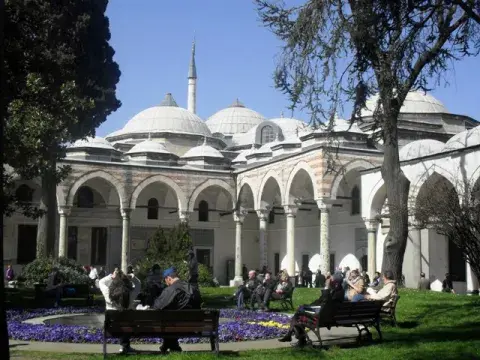
The palace is in fact an entire complex consisting of many buildings and four main courtyards. The fact that is used to be home to about 4 000 people, speaks about the area it occupies. It was the main residence for Ottoman sultans and it is located on the UNESCO World Heritage Site list since 19...
The palace is in fact an entire complex consisting of many buildings and four main courtyards. The fact that is used to be home to about 4 000 people, speaks about the area it occupies. It was the main residence for Ottoman sultans and it is located on the UNESCO World Heritage Site list since 1985.
Its construction started in the mid 15th century and during 400 years that was occupied by the sultans it was renovated several times and some constructions were added. As it is visible, it is built near the shoreline overlooking sea and besides the residential buildings it contained mosques, a hospital and other useful constructions.
The Palace was transformed into a museum and the most important and best preserved as available for visitors in the beginning of the 20th century.

Sultan Ahmed Mosque (Blue Mosque)
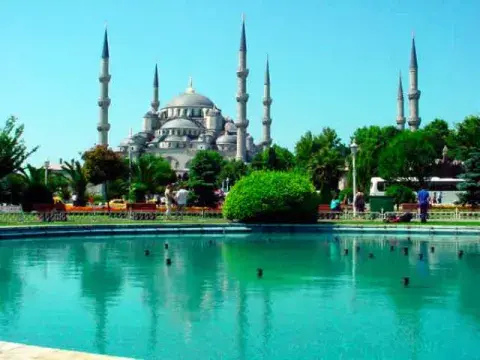
Majority of visitors who come to visit this architectural masterpiece know the mosque as the Blue Mosque and then they find out that its official name is the Sultan Ahmed Mosque. You may wonder if it is really blue. Well, its interior is decorated with blue tiles.
It is still used as a mo...
Majority of visitors who come to visit this architectural masterpiece know the mosque as the Blue Mosque and then they find out that its official name is the Sultan Ahmed Mosque. You may wonder if it is really blue. Well, its interior is decorated with blue tiles.
It is still used as a mosque but with the growth of tourist number it has become the most visited attraction in Istanbul. The mosque was built in the early 17th century by Sultan Ahmed I and designed by Mehmet Aga.
Its architectural design is magnificent and visitors as well as locals are fascinated with its beauty. There are six minarets while the majority of mosques have one to four minarets. Even though one can notice from just standing outside that the mosque has domes of several heights but as one enters can notice the amazing interior decoration made in over 20 000 blue tiles.

No Frills Ephesus Tours
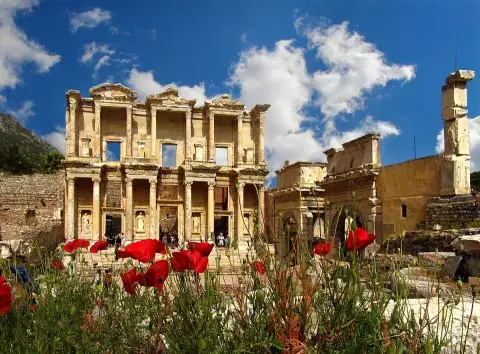
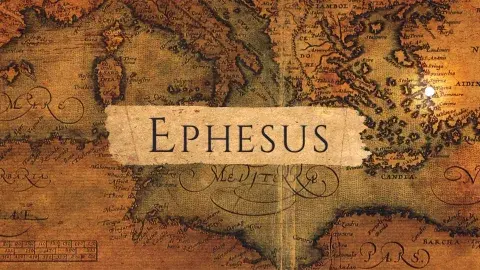
Ephesus (/ˈɛfəsəs/;Greek: Ἔφεσος Ephesos; Turkish: Efes; ultimately from Hittite Apasa) was an ancient Greek city on the coast of Ionia, three kilometres southwest of present-day Selçuk in İzmir Province, Turkey.
It was built in the 10th century BC ...
Ephesus (/ˈɛfəsəs/;Greek: Ἔφεσος Ephesos; Turkish: Efes; ultimately from Hittite Apasa) was an ancient Greek city on the coast of Ionia, three kilometres southwest of present-day Selçuk in İzmir Province, Turkey.
It was built in the 10th century BC on the site of the former Arzawan capital by Attic and Ionian Greek colonists.
During the Classical Greek era it was one of the twelve cities of the Ionian League. The city flourished after it came under the control of the Roman Republic in 129 BC. According to estimates, Ephesus had a population of 33,600 to 56,000 people in the Roman period, making it the third largest city of Roman Asia Minor after Sardis and Alexandria Troas.
The city was famed for the Temple of Artemis (completed around 550 BC), one of the Seven Wonders of the Ancient World.
In 268 AD, the Temple was destroyed or damaged in a raid by the Goths. It may have been rebuilt or repaired but this is uncertain, as its later history is not clear. Emperor Constantine the Great rebuilt much of the city and erected new public baths. Following the Edict of Thessalonica from Emperor Theodosius I, what remained of the temple was destroyed in 401 AD by a mob led by St. John Chrysostom.
The town was partially destroyed by an earthquake in 614 AD. The city's importance as a commercial center declined as the harbor was slowly silted up by the Küçükmenderes River.
Ephesus was one of the seven churches of Asia that are cited in the Book of Revelation. The Gospel of John may have been written here. The city was the site of several 5th century Christian Councils (see Council of Ephesus). It is also the site of a large gladiators' graveyard.
The ruins of Ephesus are a favourite international and local tourist attraction, partly owing to their easy access from Adnan Menderes Airport.

Grand Bazaar
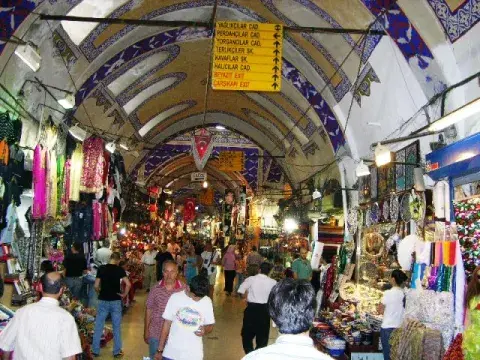
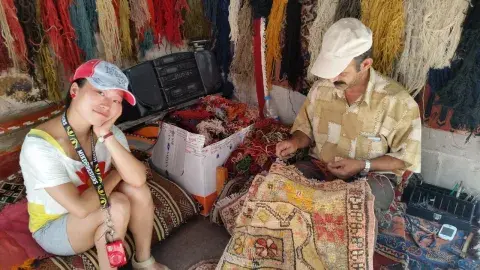
Welcome to the world´s largest covered marked covering 61 street with over 3000 shops. Maybe it seems impossible but it attracts about half of million visitors daily.
Perhaps you want just to take a look and you´re not interested in buying but the splendor, the scent, the colo...
Welcome to the world´s largest covered marked covering 61 street with over 3000 shops. Maybe it seems impossible but it attracts about half of million visitors daily.
Perhaps you want just to take a look and you´re not interested in buying but the splendor, the scent, the colors start offering themselves tempting your eyes and your valet: jewelry, carpets, antiques, embroideries, textile and of course spices, among other things.
This marked isn´t something that started to exist recently in the style of modern malls but it has a history since the mid 15th century. Naturally the things changed over time. In the beginning there were no shops as they exist today but there were stalls where merchants offered their goods and each stall occupied a determined space.
When you take into consideration the innumerable sorts of merchandise offered, it is no wonder that the Grand Bazaar was the world´s most visited single monument in the world in 2011.

Ancient City of Ephesus
History of Ephesus
According to the old legends, Ephesus was founded by the female warriors known as the Amazons. The name of the city is thought to have been derived from "APASAS", the name of a city in the "KINGDOM OF ARZAWA" meaning the "city of the Mother Goddes...
History of Ephesus
According to the old legends, Ephesus was founded by the female warriors known as the Amazons. The name of the city is thought to have been derived from "APASAS", the name of a city in the "KINGDOM OF ARZAWA" meaning the "city of the Mother Goddess".
Ephesus was inhabited from the end of the Bronze Age onwards, but changed its location several times in the course of its long history in accordance with habits and requirements.
Carians and Lelegians are to be have been among the city's first inhabitants. Ionian migrations are said to have begun in around 1200 B.C. According to legend, the city was founded for the second time by Androclus, the son of Codrus, king of Athens, on the shore at the point where the CAYSTER (Küçük Menderes) empties into the sea, a location to which they had been guided by a fish and a wild boar on the advice of the soothsayers.
The Ionian cities that grew up in the wake of the Ionian migrations joined in a confederacy under the leadership of Ephesus. The region was devastated during the Cimmerian invasion at the beginning of the 7th century B.C. Under the rule of the Lydian kings, Ephesus became one of the wealthiest cities in the Mediterranean world. The defeat of the Lydian King Croesus by Cyrus, the King of Persia, prepared the way for the extension of Persian hegemony over the whole of the Aegean coastal region.
At the beginning of the 5th century, when the Ionian cities rebelled against Persia, Ephesus quickly dissociated itself from the others, thus escaping destruction.
Ephesus remained under Persian rule until the arrival of Alexander the Great in 334 B.C., when it entered upon a fifty year period of peace and tranquillity. Lysimachus, who had been one of the twelve generals of Alexander the Great and became ruler of the region on Alexander's death, decided to embark upon the development of the city, which he called Arsineia after his wife Arsinoe. He constructed a new harbour and built defence walls on the slopes of the Panayır and Bülbül Mts., moving the whole city 2.5 km to the south-west. Realising, however, that the Ephesians were unwilling to leave their old city, he had the whole sewage system blocked up during a great storm, making the houses uninhabitable and forcing the inhabitants to move. In 281 B.C. the city was re-founded under the old name of Ephesus and became one of the most important of the commercial ports in the Mediterranean.
In 129 B.C. the Romans took advantage of the terms of the will left by Attalos, King of Pergamon, by which they were bequathed his kingdom, to incorporate the whole region into the Roman Empire as the province of Asia. Ancient sources show that at this time the city had a population of 200,000. In the 1st century B.C. the heavy taxes imposed by the Roman government led the population to embrace Mithridates as their savior and to support him in his mutiny against Roman authority and in 88 B.C. a massacre was carried out of all the Latin speaking inhabitants of the city, which was then stormed and sacked by a Roman army under Sulla, It was from the reign of Augustus onwards that the buildings we admire today were constructed. According to documentary sources, the city suffered severe damage in an earthquake in 17 A.D. After that, however, Ephesus became a very important centre of trade and commerce. The historian Aristio describes Ephesus as being recognised by all the inhabitants of the region as the most important trading centre in Asia. It was also the leading political and intellectual centre, with the second school of philosophy in the Aegean. From the 1st century onwards, Ephesus was visited by Christian disciples attempting to spread the Christian belief in a single God and thus forced to seek refuge from Roman persecution. Besides enjoying a privileged position between East and West coupled with an exceptionally fine climate, the city owed its importance to its being the centre of the cult of Artemis.
For the Christians, the city, with its highly advanced way of life, its high standard of living, the variety of its demographic composition and its firmly rooted polytheistic culture, must have presented itself as an ideal pilot region... From written sources we learn that St Paul remained in the city for three years from 65 to 68, and that it was here that he preached his famous sermons calling upon the hearers to embrace the faith in. one God. He taught that God had no need of a house made with human hands and that he was present in all places at all times. This was all greatly resented by the craftsmen who had amassed great wealth from their production of statues of Artemis in gold, silver or other materials. A silversmith by the name of Demetrius stirred up the people and led a crowd of thousands of Ephesians to the theatre, where they booed and stoned Paul and his two colleagues, chanting "Great is Artemis of the Ephesians! Great is Artemis of the Ephesians!" So turbulent was the crowd that Paul and his companions escaped only with great difficulty. From his Epistles to the communities it would appear that Paul spent some time as a prisoner in Ephesus.
Legend has it that St John the Evangelist came to Ephesus with the Virgin Mary in his care. Some also say that it was here that he wrote his Gospel and was finally buried. In 269 Ephesus and the surrounding country was devastated by the Goths. At that time there was still a temple in which the cult of Artemis was practised. In 381, by order of the Emperor Theodosius, the temple was closed down, and in the following centuries it lay completely abandoned, serving as a quarry for building materials.
The situation of the city, which had given it its privileged geographical position, was also the cause of its decline and fall. The prosperity of the city had been based on its possession of a sheltered natural harbour, but by the Roman period ships reached the harbour to the west of Mt Pion 1.5 km from the Temple of Artemis through a very narrow and difficult channel. The cause of this was the Meander (Cayster) River, which emptied into the Aegean a little to the west of the city of Ephesus, where it created a delta formed by the alluvium carried down by the river over thousands of years. By the late Byzantine era the channel had been so silted up as to be no longer usable. The sea gradually receded farther and farther, while the marshy lands around the harbour gave rise to a number of diseases, such as malaria. The new outlook that had arisen with the spread of Christianity led to the gradual abandonment of all buildings bearing witness to the existence of polytheistic cults and the construction in their place of Christian churches. In the year 431 the third Ecumenical council took place in Ephesus.
Emperor Theodosius convoked another council in Ephesus in 449, which came to be known as the "robber council". From the 6th century onwards the Church of St John was an important place of pilgrimage, and Justinian took measures to protect it by having.the whole hill on which it stood surrounded by defence walls. Shortly afterwards, the Church of the Virgin and other places of worship were destroyed and pillaged in Arab raids. In the 7th century the city was transferred to the site now occupied by the town of Selçuk and during the Byzantine era Ephesus grew up around the summit of Mt Ayasuluğ. The city enjoyed its last years of prosperity under the Selçuk Emirate of the Aydınoğulları. During the Middle Ages the city ceased to function as a port.
By the 20th century the silt carried down by the Meander had extended the plain for a distance of 5 km.

Dolmabahçe Palace
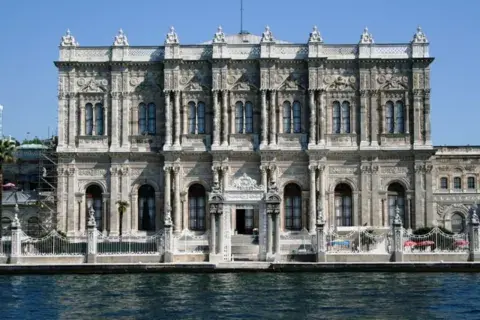
This glamorous palace has a special place in the history of Turkey. Not only it was the residence of the last Ottoman Sulans but it is the place where the founder of the modern Turkey passed away. An interesting fact is that all clocks in the palace were stopped at the time when Mustafa Kemal Ata...
This glamorous palace has a special place in the history of Turkey. Not only it was the residence of the last Ottoman Sulans but it is the place where the founder of the modern Turkey passed away. An interesting fact is that all clocks in the palace were stopped at the time when Mustafa Kemal Ataturk died, i.e. at 9:05, 1938. A clock in the room where he died still stands.
The palace was built by Sultan Abdulmecid in the second half of the 19th century. Its construction lasted for about 20 years and it can be divided into three main parts. State Apartments, Ceremonial Hall, and the Imperial Harem.
Since 1984, the palace has been opened to public as a ˝museum palace˝. It spreads on an area of 11.2 acres or 45,000 square meters containing 285 rooms, 46 halls, 68 toilets and 6 large baths where nobilities enjoyed in Turkish steam baths.

Basilica Cistern
Besides the usual name this basilica has two other names by which is often called. Sunken Palace and the Sunken Cistern. As you may conclude from the title this unusual tourist attraction once had one really important mission – it was used to provide water to the residents of Istanbul. Empe...
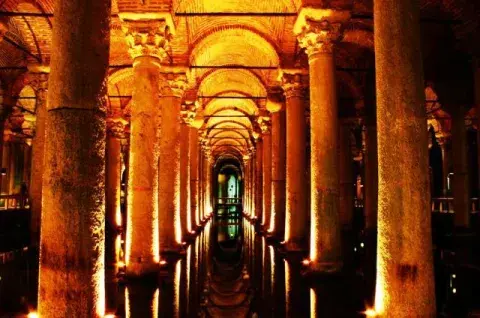
Besides the usual name this basilica has two other names by which is often called. Sunken Palace and the Sunken Cistern. As you may conclude from the title this unusual tourist attraction once had one really important mission – it was used to provide water to the residents of Istanbul. Emperor Justinian ordered its construction in the 6th century. It is also remarkable for its size with capacity of 80,000 cubic meters but also for 336 large marble pillars that hold the entire construction. Of course, this isn´t the only cistern built in the Istanbul undergrounds but it is certainly most famous and most visited.
You might also ask yourself why it is called Basilica? Well, it is located right beneath the Stoa Basilica.
In the past, people used to lower their buckets to grab the water and bring it to their houses.
Due to the tourism development, a great lighting has been installed and numerous visitors come down to visit this underground monument.
Pagination
Turkey Articles

Antalya
Antalya is extremely beautiful city where modern and ancient blend perfectly and where people are friendly. A real Mediterranean ambience. The number of visitors increases every year but this hasn´t influenced the quality of the offer in the city....
Antalya is extremely beautiful city where modern and ancient blend perfectly and where people are friendly. A real Mediterranean ambience. The number of visitors increases every year but this hasn´t influenced the quality of the offer in the city. Besides usual sightseeing, there are a lot of other leisure activities that can be done in the area. The high season lasts in the summer months but more and more visitors decide to come when the city streets are not so crowded and when the prices are little lower; especially on accommodation.
It´s not enough just to read about the city, one has to come and be assured that all positive comments are true :)
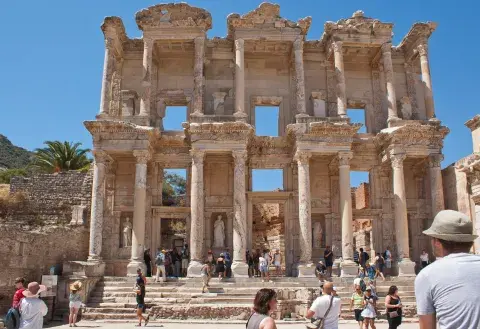
Ephesus Tour in Chinese, Spanish or English
If you are near Izmir or Kusadasi don't miss out the chance to visit the ruins of one of the most important Greco-Roman cities.
Ephesus is located about 20 kilometers from Kusadasi and 70 kilometers from Izmir.
...If you are near Izmir or Kusadasi don't miss out the chance to visit the ruins of one of the most important Greco-Roman cities.
Ephesus is located about 20 kilometers from Kusadasi and 70 kilometers from Izmir.
I can pick you up from your location whether it is a hotel or Cruise port.
I will drive you to Ephesus and start our visit of the ruins. See the famous Hadrian Temple, Library, Great Theatre and many more awesome ruins of the city.
Optionally you can visit the House of the Virgin Mary mother of Jesus. This little house is believed to be the last place where she spent last years of her life.
The tour will continue with a visit to the ruins of The Temple of Artemis. Which was one of the seven wonders of the ancient world.
After the visits optionally there will be a lunch and shopping visit upon your request.
At the end of this beautiful time I will drop you off to the location of your choice.
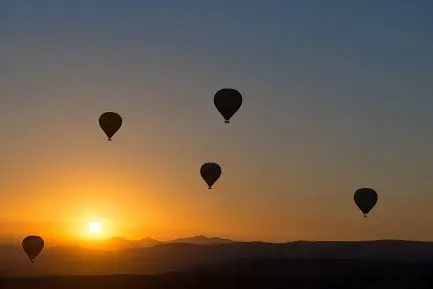
Introducing Cappadocia
Pagination
Top Turkey Tours

Classical İstanbul Tour
Sultanahmet area is also known as historical peninsula this area is so big and needs long time to walk completely but we can make an arrengment up to your wishes make it longer or shorter you have limeted day and you like to use it so effectively so I will try my best to teach and show as much as places possible in limeted time
but at least we will see :hagia sophia-sultanahmet mosque-historical hippodrome topkapı palace and basilica cistern this can be enlarge dpends on your time but these are the most important places of istanbul contact with me we will...Read more
Sultanahmet area is also known as historical peninsula this area is so big and needs long time to walk completely but we can make an arrengment up to your wishes make it longer or shorter you have limeted day and you like to use it so effectively so I will try my best to teach and show as much as places possible in limeted time
but at least we will see :hagia sophia-sultanahmet mosque-historical hippodrome topkapı palace and basilica cistern this can be enlarge dpends on your time but these are the most important places of istanbul contact with me we will talk about tour program
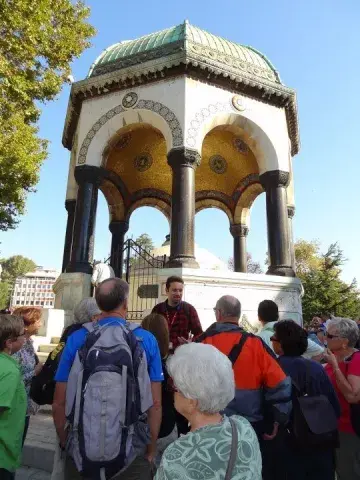
Highlights of Istanbul Tour
Tour Price : 250 Usd
Classical Old City Tour – Highlights of Istanbul
The tour usually starts at 9 a.m and finishes at 4-5 p.m.
This tour includes the very basic highlights of the city, as Hippodrome , The Blue Mosque, The Hagia Sophia Church, a Lunch Break and afterwards the imperial Topkapi Palace and finally the Grand Bazaar
Sightseeing Tours Inclusions:
- Private English Speaking Guide
Sightseeing Tours Exclusions:
- Entrance fees
...Read moreTour Price : 250 Usd
Classical Old City Tour – Highlights of Istanbul
The tour usually starts at 9 a.m and finishes at 4-5 p.m.
This tour includes the very basic highlights of the city, as Hippodrome , The Blue Mosque, The Hagia Sophia Church, a Lunch Break and afterwards the imperial Topkapi Palace and finally the Grand Bazaar
Sightseeing Tours Inclusions:
- Private English Speaking Guide
Sightseeing Tours Exclusions:
- Entrance fees
- Lunch
- Transportation
PLEASE NOTE:
HAGIA SOPHIA MUSEUM IS CLOSED ON MONDAYS. (can be replaced with the Basilica Cistern)
TOPKAPI PALACE MUSEUM IS CLOSED ON TUESDAYS.(can be replaced with the Basilica Cistern)
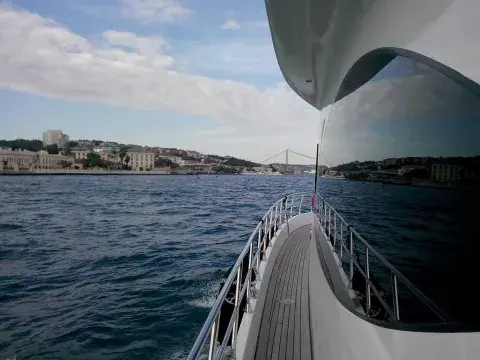
Private Yacht Rental on Bosphorus Tour
(THE PRICE MENTIONED ABOVE IS VALID FOR GROUP Minimum 1- Maximum 10 PEOPLE, IT IS NOT PER PERSON PRICE.)
Depends on your time request, we pick you up from your hotel by a private vehicle and provide you transfer service to the area where our private yacht will depart from.
(THE PRICE MENTIONED ABOVE IS VALID FOR GROUP Minimum 1- Maximum 10 PEOPLE, IT IS NOT PER PERSON PRICE.)
Depends on your time request, we pick you up from your hotel by a private vehicle and provide you transfer service to the area where our private yacht will depart from.
You will take long at least 2 hours. If you would like to make it longer, you can decide it during your tour. There will be 2 crew and 1 captain also there will be English speaking person whom can explain about highlights that you will see during Bosphorus cruise. You can have breakfast/lunch/dinner services during your tour.
PS: The price mentioned is valid for 2 hours yacht rental and up to 10 people. If you would like to make your tour longer, the price will be different.
The highlights you will see during your tour;
- Dolmabahce Palace
- Bosphorus Bridge
- Camlica Hill
- Golden Horn
- Küçüksu Pavillion
- Beylerbeyi Palace
- Maiden' Tower
- Rumeli Fortress
- Asia & Europe Continents
- FSM Bridge
- Bosphorus Bridge
Inclusions:
+ Boat Rental
+ Hot Drinks & Small Snacks
+ Guidance in English (Licensed)
+ Pick up from the hotel & drop of the hotel
Exclusions:
- Alcoholic and cold drinks
- Meals
- Tips to the staff