China Attractions

Gubeikou Great Wall

Gubeikou has long been a town of military significance and an important pass to Beijing. The Yanshan Range winds from east to west and is cut off at Gubeikou, forming a natural narrow pass here. To the west of the pass are the Chaohe River and the Wohu Mountain, and to the east is the Panlong Mou...

Gubeikou has long been a town of military significance and an important pass to Beijing. The Yanshan Range winds from east to west and is cut off at Gubeikou, forming a natural narrow pass here. To the west of the pass are the Chaohe River and the Wohu Mountain, and to the east is the Panlong Mountain. From ancient times, Gubeikou has served as a route of strategic importance, linking the southern and northern areas of the Yanshan Range. As early as 2,500 years ago, a fortification was built here and repeatedly reinforced throughout the following dynasties.

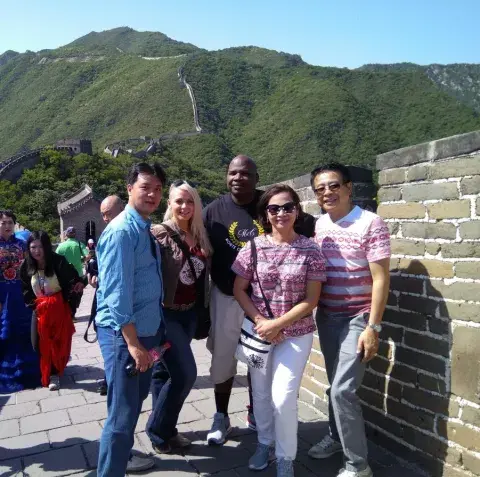
The main part of today's Gubeikou Wall was constructed under the supervision of Xu Da, a well-known general in the Ming Dynasty. This part of the Great Wall runs for more than 20 km and consists of four sections: Wohushan, Panlongshan, Jinshanling and Simatai. It has 143 beacon towers, each positioned at an average interval of 156 meters. The nearest two are only 30 meters apart. The inside of these towers varies in design. While some have a flat ceiling, others either have an arched ceiling and a domed ceiling, or an octagonal, painted ceiling. Each tower has two floors, six archways and ten arched doors, allowing garrisoned soldiers to advance and retreat freely. The towers are also different in size. The largest one can accommodate a garrison of 100 soldiers and the smallest one a garrison of 10 soldiers. The towers commonly have one to six portholes.

Features:

Gubeikou Great Wall was built along the precipitous mountain ranges, rising and falling at various sections. Simatai, built on a cliff, is extremely steep. A famous Great Wall specialist said: "The Great Wall is the best of Chinese architecture and Simatai is the best of the Great Wall."

There are plenty of legends about the Gubeikou Wall, especially the Simatai section, as well as historical relics. At night, from the Beijing Watchtower, 986 meters above sea level, one can see the lights shimmering in downtown Beijing. The west of this tower is the steeply situated Fairy Tower that looks like a slim fairy standing among shrubs and wild flowers.

Wohu Mountain: “Wohu” means “Crouching Tiger” in English, because the mountain looks like two tigers, one lying on its back while the other lies on its stomach. Located in the western section of the Gubeikou Great Wall, its highest peak measures about 665 meters (2,181 feet). A watch tower is erected every 150 meters (492 feet) of the wall, overlooking a deep valley or mounted on a strategically important hilltop. A professor from Peking University compares the wall to a huge cursive script work with the watch towers providing the pausing or transitional strokes. It retains its fascination today as its raw condition is still evident.

Panlong Mountain: West of Wohushan, it is located in the middle section of Gubeikou, where most of the historical wars took place. In ancient times, both warring parties placed emphasis on securing the Panlongshan Great Wall, because each knew that once the wall was captured, the Gubeikou Great Wall would be readily occupied. The whole wall measures about 13 kilometers (3.1 miles). Of its over 40 watch towers, the General Tower is the most famous. It is located at the commanding elevation of Panlongshan Mountain, from where wars were directed. There are four arrow windows on the north and south sides respectively, while each of the east and west sides has three arrow windows. This section is of unique construction: it is made up of earth, stone and brick walls. It is also preserved in its original state.

Maan Coffee

Imagine a Beijing utopia where cafés are spacious, with cement walls, antique-style armchairs and desk lamps that evoke the hushed feel of a Victorian library. Where by day you lounge about under glass skylights, while evening fills the room with warm light from Moroccan lamps, glass-crystal chan...

Imagine a Beijing utopia where cafés are spacious, with cement walls, antique-style armchairs and desk lamps that evoke the hushed feel of a Victorian library. Where by day you lounge about under glass skylights, while evening fills the room with warm light from Moroccan lamps, glass-crystal chandeliers and lanterns dangling from tree branches. Where each table is outfitted with sockets, inviting you to blog until midnight, and the palatial space is topped with a roof terrace. Amazingly, it exists in Gongti’s MAAN Coffee. Clearly the city’s in love with the franchise – this is the thirteenth branch – which is appropriate, since MAAN – 漫– a homonym meaning both slow and romantic – redefines café culture in China, and possibly the world.

After opening the chic Korean restaurant chain Ai Jiang Shan, the owners decided to extend their flair for design and service to cafés fit for upmarket Shire dwellers. But it’s not all appearance: MAAN Coffee baristas attend training in Maan’s Roasting Factory and Coffee School in Jiangfu; clearly, friendly customer service and espresso expertise are a priority of the company, and the education does not go unnoticed.

Daily visitors should restrict themselves to just coffee, unless the latest trendy diets allow all-day breakfasting. The menu features waffles and toast dressed like a Nutcracker fantasy. Try the plain waffle (28RMB): four batter cakes, griddled golden, garnished with jams, syrups, whipped cream, and confectioner’s sugar. Or dive deep into indulgence with the chocolate waffle (38RMB), four quarters of chewy, cocoa-flavoured deliciousness served with berry compote, a scoop of dark-chocolate ice cream, and a mini-minaret of whipped cream, garnished with a chocolate-cream- filled Oreo cookie and chocolate-roll biscuit. You shouldn’t finish it, but you will. 

The honey toast (28RMB) is bathed in salted butter and nestled within a crust that comes with three dipping sauces of maple syrup, condensed milk and berry compote. Sweet and savoury, this understated dessert earns every mouthful.

On the savoury side, the ‘bulgogi burger’ (45RMB) is actually two burgers of thinly sliced beef marinated in a sweet Korean barbecue sauce, each with tomato, lettuce and processed cheddar, all sandwiched in a satisfying English muffin. It sates a single starving appetite, or two laptop-bearing diners with no intention to leave their seat and burn off a second helping.

Drinks are equally substantial. The café mocha (32RMB) is a rich hot-chocolate variety with a notion of espresso, topped by a minaret of heavy whipped cream. All coffees are served with four sweet, buttery sticks of toast – great for dipping. The menu has the usual espresso standbys, as well as inventive concoctions such as the velvety sweet-potato latte (33RMB), and the roasted grain shake (30RMB), a chilled milk-barley tea. The mixed-berry bingsu (53RMB) is a deep bowl of shaved ice, topped with a crimson brigade of maraschino cherries, tart currants, dried cranberries, strawberry slices, cubes of watermelon and a scoop of hearty strawberry ice-cream.

MAAN Coffee is a great cafe-date spot. Sweet-toothed romantics can rendezvous or lounge with a laptop, feeling hopeful. But whatever happens, you will undoubtedly find something to make you swoon.

Yubeng Village

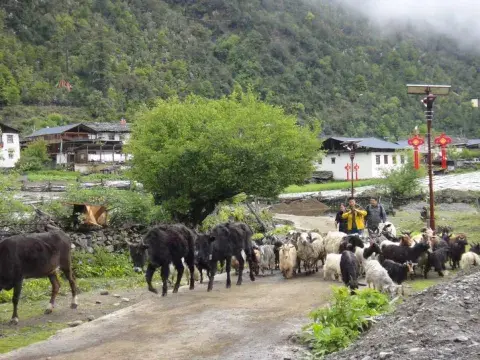
  Yubeng, the Tibetan village locates at the foot of the Meili Snow Mountain, and it has been hailed as the real Shangri-La.

  From antient time, Meili Snow Mountain has been popular for Tibetan people to pay pilgrimage to, as the mountain is considered to be the incarnation of on...

  Yubeng, the Tibetan village locates at the foot of the Meili Snow Mountain, and it has been hailed as the real Shangri-La.

  From antient time, Meili Snow Mountain has been popular for Tibetan people to pay pilgrimage to, as the mountain is considered to be the incarnation of one of thier Gods. Every year before winter comes, the Tibetan people either travel with their families members, or monks with their fellows, pay homage to the Holy Ice Lake and the Holy Waterfall at the foot of the mountain. And Yubeng village is the only place they can stay overnight.

  Surrounded by mountains, Yubeng Village is sparsely populated because of its unique geographical situation. Since ancient times, there has only been one path that leads Yubeng Village to the outside world; therefore, only around 20 families have settled there. Yubeng Village is divided into Upper Yubeng and Lower Yubeng. From Upper Yubeng, trekkers have access to the Sino-Japanese Base Camp in Kawakarpo of Meili Snow Mountain. From Lower Yubeng, yon can find the paths to the Sacred Waterfall.

  Yubeng Village lies at the foot of the Wuzi Peak under the Niancimu Peak of Meilii Snow Mountain. With beautiful scenery and simple and honest people, Yubeng Village is a land of idyllic beauty, which attracts lots of trekkers rushing to this little village, from May to November, despite the long streneous trek people have to cover by foot, or by horses.

From Shangrila there are daily buses going to Deqin County town, and from the bus station, people have to hire minivan to Xidan village, where people can start hiking, 219 kms later, you're there.

The Glass Bridge in Zhangjiajie Grand Canyon

In Zhangjiajie Grand Canyon, the plunging waterfalls, the dense trees, the fresh air, and the mist on the stream make you feel like you are in an otherworldly sort of place. A spring meanders in the canyon, along which are trails built with planks. On the way, you can see the longest and highest ...

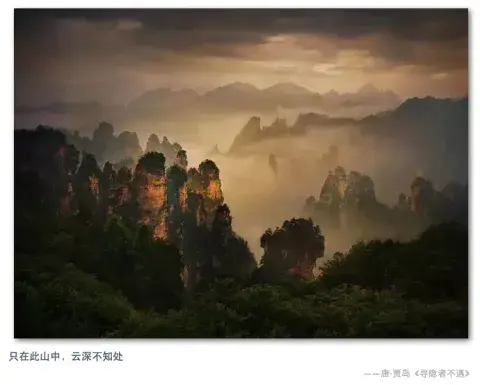
In Zhangjiajie Grand Canyon, the plunging waterfalls, the dense trees, the fresh air, and the mist on the stream make you feel like you are in an otherworldly sort of place. A spring meanders in the canyon, along which are trails built with planks. On the way, you can see the longest and highest glass bridge in the world as well as the karst landform in the north temperate zone. You have to walk for over two hours to visit the canyon, so remember to wear sports shoes and bring some food. You are recommended to start at the top of the canyon and move downhill, the following attractions coming into view successively.

A Strip of Sky & Sky Ladder Plank Road
‘A Strip of Sky’ is a narrow valley through which only one person can pass at a time. The valley is over 765 yards (700 meters) long with a drop of 985 feet (300 meters) from the beginning to the end. After passing through the valley, you will see Sky Ladder Plank Road. This road is very steep and the planks are narrow, making it look like a sky ladder. Walking along it for three minutes, you come to the best place to see the entire ‘A Strip of Sky’.

Southern Red Flag Canal
The canal is 3 feet (1 meter) deep and 3 feet wide, but over 6 miles (10 kilometers) long. It directs the spring from the lofty cliffs. The excavation took local people seven years, and many of them sacrificed their life for it. Thanks to the canal, residents of eight nearby villages have water to drink and irrigate the rice fields.

Tip: There is a skidway made of granite slates among the A Strip of Sky, the Sky Ladder Plank Road, and the Southern Red Flag Canal. It takes you only 3-5 minutes, 20 minutes shorter than walking.

Glass Bridge
Zhangjiajie Glass Bridge, built with 99 sheets of glass, is 470 yards (430 meters) long, 6.6 yards (6 meters) wide and 985 feet (300 meters) high, the longest and highest glass bridge in the world. Unlike the Zhangjiajie Tianmen Mountain Glass Bridge, which is inserted on the mountain side with a height of 4,690 feet (1,430 meters), Zhangjiajie Grand Canyon Glass Bridge hangs over a valley. It provides a superb panorama of the entire grand canyon. Standing on it is like floating in the air. Come and have a try if you are brave enough. There is also a rope line nearby, which surely excites your nerves.

Please note that visitors need to book a ticket for the Glass Bridge on its official website at least one day before the visit. Only those who qualify for ticket discounts can buy the ticket on spot. Valid ID certificate like passport is required for purchasing the ticket.

 Some Tips for Walking along the Glass Bridge:
1. The bridge may be closed if the weather is bad.
2. High heels are not allowed on the bridge. One can only bring a cell phone with cover and purse while walking on the bridge.
3. Do not run on the bridge or stand against the rail.
4. Those who have heart disease, high blood pressure and acrophobia are not recommended to set feet on the bridge.

Barrel Cliff & Flying Fox Rushing Downhill
The cylindrical cliff is neither chiseled by human nor eroded by waterfalls, and only grasses grow on it with no trees.  Geologists and botanists cannot explain why. Keep moving 10 yards (10 meters), you can see the Flying Fox Rushing Downhill. On the cliff, a big rock gets in the running waterfall’s way and the water forms a rock cover, which looks like a fox rushing downhill.

Pearl Wall & Waterfall of Butterfly Spring
The spring flows slowly downward along the cliff on which lots of plants grow. Then it forms many pearlescent crystal droplets on those plants. Thus the cliff is called Pearl Wall. After two minutes’ walk, the Waterfall of Butterfly Spring comes into view. It flows past trees and lawns, and butterflies dance there every day, giving it its name.

Swallow Cliff
There are thousands of swallow nests on Swallow Cliff. These rock swallows are smaller than ordinary ones and do not nest in houses. Their nests can be cooked and eaten.
At the end of the canyon, there is a reservoir where you need to take a boat. Ducks play on the reservoir, you may also see egrets flying past.

1. You can take the shuttle bus from Wulingyuan Bus Station to Cili and get off at Grand Canyon, taking about 20 minutes and costing CNY 12.
2. You can take the long-distance bus from Guanghe Mall in Zhangjiajie to Jiangya Hot Spring and get off at the canyon. The bus departs every 60 minutes with a duration of 1 hour and a ticket price of CNY 20.
3. You can also take the direct bus from Zhangjiajie Center Bus Station to the canyon with a duration of 1.5 hours

China Articles

Top China Tours

$238 Per Day

Private Hangzhou Day Trip from Shanghai by Bullet Train

Take in the highlights of beautiful Hangzhou on a private full-day tour from Shanghai. After hotel pickup and transfer by high-speed train to Hangzhou, your private guide takes you to see some city attractions, such as Faxi temple. Moreover, enjoy a tasty lunch at a local restaurant before heading to Longjing village. There, learn about the process of farming and producing dragonwell tea, the region’s most famous product. Finally, enjoy a scenic boat cruise on UNESCO World Heritage-listed West Lake before returning to Shanghai.

This is a private, full-day trip from Shanghai to Hangzhou. After you are picked up in your hotel lobby in the early morning, you will take a bullet train to Hangzhou. This is the fastest way to Hangzhou and you can experience train speeds of up to 300 kilometers per hour. Your tour begins at one of Hangzhou's signature sites, the West Lake. Enjoy a lake cruise to see the top ten West Lake scenic views. You will then be taken to experience the wonderful cuisine of Hangzhou at a local restaurant. After lunch, you will visit Faxi temple, a well-known Temple dating back to the Jin Dynasty. See its famous wooden Buddha. Here, you will see fewer tourists and more locals. Finally, enjoy a cup of green tea when you visit the famous Longjing village to see wild fields of Longjing tea bushes where the locals produce the world famous green tea- Longjing Tea. In the village, all locals are tea farmers and you will see the entire procedure of making the famous tea and will get the chance to taste the best quality emperor tea. Afterwards, you will take the bullet train back to Shanghai and you will be returned to your hotel.


$150 Per Day

Guangzhou

Day 1 Arrive in Guangzhou

Arrive in Guangzhou in the morning, you will be met and transferred to hotel, then visit Sun Yat-sen Memorial Hall. The Memorial Hall is a very famous historical scenic spot. It is in memory of Sun Yat-sen, the great revolutionary forerunner. After that proceed to visit the Ancestral Temple of the Chen Family. It is a unique site for offering up sacrifices to worship ancestors of 72 Chen families in Guangdong. This ancestral temple is also the largest, best preserved and best decorated ancient architecture existing in Guangdong province.

Day 2 Guanzhou Tour 

After breakfast, you will go to Yuexiu Park first, the largest and the most famous park in downtown Guangzhou. There are three artificial lakes and seven hills of Yuexiu Mountain. Then you will visit Temple of Six Banyan Trees, which is one of the four best Buddhist temples in Guangzhou and located on the Liurong Road (meaning the Six Banyan Trees Road). The Nanyue King Tomb Museum is a must-see Guangzhou attraction, which dates back to 2,000 years ago, is the earliest large scale painted stone chamber tomb ever found south of the Five Ridges. Buried with the tomb owner in a jade shroud are a gold seal and a lot of exquisite jade adornments. It has become a world famous museum. After the day tour you will be transferred to airport for your next destination.

$53 Per Day

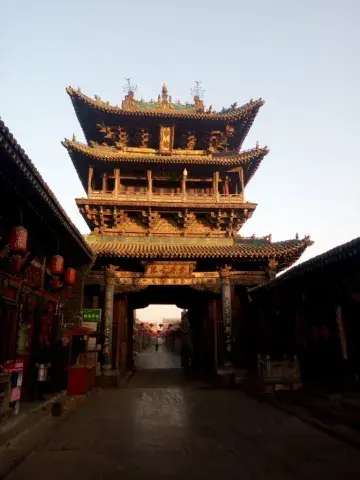
Pingyao Highlights Walking Tour

Pingyao Highlights Walking Day Tour

With our guide to know the Ancient Pingyao better!

Our guide will meet you at your hotel lobby at 08:00 or 08:30, then show you the ticket office to get the ticket for the museums we will visit later.

First we will visit the 700 years old City wall, We will climb up from south gate and have a walk on the wall. We are not sure how many km we can walk, because of the renovating of the wall. Normally we will walk from south gate to the Yunlu Exit.

Then visit the Confucius temple, there is a old building named Dacheng Hall which is over 840 years old. From outside, we can see the big wood joints to lift the big roof around the building which is named Dougong. Due to this design, there are less columns inside the hall for giving the big space for the statues and the prayer. We have chance to see the Confucius statue and learn the philosophy of Confucius. If you like, you can pray for you and your children to get better study.

There is the Paper Cutting master named Wentao nearby the exit of Confucius temple. She is very smart and create the new style paper cutting with much more details and good wishes on it. Her products are made by hanks. It is worth to visit and buy as a souvenir from Pingyao. From the table standing and wall hangings. Please remember, take the red one because of red is the traditional and happy color. But the white one is the best. It is really difficult to choose, because of all of them are really nice.

Then you can have coffee break or tea break if you need at Chummy coffee, after this, visit the City god temple (ChenghuangMiao) which is most beautiful temple inside the wall. Because of the roof is covered by the colorful glazed tiles. There is not only city god and also the three money gods, Now you know why pingyao was the financial center.

Next we will visit the Ancient government building, to see the pingyao politics center in the ancient time. It is the complete building with officials bed room, kitchen and private garden. Follow the guide to look the official’s life from the 250km far away from the hometown.

Have a stroll in the alley to the Rishengchang exchange bank, which is the first bank all of china.You can not miss it.

After lunch, walk to the Ming and Qing street, this is the shopping street full of the stores on the both side of street. You can find alot things here , from post card to lacquered boxes, and wall panels. One more place to see, it is the Armed escort agency also named security and transport service for the business man before the bank founded.

Inlcusions

1.private english speaking tour guide servcie

2.bottle water for the tour