Beijing Attractions

Beijing Articles
History of Divine Music Administration
There were 300 royal musicians and dancers when the Ming Empire (1368 - 1644) moved its capital to Beijing in 1420, so the Divine Music Administration was set to manage them. The officials and performers in the administration were all Taoists....
There were 300 royal musicians and dancers when the Ming Empire (1368 - 1644) moved its capital to Beijing in 1420, so the Divine Music Administration was set to manage them. The officials and performers in the administration were all Taoists. Their number soon increased to about 600 people. The administration reached its peak in the reign of Emperor Jiajing of the Ming Dynasty, when the number of the performers totaled an amazing 2,200.
At that time, this was also a resort for the civilians to entertain themselves. Every year, the officials who accompanied the emperor to worship the heavens, would rent houses near the Divine Music Administration, thus making the area livelier. The Taoists planted many popular flowers and herbs. Drugstores were set up and they held a prosperous temple fair.
To keep the security and dignity of the imperial ritual site, the temple fair was disbanded during the Qing Dynasty (1644 - 1911). Only several popular drugstores remained. At that time, about 500 performers of the sacred music remained.
Resting Palace and Belfry
Resting Palace...
Resting Palace
The Resting Palace is at the back of the Beamless Hall. The main room has tables, porcelains, and other ornaments in it. There is a Study Room in the palace, where bookshelves, tables and “the four treasures of study” (writing brush, ink stick, ink slab and paper) are set. The bedroom has a couch especially for the emperor. In the north and south parts of the palace, there are five rooms for preparing meals, tea and fruit. At the back, there is a palace for princes to fast.
Belfry
At the northeast corner, a double-layered bell tower facing the south, named the Bell of Supreme Harmony, was built to house a gigantic bell cast in Yongle’s reign during the Ming Dynasty. The bell has a large, thick body with a height of 2.8 meters (9 feet), a thickness of 0.1 meters (0.3 feet), and a diameter of 1.55 meters (5 feet). Its body is carved with beautiful pictures. The bell can be heard far and wide when struck. Before the ritual started, the bell was struck to announce the departure of the emperor from the Palace of Abstinence, his arrival at the altar, and the ending of the ceremony. Today, visitors can personally strike the bell to pray for good fortune and happiness.
Beamless Hall
Beamless Hall...
Beamless Hall
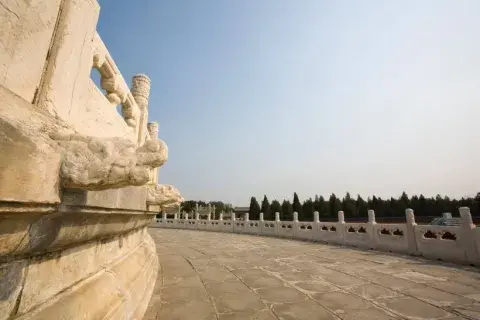
Located in the center of the Hall of Abstinence, the Beamless Hall is the main hall, where ceremonial rituals were held on the arrival and departure of the emperor. It was built in 1420. Its name is derived from the fact that the hall is supported only by the walls and a brick dome. There are no beams. A placard board on the lintel bears the inscription 'Admirable as Heaven’ in Emperor Qianlong’s handwriting. The hall originally had seven rooms. Four of the rooms have been converted into exhibition halls: the Architecture Exhibition, showing the history and evolution of the architecture; the Abstinence Ceremony Exhibition displaying the sacrificial relics as well as introducing features of the abstinence system and rituals during the Ming and Qing Dynasties (1368 - 1911); the Official's Abstinence Exhibition, depicting the officials fasting; and the Emperor Abstinence Exhibition showing pictures of twenty-two emperors who came to the Temple of Heaven for the Worshipping Ceremony including thirteen Ming emperors and nine Qing emperors. After visiting this exhibition, you will have a general idea about how much emphasis each emperor put on the importance of worshipping heaven.
Top Beijing Tours
$200 Per Day
Private Beijing Antique Shopping Tour with Lunch
Start your private tour with pickup from your central Beijing hotel, and meet your private guide.
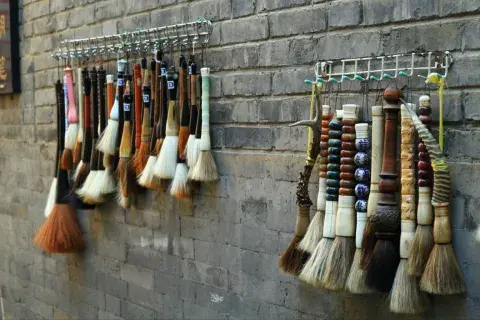
Hop inside your private, climate-controlled vehicle and travel to your first stop: Liulichang Antique Street. Situated in old Beijing, this history-steeped street is lined with stone shop-houses selling antique books, handicrafts, paintings, rubbings, glazed pottery, and other treasures.
Hear about Liulichang’s history, and get advice from your guide as to the best shopping opportunities....Read more
Start your private tour with pickup from your central Beijing hotel, and meet your private guide.
Hop inside your private, climate-controlled vehicle and travel to your first stop: Liulichang Antique Street. Situated in old Beijing, this history-steeped street is lined with stone shop-houses selling antique books, handicrafts, paintings, rubbings, glazed pottery, and other treasures.
Hear about Liulichang’s history, and get advice from your guide as to the best shopping opportunities. Sift through the traditional shops and stands, and explore the side lanes (hutongs), where the shops still bear original Ming and Qing architectural features like ornately carved doors and upswept roofs.
Next, drive to Panjiayuan Market, a so-called ‘weekend market’ that’s open daily. Weave through the throng of stands, perusing the huge array of antiques, curios, ceramics, Tibetan rugs, calligraphy, and other finds.
After shopping here, refuel with lunch at a Chinese restaurant, and continue to Baoguosi Cultural Market, set around an old temple. Scour the courtyards of vendors hawking stamps, books, coins and jade, and get tips on scouting out and clinching the best deals from your guide.
If time allows, squeeze in a visit to Hongqiao Market, a mall known for its pearl traders, and electronics, art, clothes, and accessories shops. Trawl for bargains, and haggle over pearls and other precious gems as perfect keepsakes of your time in Beijing.
After seven hours, your tour concludes with a hotel drop-off.
$50 Per Day
One day tirp to Bajiao Zhai, a noticeable Danxia Landform.
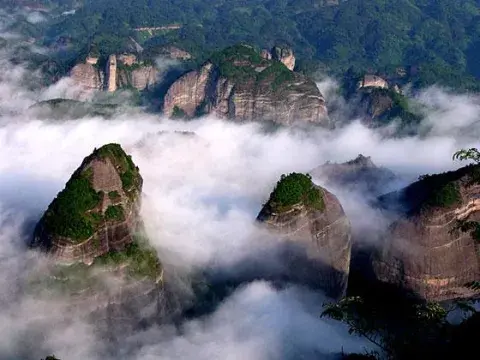
This is a tailor-made trip for nature-lovers and fans of photography. Danxia rock formation in the inland basin is a red rock debris, and later uplift due to the movement of the earth-crust, erosion of rocks by the water and weathering, which was dominant in the hillside to collapse back, kept down the rocks to form the red mountain block. This area was listed in the Natural Heritage of the world in 2009 by UNESCO. Bajiao Zhai Village is a combination of strategic place, steepy mountian, elegant scenery and secluded remote....Read more
This is a tailor-made trip for nature-lovers and fans of photography. Danxia rock formation in the inland basin is a red rock debris, and later uplift due to the movement of the earth-crust, erosion of rocks by the water and weathering, which was dominant in the hillside to collapse back, kept down the rocks to form the red mountain block. This area was listed in the Natural Heritage of the world in 2009 by UNESCO. Bajiao Zhai Village is a combination of strategic place, steepy mountian, elegant scenery and secluded remote. It is reputed as the "Soul of Danxia Landform". Here you can enjoy the sunrise or sunset and the sea-cloud. 1. I'll pick you up at 8:00 am in your hotel, and transfer to Bajiao Zhai Village by our private van. On the way, you can enjoy some terraced fields, bamboo groves and the wooden residences of the natives.(3.5 hours by ride) 2. First, we'll visit the village and have lunch in the village, and then we'll hike the mountains, the scenery including the group of snails looking up the sky, the ancient trail, Eye-stone, Joss stick of dragon's head and the Treasured sword Peak.(4 hours by hike) 3. After appreciating the sunset, after dinner in Ziyuan county, we'll take the bus back to your hotel around 10:00 pm.