Beijing Attractions
Beijing Articles
Solar Terms
Solar Terms is a calendar of twenty-four periods and climate to govern agricultural arrangements in ancient China and functions even now....
Solar Terms is a calendar of twenty-four periods and climate to govern agricultural arrangements in ancient China and functions even now. As we have mentioned the Chinese calendar is a lunisolar calendar, it takes into account the longest and the shortest days and the two days each year when the length of the day equals that of the night. In other words, the significant days are the Summer Solstice, Winter Solstice and the Spring and Autumn Equinoxes.
Today the year comprises 24 Solar Terms. During the Shang Dynasty they only used four; the Zhou Dynasty (11th century BC - 221BC), used eight; but it was in the Western Han Dynasty (206BC - 24) that the 24 terms were finally decided upon.
These solar terms have meaningful titles. Some of them reflect the change of seasons such as the Beginning of Spring, the Beginning of Summer, the Beginning of Autumn, and the Beginning of Winter; some embody the phenomena of climate like the Waking of Insects (Jing Zhe), Pure Brightness (Qing Ming), Lesser Fullness of Grain (Xiao Man) and Grain in Beard (Mang Zhong); and some indicate the change of climate like Rain Water (Yu Shui), Grain Rain (Gu Yu), Lesser Heat (Xiao Shu), Greater Heat (Da Shu), and so on.
Chinese Calendar
Each time the moon moves into line with the earth and the sun a new month begins and this is called 'Chu Yi' or 'Shuo Ri' (the first day of a lunar month)....
Each time the moon moves into line with the earth and the sun a new month begins and this is called 'Chu Yi' or 'Shuo Ri' (the first day of a lunar month). The longest day of a year or Summer Solstice falls on the 21st or 22nd of June, and the shortest day is the Winter Solstice on either December 21, 22, or 23. Using these two annual events the year was divided into in 24 equal parts, each forming the 24 solar terms. The month with its first day nearest the Beginning of Spring (the first solar term) is the first lunar month, and on that day the Spring Festival is held and this varies between January 20th and February 20th.
Just as the Gregorian calendar has a leap year in order to compensate for the fact that the earth does not travel around the sun in exactly 365 days, so the Chinese calendar is adjusted so as to ensure that it bears a proper relationship with the apparent movement of the sun between the northern and southern tropics. People in ancient times concluded that there is a 19 year cycle and within this cycle certain days will equate with the lunar day. For example, in 1963, 1982, and 2001, May 28th coincided with the sixth day of the fourth month in lunar year.
To decide when a leap month needs to be added to bring the lunar calendar in relation to the earth's movement around the sun, the 24 solar terms are considered. Most months will have solar terms and but in those instances where a month has only one, it will be repeated with 29 or 30 days the same as normal month. This phenomenon can occur every two or three years.
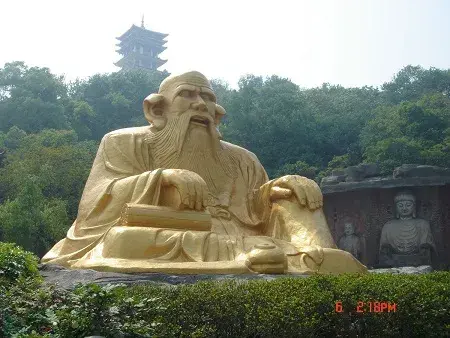
Lao Zi the great thinker
Lao Zi was the creator of this religion. According to the Shi Ji, or Records of the Historian, by Sima Qian , Lao Zi was named Li Er, with Dan as his alias....
Lao Zi was the creator of this religion. According to the Shi Ji, or Records of the Historian, by Sima Qian , Lao Zi was named Li Er, with Dan as his alias. He was a reputed thinker around 6th century B.C. There are many legends about Lao Zi but few historical records. He left a 5, 000-word book and went on his ox from Hangu Pass and to where nobody knows! Lao Zi's 5,000 words are rather concise compared to his profound ideological system but there were numerous books interpreting the true meaning of his book.
A Taoist phrase is to say an ordinary man can become immortal if he does good 3,000 times and accomplishes 800 exploits. Of course the number is symbolic. It requires people to do good without making it known to others as the gods will know it naturally, much like the Christian principle expressed in Matthew 6:3-4, "But when you give alms, do not let your left hand know what your right hand is doing, so that your alms may be done in secret; and your Father who sees in secret will reward you.
Tao is wu wei, namely Non-action. Non-action is to follow the rule of nature instead of overriding it. By conforming to the natural rules, Tao does nothing but it can do everything. Tao makes everything run smoothly but it does not boast about its own achievement. Those learning this religion should be pure and take non-action.
Top Beijing Tours
$200 Per Day
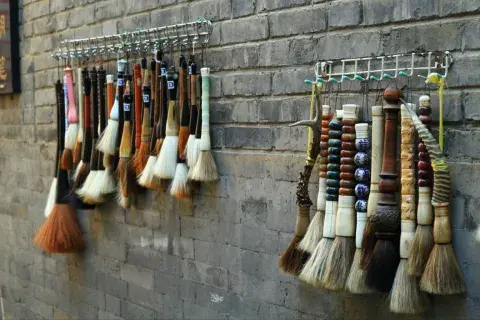
Private Beijing Antique Shopping Tour with Lunch
Start your private tour with pickup from your central Beijing hotel, and meet your private guide.
Hop inside your private, climate-controlled vehicle and travel to your first stop: Liulichang Antique Street. Situated in old Beijing, this history-steeped street is lined with stone shop-houses selling antique books, handicrafts, paintings, rubbings, glazed pottery, and other treasures.
Hear about Liulichang’s history, and get advice from your guide as to the best shopping opportunities....Read more
Start your private tour with pickup from your central Beijing hotel, and meet your private guide.
Hop inside your private, climate-controlled vehicle and travel to your first stop: Liulichang Antique Street. Situated in old Beijing, this history-steeped street is lined with stone shop-houses selling antique books, handicrafts, paintings, rubbings, glazed pottery, and other treasures.
Hear about Liulichang’s history, and get advice from your guide as to the best shopping opportunities. Sift through the traditional shops and stands, and explore the side lanes (hutongs), where the shops still bear original Ming and Qing architectural features like ornately carved doors and upswept roofs.
Next, drive to Panjiayuan Market, a so-called ‘weekend market’ that’s open daily. Weave through the throng of stands, perusing the huge array of antiques, curios, ceramics, Tibetan rugs, calligraphy, and other finds.
After shopping here, refuel with lunch at a Chinese restaurant, and continue to Baoguosi Cultural Market, set around an old temple. Scour the courtyards of vendors hawking stamps, books, coins and jade, and get tips on scouting out and clinching the best deals from your guide.
If time allows, squeeze in a visit to Hongqiao Market, a mall known for its pearl traders, and electronics, art, clothes, and accessories shops. Trawl for bargains, and haggle over pearls and other precious gems as perfect keepsakes of your time in Beijing.
After seven hours, your tour concludes with a hotel drop-off.
$50 Per Day
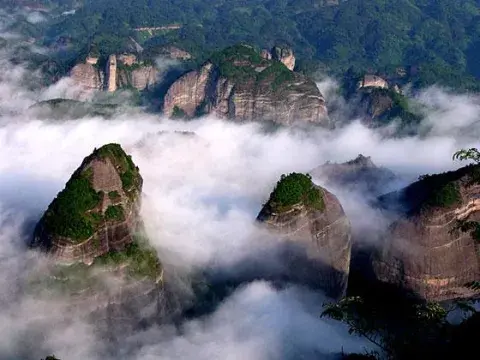
One day tirp to Bajiao Zhai, a noticeable Danxia Landform.
This is a tailor-made trip for nature-lovers and fans of photography. Danxia rock formation in the inland basin is a red rock debris, and later uplift due to the movement of the earth-crust, erosion of rocks by the water and weathering, which was dominant in the hillside to collapse back, kept down the rocks to form the red mountain block. This area was listed in the Natural Heritage of the world in 2009 by UNESCO. Bajiao Zhai Village is a combination of strategic place, steepy mountian, elegant scenery and secluded remote....Read more
This is a tailor-made trip for nature-lovers and fans of photography. Danxia rock formation in the inland basin is a red rock debris, and later uplift due to the movement of the earth-crust, erosion of rocks by the water and weathering, which was dominant in the hillside to collapse back, kept down the rocks to form the red mountain block. This area was listed in the Natural Heritage of the world in 2009 by UNESCO. Bajiao Zhai Village is a combination of strategic place, steepy mountian, elegant scenery and secluded remote. It is reputed as the "Soul of Danxia Landform". Here you can enjoy the sunrise or sunset and the sea-cloud. 1. I'll pick you up at 8:00 am in your hotel, and transfer to Bajiao Zhai Village by our private van. On the way, you can enjoy some terraced fields, bamboo groves and the wooden residences of the natives.(3.5 hours by ride) 2. First, we'll visit the village and have lunch in the village, and then we'll hike the mountains, the scenery including the group of snails looking up the sky, the ancient trail, Eye-stone, Joss stick of dragon's head and the Treasured sword Peak.(4 hours by hike) 3. After appreciating the sunset, after dinner in Ziyuan county, we'll take the bus back to your hotel around 10:00 pm.