Beijing Attractions
Beijing Articles
Lama Temple Ⅰ
As the largest and best-preserved lamasery in Beijing, the Lama Temple (Yonghegong) is located in the northeast part of the city, on the eastern side of Lama Temple Street....
As the largest and best-preserved lamasery in Beijing, the Lama Temple (Yonghegong) is located in the northeast part of the city, on the eastern side of Lama Temple Street. Yonghegong, meaning 'Palace of Eternal Harmony', was built in 1694 originally as a residence for Prince Yongzheng before he ascended the throne. After Yongzheng's death in 1735, his coffin was placed in the temple. Emperor Qianlong, his successor, upgraded Yonghegong to an imperial palace with its turquoise tiles replaced by yellow tiles (yellow was the imperial color in the Qing Dynasty, 1644 - 1911). During the 9th year of Emperor Qianlong's region (1744), it was converted into a lamasery and became a residence for large numbers of monks from Mongolia and Tibet.
Imperial College Ⅲ
The east and west auxiliary halls of the Biyong Hall originally housed the Qianlong Stone Scriptures. In the middle of the 18th century, Emperor Qianlong ordered to have the Thirteen Classics engraved in stone....
The east and west auxiliary halls of the Biyong Hall originally housed the Qianlong Stone Scriptures. In the middle of the 18th century, Emperor Qianlong ordered to have the Thirteen Classics engraved in stone. To carry out his order, a scholar named Jiang Heng spent 20 years carving the 630,000 Chinese characters onto 189 stone tablets. Today these tables are located to the east of the Taixue Gate.
Behind the Biyong Hall stands the former Chongwen (Exalted Literature) Pavilion, this used to be a library during the Yuan Dynasty. Later its name was changed to the Yilun (Ethics) Hall. Here the emperor and other noted scholars gave lectures during the period before the Biyong Hall was built. Now it is one of the reading rooms of the Capital Library.
Entrance Fee: CNY 30 (through ticket including the Confucius Temple and the Imperial College)
Transportation:
A. Bus Routes:
Take Bus No. 13, 116,117 or 684 and get off at Yonghegong (Lama Temple).
Take Bus No. 104, 108, 113, 124, 758 or 850 and get off at Fangjia Hutong.
B. Subway: Take Subway Line 2 or 5 and get off at Yonghegong Station.
Opening Hours: 08:30 - 16:30
Imperial College Ⅱ
The college is located to the west of the Confucian Temple and connects with the temple through a side gate. Established in 1287 during the Yuan Dynasty and subsequently enlarged several times, it attains its present dimensions during the reign of Emperor Qianlong of the Qing Dynasty....
The college is located to the west of the Confucian Temple and connects with the temple through a side gate. Established in 1287 during the Yuan Dynasty and subsequently enlarged several times, it attains its present dimensions during the reign of Emperor Qianlong of the Qing Dynasty. After the founding of the People's Republic in 1949, the Imperial College was completely renovated and the Capital Library was incorporated within its grounds.
Upon entering the main gate, visitors will be confronted by a pair of wells as well as the Taixue (Highest Scholarship) Gate, also known as the Jixian (Assembled Virtue) Gate. Inside this gate is a glazed tile memorial archway with bell and drum towers standing to the east and west. In front of the gate is the famous Biyong (Jade Disc) Hall. The square pavilion, which lies in the center of a circular pond, has a double-eave roof surmounted by a gilded sphere. The pond is crossed by four marble bridges and provided on four sides with stone spouts in the shape of dragon's heads. It was here that the emperor came occasionally to expound the classics to an audience consisting of civil and military officials from the imperial court and students of the Imperial College.
Top Beijing Tours
$200 Per Day
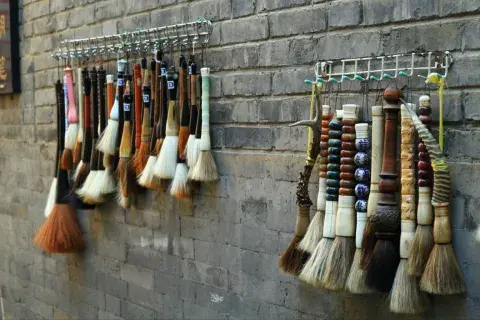
Private Beijing Antique Shopping Tour with Lunch
Start your private tour with pickup from your central Beijing hotel, and meet your private guide.
Hop inside your private, climate-controlled vehicle and travel to your first stop: Liulichang Antique Street. Situated in old Beijing, this history-steeped street is lined with stone shop-houses selling antique books, handicrafts, paintings, rubbings, glazed pottery, and other treasures.
Hear about Liulichang’s history, and get advice from your guide as to the best shopping opportunities....Read more
Start your private tour with pickup from your central Beijing hotel, and meet your private guide.
Hop inside your private, climate-controlled vehicle and travel to your first stop: Liulichang Antique Street. Situated in old Beijing, this history-steeped street is lined with stone shop-houses selling antique books, handicrafts, paintings, rubbings, glazed pottery, and other treasures.
Hear about Liulichang’s history, and get advice from your guide as to the best shopping opportunities. Sift through the traditional shops and stands, and explore the side lanes (hutongs), where the shops still bear original Ming and Qing architectural features like ornately carved doors and upswept roofs.
Next, drive to Panjiayuan Market, a so-called ‘weekend market’ that’s open daily. Weave through the throng of stands, perusing the huge array of antiques, curios, ceramics, Tibetan rugs, calligraphy, and other finds.
After shopping here, refuel with lunch at a Chinese restaurant, and continue to Baoguosi Cultural Market, set around an old temple. Scour the courtyards of vendors hawking stamps, books, coins and jade, and get tips on scouting out and clinching the best deals from your guide.
If time allows, squeeze in a visit to Hongqiao Market, a mall known for its pearl traders, and electronics, art, clothes, and accessories shops. Trawl for bargains, and haggle over pearls and other precious gems as perfect keepsakes of your time in Beijing.
After seven hours, your tour concludes with a hotel drop-off.
$50 Per Day
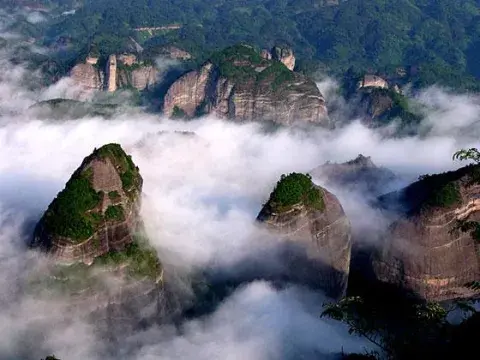
One day tirp to Bajiao Zhai, a noticeable Danxia Landform.
This is a tailor-made trip for nature-lovers and fans of photography. Danxia rock formation in the inland basin is a red rock debris, and later uplift due to the movement of the earth-crust, erosion of rocks by the water and weathering, which was dominant in the hillside to collapse back, kept down the rocks to form the red mountain block. This area was listed in the Natural Heritage of the world in 2009 by UNESCO. Bajiao Zhai Village is a combination of strategic place, steepy mountian, elegant scenery and secluded remote....Read more
This is a tailor-made trip for nature-lovers and fans of photography. Danxia rock formation in the inland basin is a red rock debris, and later uplift due to the movement of the earth-crust, erosion of rocks by the water and weathering, which was dominant in the hillside to collapse back, kept down the rocks to form the red mountain block. This area was listed in the Natural Heritage of the world in 2009 by UNESCO. Bajiao Zhai Village is a combination of strategic place, steepy mountian, elegant scenery and secluded remote. It is reputed as the "Soul of Danxia Landform". Here you can enjoy the sunrise or sunset and the sea-cloud. 1. I'll pick you up at 8:00 am in your hotel, and transfer to Bajiao Zhai Village by our private van. On the way, you can enjoy some terraced fields, bamboo groves and the wooden residences of the natives.(3.5 hours by ride) 2. First, we'll visit the village and have lunch in the village, and then we'll hike the mountains, the scenery including the group of snails looking up the sky, the ancient trail, Eye-stone, Joss stick of dragon's head and the Treasured sword Peak.(4 hours by hike) 3. After appreciating the sunset, after dinner in Ziyuan county, we'll take the bus back to your hotel around 10:00 pm.