Beijing Attractions

Beijing Huanghuacheng Lakeside Great Wall
Beijing Huanghuacheng Lakeside Great Wall is a tourist resort famous for its uniqueness, characterized by its beauty and integration of mountains, clear waters and an ancient stretch of the Great Wall . There are flowers in season for three of the seasons and great scenery can be seen all year ro...
Beijing Huanghuacheng Lakeside Great Wall is a tourist resort famous for its uniqueness, characterized by its beauty and integration of mountains, clear waters and an ancient stretch of the Great Wall . There are flowers in season for three of the seasons and great scenery can be seen all year round, These sceneries are made magical with clear mountains, beautiful waters, bird song and fragrance of flowers.
Visitors to the site surrounded by mountains and exuberant green forests, are treated to a gorgeous botanical sights whichever season they visit. You can enjoy both the beautiful lake and mountains and view the graceful beauty of the Great Wall simultaneously whilst being surrounded by the verdant trees and red flowers bringing you back to nature. Cross wooden bridges, wade creeks, stride strange stones, ascend the the ancient paths and you can reach Heilong Pond.
There are so many natural scenes for you to see that it will be difficult to tear yourself away, these places include Longwei Cave, Zicui Peak, Zuinv Hill, Shilang Valley, Sweetheart Peak and Three-Pearl Pond. The Heilong Pond, located at the westernmost end of the resort, is surrounded by mountains and its waters are green, clear and deep. Spring water gushes out from the bottom of the pond and the water is crystal clear and cold. In summer when the weather is too hot to bear, it’s pleasantly cool in the pond. The cruise terminal is located on the west side of the central peninsula and hand-rowed boats and pedaloes are the types of boats widely available. Tourists can not only row a boat on the lake, but also take a rest in the cool and enjoy the beautiful view.
Ancient Badaling Great Wall
The Ancient Badaling Great Wall is located in Donggou Village, Badaling Town of Yanqing County. It is about 65 kilometers (40 miles) from Beijing. This section of the Great Wall is about 5 kilometers (3 miles) from the famous Badaling, and is nearby the western gate of the military defense system...
The Ancient Badaling Great Wall is located in Donggou Village, Badaling Town of Yanqing County. It is about 65 kilometers (40 miles) from Beijing. This section of the Great Wall is about 5 kilometers (3 miles) from the famous Badaling, and is nearby the western gate of the military defense system on the Badaling Great Wall.
Seen from a distance, the Ancient Badaling Great Wall resembles a dragon winding its way along the mountain peaks. With lofty ridges and towering mountains, the deep trenches and high embarkments all contribute to the strength of this strategically crucial section of the Great Wall. Surviving the vicissitudes of nearly 2,000 years, the walls dominate the scene with an indelible mark made by history. The remnant wall, with its ubiquitous broken body, conveys a peculiar glamour.
This section of the Great Wall is in its original form, and replicates the character of the Ming Dynasty’s Great Wall. The whole section is 2,000 meters long, but only about 100 meters are open to tourists. Two routes are easily accessible to tourists that plan to enjoy the splendid panorama of the Great Wall at their leisure.
Take Bus No. 919, and get off at Xibozi Stop (西拨子站) which is the next stop after Badaling.
Gubeikou Great Wall
Gubeikou has long been a town of military significance and an important pass to Beijing. The Yanshan Range winds from east to west and is cut off at Gubeikou, forming a natural narrow pass here. To the west of the pass are the Chaohe River and the Wohu Mountain, and to the east is the Panlong Mou...
Gubeikou has long been a town of military significance and an important pass to Beijing. The Yanshan Range winds from east to west and is cut off at Gubeikou, forming a natural narrow pass here. To the west of the pass are the Chaohe River and the Wohu Mountain, and to the east is the Panlong Mountain. From ancient times, Gubeikou has served as a route of strategic importance, linking the southern and northern areas of the Yanshan Range. As early as 2,500 years ago, a fortification was built here and repeatedly reinforced throughout the following dynasties.
The main part of today's Gubeikou Wall was constructed under the supervision of Xu Da, a well-known general in the Ming Dynasty. This part of the Great Wall runs for more than 20 km and consists of four sections: Wohushan, Panlongshan, Jinshanling and Simatai. It has 143 beacon towers, each positioned at an average interval of 156 meters. The nearest two are only 30 meters apart. The inside of these towers varies in design. While some have a flat ceiling, others either have an arched ceiling and a domed ceiling, or an octagonal, painted ceiling. Each tower has two floors, six archways and ten arched doors, allowing garrisoned soldiers to advance and retreat freely. The towers are also different in size. The largest one can accommodate a garrison of 100 soldiers and the smallest one a garrison of 10 soldiers. The towers commonly have one to six portholes.
Features:
Gubeikou Great Wall was built along the precipitous mountain ranges, rising and falling at various sections. Simatai, built on a cliff, is extremely steep. A famous Great Wall specialist said: "The Great Wall is the best of Chinese architecture and Simatai is the best of the Great Wall."
There are plenty of legends about the Gubeikou Wall, especially the Simatai section, as well as historical relics. At night, from the Beijing Watchtower, 986 meters above sea level, one can see the lights shimmering in downtown Beijing. The west of this tower is the steeply situated Fairy Tower that looks like a slim fairy standing among shrubs and wild flowers.
Wohu Mountain: “Wohu” means “Crouching Tiger” in English, because the mountain looks like two tigers, one lying on its back while the other lies on its stomach. Located in the western section of the Gubeikou Great Wall, its highest peak measures about 665 meters (2,181 feet). A watch tower is erected every 150 meters (492 feet) of the wall, overlooking a deep valley or mounted on a strategically important hilltop. A professor from Peking University compares the wall to a huge cursive script work with the watch towers providing the pausing or transitional strokes. It retains its fascination today as its raw condition is still evident.
Panlong Mountain: West of Wohushan, it is located in the middle section of Gubeikou, where most of the historical wars took place. In ancient times, both warring parties placed emphasis on securing the Panlongshan Great Wall, because each knew that once the wall was captured, the Gubeikou Great Wall would be readily occupied. The whole wall measures about 13 kilometers (3.1 miles). Of its over 40 watch towers, the General Tower is the most famous. It is located at the commanding elevation of Panlongshan Mountain, from where wars were directed. There are four arrow windows on the north and south sides respectively, while each of the east and west sides has three arrow windows. This section is of unique construction: it is made up of earth, stone and brick walls. It is also preserved in its original state.

Beijing Articles

Why did Chinese build the Great Wall?
Why did Chinese build the Great Wall?
Great Wall in Chinese named Chang Cheng (that is long wall), Great Wall means the first: that is so long has 21196Km,that is longer than the one of the UK’s famous section Hadrians Wall, we can called shorter wall.
...Why did Chinese build the Great Wall?
Great Wall in Chinese named Chang Cheng (that is long wall), Great Wall means the first: that is so long has 21196Km,that is longer than the one of the UK’s famous section Hadrians Wall, we can called shorter wall.
Only 135Km from the eastern coast river tyne to the west coast of Solway firth.
Secondly, Great Wall started to build since 1046BC, more than 2000 years history with 10 different dynasties. Well the hadrians wall dates back to 122AD to 147AD.
Thirdly, Great Wall cross by the 15 different provinces, while the hadrians wall cross by 3 counties and 12 shires.
Great Wall is the function of defending project which is keep out barbarian outside of the wall. Who is barbarian: no matter where the people around the world, they have civilized people and uncivilized respectively.
For Hadrains Wall is to keep pics out (at that time Roman people called Caledonia), in 142 AD, they started to build another section Antonine Wall, total length only has 59Km.
One of the Disney movie: Hua Mulan, story happened in the Han dynasty: Huns people what we called barbarians. Because of north location and environment condition, and shortage of variety food, they are good at catching and stealing to the main city. That is why we build Great Wall. Dates back 2000 years, during the silk road time, for business people pass through the gate without pass, what we called passport right now, they have to go back, so for us, the Great Wall not only for its defending project, but also a security gate at that time. We must say, China Great Wall is so far a tremendous cultural project,. Great Wall is one of the seven wonders of the world!

China National Museum-The Four-Goat Square Sacrificial Vessel(Zun).
The Four-Goat Square Sacrificial Vessel(Zun). 四羊方尊
It is a ritual vessel that has history of 3000 years.
...The Four-Goat Square Sacrificial Vessel(Zun). 四羊方尊
It is a ritual vessel that has history of 3000 years.
In the remote past, the Shang Dynasty used it to pray for good luck. Among the 10 National treasures, it occupies the third place. In order to protect it, the government has banned its trips to foreign countries. It is The Four-goat Square Sacrificial Vessel..
Today I will share the ancient story of the Four-goat Square Zun. This is not a commonly liquor vessel, in the height of 58.3 centimeters, with the weight of 34.5 kilograms. It is used to offer sacrifices to gods or ancestors, It is also the largest square bronze untensil among all existing Shang Dynasty bronze objects. Today the Four-goat Square Zun can be rank third among the ten great national treasures. It is closely related to its casting process.
In accordance with the analysis of archeologists, The Four-goat square Zun was forged by twice forging technique: firstly the horns and heads were forged separately, they were placed in the planned position for an integrated forging. But it was perfectly integrated, reflecting the excellent forging techniques, therefor it is regard the ultimate model of bronze ware. More than that, the Four-goat Square Zun represents the sheep totem. It is an important reason for its priceless, what is all about? Goat was one of earliest hunted and domestic animals meanwhile, the species was widely and commonly raised across China. Therefore, goat had a long relationship with mankind.
Lamb had the tradition to kneel to suck its mother’s milk which was considered a model for kindness and filial piety. Even later generation took it a role model of filial piety. Not only for that, sheep are often associated with auspicious words of kindness.
The Four-Goat Square Zun is priceless, because it is confirmed as early as in the Shang Dynasty, sheep have become an important totem culture. Early in the Shang Dynasty 3000 years ago, ancient people carried out rites with it. After 3000 year the treasure is finally woke up, unearthed in 1938, one day of April in Huangcai village of Hunan Province, three yang men were cultivating the land, suddenly their hoes meet something strong, and the sound clear voice, and thus make 3 guys attention, they started to dig it out, though never been touched antiques before, they believed this object must be a treasure and took it back home. At home 3 boys kept knocking and tapping until they broke one piece of it, then they parceled it and put into the box, soon after, everybody in the village knows it, even the antique shop in the city which the boss paid 400 Yuan bought it, at that poverty time, poor family with 3 boys, the only incomes is their father’s part time working hour’s pay and of handed –made beancurd done by grandfather’s pay, it has been said enough money for support family, though they wanted to keep it , they have to sell it . By selling treasure must through the process via the leader of village and security manager, that is why they only get 240 Yuan left. For many years after the war happened in China, the unearthed bronze ware not been oxygenized by air, still keeping its golden color, the inscription carved on it is clearly seen. It uses its unique manner to tell an ancient story.

Confucius
Confucius
...
Confucius
Confucius is the most famous ancient Chinese philosopher known to the Western world. His importance could be compared with Socrates in ancient Greece, or Buddha in ancient India. They lived in similar times. Confucius (6th-4th BC). Many call this time as a period of wisdom. My understanding is that people were smart enough to have literature and logic, and a good amount of observations in life, but had not discovered scientific solutions. So, they came up with many abstract concepts to explain the world. That is called philosophy. The name Confucius was a Latinized translation of Kong Zi. Kong was his surname. Zi is a suffix for Master. Confucius lived in an era when China was not unified. Several kingdoms constantly fought against each other. War and human suffering together born many philosophers and Confucius was just one of them. When he was alive, he traveled all over China to persuade kings to adopt his advice of governance, and the people to follow his teaching to self-cultivate. Some kings paid attention to him for a while but eventually chased him away. He did have many students. Among them, 72 faithfully followed him. We do not know if he wrote any books. If so, none of them survived. Many of his stories and words were recorded by these students. This is the classic book “Lun Yu” which probably the most well read book in China. Confucius never gained much fame and definitely not any fortune. He nearly starved to death a few times. But, he managed to have a sense of humor. Once, he was lost and helpless by a road. His students asked a villager if he saw an old gentleman. The villager answered: “no, but I only saw a poor guy like an old stray dog at the end of the road”. When his students found him and complained about how rude the villager was, Confucius laughed, “Thanks to his accurate description, you find me!”.
Confucianism’s core is humanity, which includes respect, empathy, honesty, and mutual favor. This is similar to the golden rule in the west – Do not impose on others what you do not desire. He pointed out that a society, or even a family, must follow certain structures. People need to behave according to their roles to achieve harmony. He also promoted “Balance” or some may interpret as mediocracy. For example, in a forest, if a tree is taller and stronger than all others, it may be cut down first for lumber. If a tree is the weakest, it may be cut down to make room for others. So, those trees in the middle survive. If you are pessimistic, you may see this as a reason to be mediocre. If you are optimistic like me, you may think that we should not be too extreme, but to find a balance somewhere in the middle. One other important part of Confucianism is education. Life is a journey of learning. If a person is not educated, his father is the first to blame. If a student is not well disciplined, his teacher must be too lazy. The concept of self-cultivation is also from Confucius, for that the most important education is to educate ourselves. We shall self-examine three times a day to reflect and learn.
None of his teachings promote violence. You can see why his ideas were not adopted during his time when kingdoms kept fighting wars. Nearly 400 years later, after China had long been unified, the emperor picked Confucianism as the dominant philosophy to govern China. All the humanity, structure, balance, and education together served the emperor well. 1,400 years ago, when China decided to use a civil service exam system to select talents for all levels in the administration, Confucianism was picked as the testing subject. People were proud to claim themselves as students of Confucius. In fact, everyone in the administration was indeed his student. China has many different dynasties. All of them only lasted around 300 years or less. Confucianism has governed China for over 2,000 years. It is safe to say that Confucius is more powerful than any of the emperors. Furthermore, China radiated its culture to its neighboring states for thousands of years as well. People may relocate outside of China, but they always carry Confucius teaching with them. Confucianism became the common denominator for all Chinese people, and still going strong today. If you travel to Korea, Vietnam, Singapore, or Japan, you can easily find Confucius temples. If you have a China town in your home town, I bet you can find a Confucius statue there. In the end, I’d like to offer you a quote from Confucius – Everything has beauty, but not everyone sees it. You will see many beautiful things and meet many beautiful people in China. I wish you a beautiful journey.
Top Beijing Tours
$200 Per Day
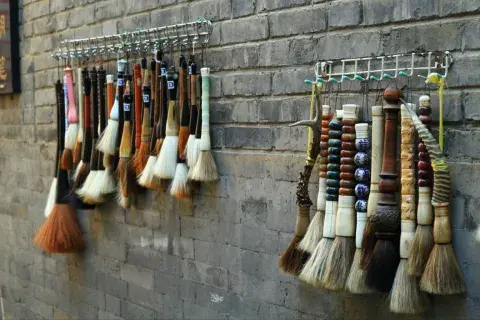
Private Beijing Antique Shopping Tour with Lunch
Start your private tour with pickup from your central Beijing hotel, and meet your private guide.
Hop inside your private, climate-controlled vehicle and travel to your first stop: Liulichang Antique Street. Situated in old Beijing, this history-steeped street is lined with stone shop-houses selling antique books, handicrafts, paintings, rubbings, glazed pottery, and other treasures.
Hear about Liulichang’s history, and get advice from your guide as to the best shopping opportunities....Read more
Start your private tour with pickup from your central Beijing hotel, and meet your private guide.
Hop inside your private, climate-controlled vehicle and travel to your first stop: Liulichang Antique Street. Situated in old Beijing, this history-steeped street is lined with stone shop-houses selling antique books, handicrafts, paintings, rubbings, glazed pottery, and other treasures.
Hear about Liulichang’s history, and get advice from your guide as to the best shopping opportunities. Sift through the traditional shops and stands, and explore the side lanes (hutongs), where the shops still bear original Ming and Qing architectural features like ornately carved doors and upswept roofs.
Next, drive to Panjiayuan Market, a so-called ‘weekend market’ that’s open daily. Weave through the throng of stands, perusing the huge array of antiques, curios, ceramics, Tibetan rugs, calligraphy, and other finds.
After shopping here, refuel with lunch at a Chinese restaurant, and continue to Baoguosi Cultural Market, set around an old temple. Scour the courtyards of vendors hawking stamps, books, coins and jade, and get tips on scouting out and clinching the best deals from your guide.
If time allows, squeeze in a visit to Hongqiao Market, a mall known for its pearl traders, and electronics, art, clothes, and accessories shops. Trawl for bargains, and haggle over pearls and other precious gems as perfect keepsakes of your time in Beijing.
After seven hours, your tour concludes with a hotel drop-off.
$50 Per Day
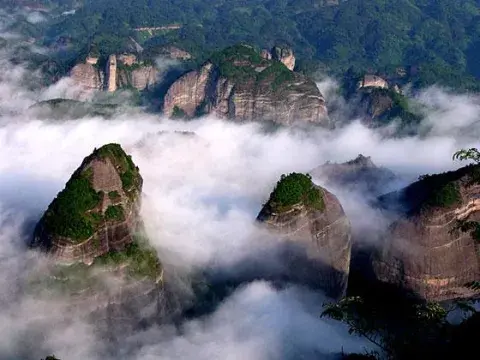
One day tirp to Bajiao Zhai, a noticeable Danxia Landform.
This is a tailor-made trip for nature-lovers and fans of photography. Danxia rock formation in the inland basin is a red rock debris, and later uplift due to the movement of the earth-crust, erosion of rocks by the water and weathering, which was dominant in the hillside to collapse back, kept down the rocks to form the red mountain block. This area was listed in the Natural Heritage of the world in 2009 by UNESCO. Bajiao Zhai Village is a combination of strategic place, steepy mountian, elegant scenery and secluded remote....Read more
This is a tailor-made trip for nature-lovers and fans of photography. Danxia rock formation in the inland basin is a red rock debris, and later uplift due to the movement of the earth-crust, erosion of rocks by the water and weathering, which was dominant in the hillside to collapse back, kept down the rocks to form the red mountain block. This area was listed in the Natural Heritage of the world in 2009 by UNESCO. Bajiao Zhai Village is a combination of strategic place, steepy mountian, elegant scenery and secluded remote. It is reputed as the "Soul of Danxia Landform". Here you can enjoy the sunrise or sunset and the sea-cloud. 1. I'll pick you up at 8:00 am in your hotel, and transfer to Bajiao Zhai Village by our private van. On the way, you can enjoy some terraced fields, bamboo groves and the wooden residences of the natives.(3.5 hours by ride) 2. First, we'll visit the village and have lunch in the village, and then we'll hike the mountains, the scenery including the group of snails looking up the sky, the ancient trail, Eye-stone, Joss stick of dragon's head and the Treasured sword Peak.(4 hours by hike) 3. After appreciating the sunset, after dinner in Ziyuan county, we'll take the bus back to your hotel around 10:00 pm.