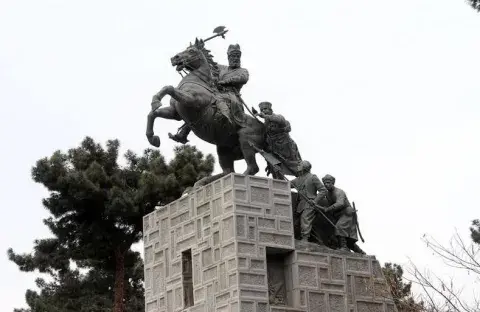
Tomb of Nāder Shāh Afshār
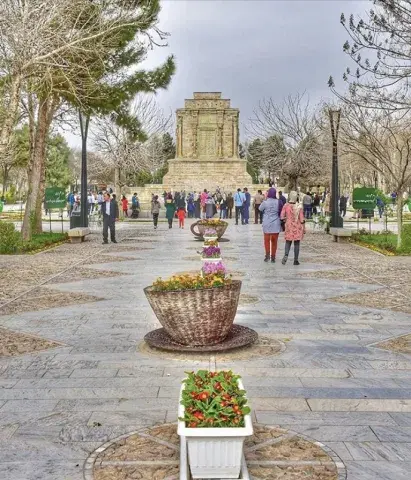
Nāder Shāh Afshār (1688-1747) was a member of the Turkic Afshar tribe of northern Persia supplying the military power to the Safavid state....
Nāder Shāh Afshār (1688-1747) was a member of the Turkic Afshar tribe of northern Persia supplying the military power to the Safavid state. Nader rose to power during a period of anarchy in Iran after a rebellion overthrown the weak Persian Shah Sultan Husayn and both the Ottomans and the Russians had seized Persian territory for themselves. Nader reunited the Persian realm and removed the invaders. His numerous campaigns created a great empire that briefly encompassed what is now part of Iran, Armenia, Azerbaijan, Georgia, the North Caucasus, Iraq, Turkey, Turkmenistan, Afghanistan, Tajikistan, Uzbekistan, Pakistan, North India, Oman and the Persian Gulf. In his campagins, he imitated the military prowess of Mongols and their cruelty. His victories briefly made him West Asia's most powerful sovereign though his empire quickly disintegrated after he was assassinated in 1747. Nadir was Persia's most gifted military genius known as "The Napoleon of Persia". He raised his country from the lowest depths of degradation to the proud position of the foremost military power in Asia. Unfortunately, his triumphs were at the expense of incalculable suffering and terrible loss of life. His grandiosity, his insatiable desire for more conquests and his egocentric behaviour suggest a narcissistic personality disorder and in his last years he seems to have developed some paranoid tendencies.
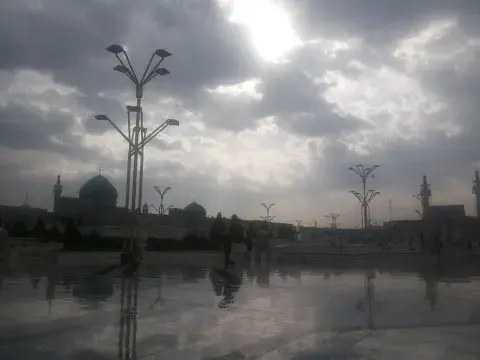
The Imam Reza Shrine
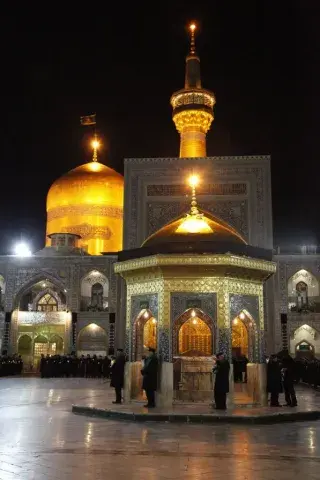
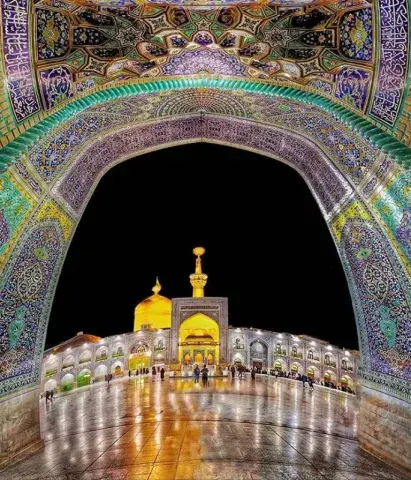
The Imam Reza Shrine (Persian: حرم امام رضا) in Mashhad, Iran is a complex which contains the mausoleum of Imam Reza, the eighth Imam of Twelver Shi'ites. It is the largest mosque in the world by dimension and the second largest by capacity....
The Imam Reza Shrine (Persian: حرم امام رضا) in Mashhad, Iran is a complex which contains the mausoleum of Imam Reza, the eighth Imam of Twelver Shi'ites. It is the largest mosque in the world by dimension and the second largest by capacity. Also contained within the complex are the Goharshad Mosque, a museum, a library, four seminaries, a cemetery, the Razavi University of Islamic Sciences, a dining hall for pilgrims, vast prayer halls, and other buildings.
In 818, Imam Ali al-Ridha was murdered by the Abbasid caliph al-Ma'mun (ruled 813–833) and was buried beside the grave of al-Ma'mun's father, Harun al-Rashid (r. 786–809). After this event, the location was called as Mashhad al-Ridha ("the place of martyrdom of al-Ridha"). Shias and Sunnis began visiting his grave on pilgrimage. By the end of the 9th century a dome was built on the grave and many buildings and bazaars sprang up around it. During more than a millennium it has been devastated and reconstructed several times.
In 993 the holy shrine was ruined by Saboktakin, a Ghaznavid king. However, in 1009, his son Sultan Mahmud of Ghazni ordered the shrine to be repaired and expanded. About 1150 Sultan Sanjar, a Seljuq king, renovated the sanctuary and added new buildings after his son was miraculously healed at the shrine. Later, Sultan Muhammad Khodabande, an Ilkhanate king who converted to Shiism, renovated the holy shrine around 1310. The celebrated Muslim traveler Ibn Battuta visited Mashhad in 1333 and reported that it was a large town with abundant fruit trees, streams and mills. A great dome of elegant construction surmounts the noble mausoleum, the walls being decorated with colored tiles. Opposite the tomb of the Imam is the tomb of Caliph Harun al-Rashid, which is surmounted by a platform bearing chandeliers. However, the tomb of Harun al-Rashid is not considered sacred, as he was responsible for the murders of the 6th and 7th Shia Imams.
In the 15th century, during the reign of the Timurid Shahrukh Mirza, Masshad became one of the main cities of the realm. In 1418 his wife Goharshad funded the construction of an outstanding mosque beside the shrine, which is known as the Goharshad Mosque