Mount Wutai (Wutai Shan)
Mount Wutai (simplified Chinese: 五台山; pinyin: Wǔtái shān; literally “Wutai Mountain”) is the first mountain of the four famous Buddhist mountains. It is located in the northeastern of Wutain Country in Shanxi....
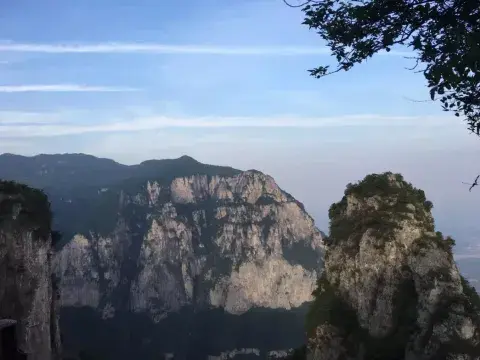
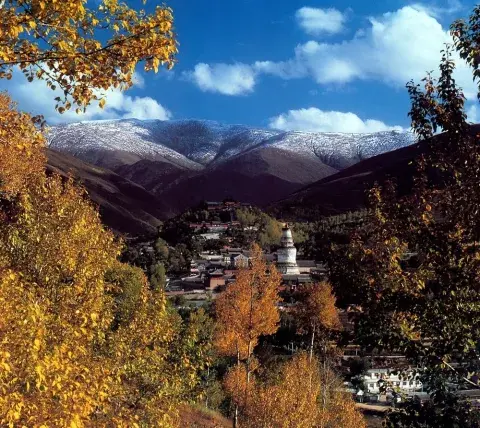
Mount Wutai (simplified Chinese: 五台山; pinyin: Wǔtái shān; literally “Wutai Mountain”) is the first mountain of the four famous Buddhist mountains. It is located in the northeastern of Wutain Country in Shanxi. The Mount Wutai composed with many huge mountains and peaks which including five peaks. The tops of the peak are flat, and look like platforms, so called Mount Wutai. People called the mountain “the ridge of China” because of towering peaks and majestic mountains. The east of the mountain is 2795 meters high and the circumference reached 250km. You can see the red clouds look like sea, people called it Wanghai Peak. The south of the mountain is 2485 meters high and flowers covers with the mountain, people call it Jinxiu Peak. The west of the mountain is 2773 meters high and it is a good place to see moon, people call it Guayue Peak. The north of the mountain is 3508 meters high and it is the highest peak. The white clouds float around the peak, people call it Yedou Peak. The middle of the mountain is 2894 meters high and you can see the peak hide in the mist. In the back of the north of the mountain has the thousand year snow and ice. Even it will be snow in the summer there. So it is a good summer resort and is also called Qingliang Mountain. Mount Wutai has a long history. The Xiaowen Emperor of the Beiwei period, the SuiyangEmpersor, Songtai Zong Emperior and Yuan ying Zong Empeior, also include Qingsheng Zu Emperior and Qinggao Zong Emperior had came to the Mount Wutai. All the emperors and empress from Beiwei period to the Qing Dynasty has sent presents to Mount Wutai. If you read the history book of the temples in Mount Wutai you can see two words “Chijia” (it means all the temples were built by the royal) in the first page. The Mount Wutai also the only place has Handi Buddhism and Lamaism. Many nationalities like Tibet, Inner Mongolia, Qinghai, Gansu and Heilongjian are all respect it. Some famous Buddhism monks emerged here. In the Tang Dynasty, this place had become Buddhism school for people from overseas. A great many people came here to worship from India, Japan, Mongolia and North Korea, also some from Nepal and Sri Lanka in thousand years. Even some people live in the Mount Wutai forever. There are more than 3000 Buddhism Statues here. Not only have Buddha, Bodhisattva, Arhat, servant, provider and Hufa God, but also have Confucianism, Taoism and local religious and so on. The Buddhism statues have eight types. They are clay sculpture, metal, carved stone, woodcarving, porcelain, sloughing, embroidery and portrait.
Mount Wutai Attractions
Xiantong Temple
Tayuan Temple
Jinge Temple
Bodhisattva Ding
Qixian Temple
Mount Wutai Stories
1. Dipankara Mother Tower
There is a Baohua Temple in the north of the Xiantong Temple and it is about 7 Li away from there. The Dipankara Mother Tower is in front of the Temple. The tower is tall and the shape is like the Tibet Bottle. In the corners have some little towers and many carved stones. According to the legend, the tower footing is in the Tibet while the tower body in the Taer Temple. The top of the tower is in the Taer Ditch. Long time ago, an old man came to the Taer Ditch and said to the residents that the top of tower will falls down here at tomorrow noon, people should move their valuables into a safe. But people thought the old man was mad and nobody listened to him. The old man worried and thought a method. He took a little boy of the village and run, the residents thought he was a bad person and run after him wanted the boy back. The old man brought the little boy run faster and faster until they arrived at a lawn. The residents also run after him to the lawn. At the same time, they saw the sky became dark, the wind was strong and suddenly they heard a rumbling sound. Then, the wind stopped and the clouds away, the sun rose again. But the top of the tower and the four little tops of towers fell down on the Dipankara Mother Tower. At that time, people knew the old man just wanted to save their lives. They found he has gone when they wanted to thank him. People thought the old man was the Wenshu Bodhisattva. People built a Wenshu Bodhisttva statue in the temple in order to the tops of towers fly to other places. People called the tops “Tibet Feilai Tower” because he came from Tibet.
2. The origin of the fifth lord of Mount Wutai put on dragon robe
In a legend, the Kangxi Emperor looked his father in Mount Wutai. One day night, there is a strong wind suddenly on the way back to his palace. All the people stand around the emperor to protect him. The horse also got panic. Then they heard someone said that they needn’t feel afraid him, he is the fifth lord and come here to welcome the emperor. The emperor told him if he can keep their safe, he will let him get the position of Gonghou (a position in royal and will control many things). Finally, the emperor returned his palace safe. He kept his words and rewarded the fifth lord a dragon robe. The fifth lord is the Wenshu Bodhisattva and many people make a wish toward him will come true. People often worship him later to sure they have a peace time.
3. The legend of the Wenshu Bodhisattva of Nepal
Mount Wutai is the place of Wenshu Bodhisattva. Many people from Japan, India, Sir Lanka, Burma and Nepal to worship because the classic of Dacheng (it is a religious, and emphasizes promote himself should according to the interest of himself and others). So the Mount Wutai is famous in these countries. Here is a legend. The valley area of Jiagu Jiao (the capital of Nepal) was a large lake in the past. The Wenshu Bodhisattva went there from Chian and used a magic to spilt a mountain. Make the water of the lake run out and settled down there with the people who came there with him. Then the country Nepal emerged. Because of the legend, the Nepal people have the deep emotion to the Mount Wutai. They put their palms together and show the respect to the Mount Wutai and the Wenshu Bodhisattva.
Jinge Temple
Except the temples of the Mount Wutai, the Jinge Temple is the second highest in the south. The elevation is 1900 meters high and 15km from the Huai town....
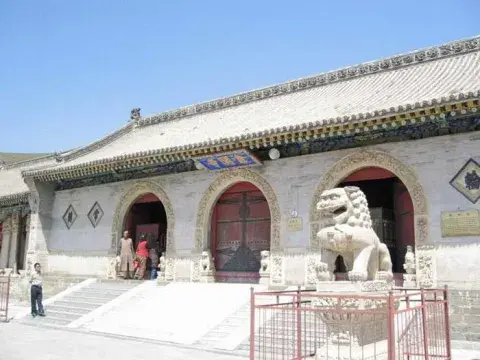
Except the temples of the Mount Wutai, the Jinge Temple is the second highest in the south. The elevation is 1900 meters high and 15km from the Huai town. In 770, the master Sanzang from India was called to the Mount Wutai and he built the Jinge Temple according the place of Wenshu Bodhisattva was in. People use copper as the tiles and then painted gold on tiles. People call it Jinge. The master supervised the process of built the temple. All the emperors in different dynasties showed the respect to the master Sanzang.
The master is one of the main founders. After he left the Mount Wutai, the monk Hanguan often came to the temple and the temple was famous in the world. In the Ming, Qing Dynasty and the Minguo period, the temple was repaired. Now it has more than 160 rooms. The layout of the temple is there are two yards and a palace which toward the south. In front of the temple, there also have Tianwang Palace and two Zhonggu buildings. In the middle of the first yard has a cabinet, and the Thousand arms Guanyin Copper Statue in it. The statue is 17.7 meters high and the Guanyin has 48 arms. This is the largest statue in the Mount Wutai, it was made by mud outside and then painted gold. The statues of a boy and a girl stand beside the Guanyin Statue. The boy hold a sword in his hand, in a legend the boy and the girl are the parents of the Guanyin. There are 24 statues in the walls of the temple, people call them “24 Zhutian.” A ancient legend in India said that 20 gods to beat the evils and protect goodness people, in Buddhism people call the 20 gods “20 Zhutian.” When the legend spread to China, people added another four gods and changed into “24 Zhutian.” In the southwest corner, there is another statue of the Tangdai Zong Emperor (Li Yu).
The cabinet has two relics of stone pillars. In front of the Jinge temple have two stone monuments of the Jiajing year 36 and 37. Also has a stone monument of the Minguo period year 24. The mark of monuments has the details about the history of the Jinge Temple and how to build the Guanyin Statue. In the north of the first yard have a row of dormitories for monks and in the upstairs have all kinds of palaces. The design of these palaces was complicated, and the Yuhuang Palace and the Sanhuang Palace are most interesting. The Yuhuang is the most powerful god in Taoism, also called Yudi. The Sanhuang means three emperors. It includes Fuxi Shi, Zuiren Shi and Shennong Shi. The three emperors also called Tianhuang, Dihuang and Renhuang.
Qixian Temple
Qixian Temple is in the Dashe Village of Mount Wutai. The temple in the Dashe Village was called Dashe Temple. During the years of the Beisong Dynasty, the seven son of Ganeral Yang killed the third son Pan Bao of Prime Minister Pan Renmei. The Pans regarded the Yangs as the biggest enemy....
Qixian Temple is in the Dashe Village of Mount Wutai. The temple in the Dashe Village was called Dashe Temple. During the years of the Beisong Dynasty, the seven son of Ganeral Yang killed the third son Pan Bao of Prime Minister Pan Renmei. The Pans regarded the Yangs as the biggest enemy. They accused the Yangs in front of the emperor. The emperor punished the Yangs by disposing their positions and sending them to Mount Wutai for house arrest. In the next autumn, the Liao Kingdom invaded the Song’s territory. The emperor followed Pan Renmei’s suggestions, led the troops to fight with the enemy and was trapped in Youzhou. Under that circumstance, the Emperor Taizong had no choice but to resume positions of General Yang and his sons. His eighth younger brother went to Mount Wutai and asked the Yangs for help. When the Yangs left Dashe Village, villagers renamed the Dashe Temple as Qixian Temple in the Yangs’ honor. In the central palace of the Qixian Temple, there is a bronze beef statue, which is one metre high and two metres long. It is one of the top ten attractions in the Mount Wutai. In the Tianwang Palace, there is a wooden tower with eight straight-angles and thirteen floors. The tower is nine metres high. It is the only wooden tower in the Mount Wutai. In the back of the palace, there is a biggest bull feather drum in the Mount Wutai. The drum’s diameter is one and a half metres. The width of the drum is 1.67 metres.
Bodhisattva Ding
Bodhisattva Ding is located in the north of the Xiantong Temple. You will see the stairs are very steep and direct to the top of the Bodhisattva. In a legend, the Wenshu Bodhisattva lived in the top of the mountain. So people call it Bodhisattva Ding or the Wenshu Temple....
Bodhisattva Ding is located in the north of the Xiantong Temple. You will see the stairs are very steep and direct to the top of the Bodhisattva. In a legend, the Wenshu Bodhisattva lived in the top of the mountain. So people call it Bodhisattva Ding or the Wenshu Temple. The Wenshu Temple was built in the Beiwei period and named Qingmiao. In the Shunzhi period of the Qing Dynasty, after expanded and repaired, changed into Huang Temple and controlled by Lama. The temple is large and covers an area of 45 Mu, it has more than 430 rooms and all were built in the Qing Dynasty. According to the royal palaces, they used three color tiles and green bricks. It looks luxury and the top of all the temples in the Mount Wutai. The temple has 108 stairs and it suggested 108 countries of Shanxi province. Other people said that it means 108 kinds of worries and people tread the worries underfoot can see the appearance of Bodhisattva. There is a wood building in the Bodhisattva Ding and a brand “Lingfeng Sheng Jing” hangs on the building. People said it was written by the Kangxi Emperor. The temple has two brands, one is the Kangxi Emperor’s and another is the Qianlong Emperor’s. The brand from the Qianglong Emperor was made by white marble and craved words in Han, Man, Men, Zang four kinds of words. It is symbolized the unity of the nationality. Visitors come here will see the green mountains and trees and will have a solemn feeling. There are three large pots. The largest one is 2 meters wide and 1 meters depth. People use the pots each year in the past. People use it to celebrate the date which the Sakya became god. In that day, people use millet, mung bean, red dates, rice and walnuts, also include brown sugar to make Rice pudding and sent it to many people.
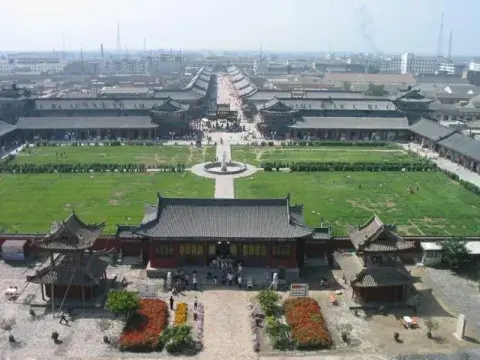
Nancy' s Private Datong Tour
This is the private tour in Datong. I show some pictures I took in 2012.