Zhanshan Temple, Qingdao
Zhanshan Temple (English: Zhan Shan Temple; pinyin: Zhànshān Sì; German: Dschanschan Tempel) is a Buddhist temple in Qingdao, Shandong, China. It is located on the southern side of Zhanshan (literally 'clear' or 'deep mountain'), Facing the sea
The monastery was built in 1945 and is ...
Zhanshan Temple (English: Zhan Shan Temple; pinyin: Zhànshān Sì; German: Dschanschan Tempel) is a Buddhist temple in Qingdao, Shandong, China. It is located on the southern side of Zhanshan (literally 'clear' or 'deep mountain'), Facing the sea
The monastery was built in 1945 and is an active, functional Buddhist sanctuary. Apart from the Stupa and the Olympic Mascot Bell Tower, located on the right-hand side of the grounds, the remaining buildings are situated in a square format. To the right Of the entry portal is one of the several Buddhist scripture shops. Here, incense sticks and other Buddhist supplies are available for purchase. Adjacent the scripture shop is a Bell Tower (zhonglou; bell tower) with the first of many statues of Buddha. Right of the entry is the Drum Tower (gulou)
Returning to the central path, directly ahead of the Heavenly King Hall (tianwang dian; king of the temple). The large Buddha, which is the focal point of this shrine, is flanked by four large statues, one depicting a pipa player. Directly behind Heavenly King of the largest Hall of Sakyamuni, which honors the founder of Buddhism, the son of a king of the Sakya clan of the Kshatriya (ie, warriors). His given name was Siddhartha, his family name, Gautama. The Epithet "Sakyamuni" means "sage of the Sakyas." In this magnificent hall, a large, central Buddha is flanked by two smaller statues, each attended by eight priests. This hall is an active place of prayer equipped with cushions for kneeling, candles For lighting incense, and other Buddhist prayer supplies.
Behind the Hall of Sakyamuni is the Hall of Three Saints (san sheng dian; three sanctuaries). In the center of the hall are three large, gilded statues, each about twelve feet in height.
Continuing along the central path, the next building is the Preaching Hall (shengtang; church), where, behind a long, gilded Altar, a gilded, bejeweled statue of Buddha stretches out almost twenty feet in length
Opposite the Hall of the Recumbent Buddha is the Shandong Zhanshan Buddhist College (Shandong Zhanshan Fo xue yuan). To the right of the Hall of the Recumbent Buddha is the headquarters of the Qingdao Buddhist Association, Tiantai sect, (Qingdao) The following is from the top of this bell tower is panoramic; however, there is an additional fee of () 10 yuan to see that view.
The 8 April of the lunar calendar is tradimate as the birthday of the Buddha. On that day, thousands of Buddhists flock to the monastery grounds to attend religious events.
In 2004 June, the renovation remains in progress.
Qingdao International Sailing Centre
The Qingdao International Sailing Centre is a sailing marina located on the former site of the Beihai Shipyard by Qingdao's Fushan Bay at Shandong Province in China. It was constructed for the 2008 Summer Olympics. It hosted the Olympic and Paralympic Sailing competitions. Wind conditions v...
The Qingdao International Sailing Centre is a sailing marina located on the former site of the Beihai Shipyard by Qingdao's Fushan Bay at Shandong Province in China. It was constructed for the 2008 Summer Olympics. It hosted the Olympic and Paralympic Sailing competitions. Wind conditions vary greatly from very light winds to +15knots. During the Olympic competitions, fog was also an occasional factor.
Great Wall of Qi
The Great Wall of Qi is the oldest existing Great Wall in China. Construction of the wall started in 685 BC by the state of Qi, to defend itself against an invasion by the Kingdom of Chu. The existing sections date back to 500 BC. Construction ended during the Warring States period. The wal...
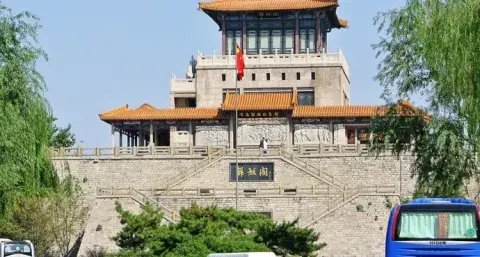
The Great Wall of Qi is the oldest existing Great Wall in China. Construction of the wall started in 685 BC by the state of Qi, to defend itself against an invasion by the Kingdom of Chu. The existing sections date back to 500 BC. Construction ended during the Warring States period. The wall stretches from the areas under the administration of the present-day city of Jinan to the present-day city of Qingdao across the territories of the present-day cities of Tai'an, Zibo, Laiwu, Weifang, Linyi, and Rizhao. Its total length has been estimated at about 600 kilometers.
St. Michael's Cathedral, Qingdao
St. Michael's Cathedral, also called the Zhejiang Road Catholic Church, is a Catholic church in Qingdao, Shandong Province, China and is the seat of the Bishop of the Roman Catholic Diocese of Qingdao. It is located in the oldest part of Qingdao, at 15 Zhejiang Road, on the east side of Zho...
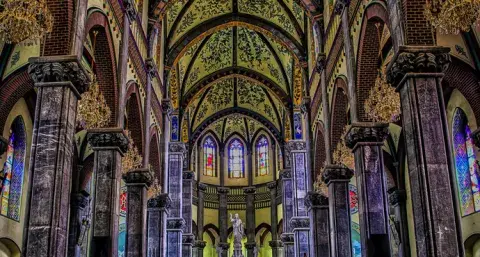
St. Michael's Cathedral, also called the Zhejiang Road Catholic Church, is a Catholic church in Qingdao, Shandong Province, China and is the seat of the Bishop of the Roman Catholic Diocese of Qingdao. It is located in the oldest part of Qingdao, at 15 Zhejiang Road, on the east side of Zhongshan Road in Shinan District. Built by German missionaries, the cathedral stands at the top of a hill in the center of the old German-built part of the city. It is the largest example of Romanesque Revival architecture in the province, resembling a German cathedral of the 12th century.
Jiaozhou Bay Bridge
Jiaozhou Bay Bridge is a 26.7 km long roadway bridge in eastern China's Shandong province, which is part of the 41.58 km Jiaozhou Bay Connection Project. As of December 2012, Guinness World Records lists the Jiaozhou Bay Bridge as the world's longest bridge over water at 41.58 km.
...
Jiaozhou Bay Bridge is a 26.7 km long roadway bridge in eastern China's Shandong province, which is part of the 41.58 km Jiaozhou Bay Connection Project. As of December 2012, Guinness World Records lists the Jiaozhou Bay Bridge as the world's longest bridge over water at 41.58 km.
Length: 87,621 feet (26,707 m)
Width: 115 feet (35 m)
Clearance below: 133 feet (40.50 m)
Longest span: 853 feet (260 m)
Height: 489 feet (149 m) (Architectural)
Qingdao Aquarium
The Qingdao Aquarium also known as the Qingdao Underwater World is the oldest public aquarium in China. It is located in the city of Qingdao, Shandong Province. The aquarium originated from an initiative launched by the educator Cai Yuanpei in 1930 and was first opened to the public on May 8, 193...
The Qingdao Aquarium also known as the Qingdao Underwater World is the oldest public aquarium in China. It is located in the city of Qingdao, Shandong Province. The aquarium originated from an initiative launched by the educator Cai Yuanpei in 1930 and was first opened to the public on May 8, 1932. As of 2013, the aquarium consists of four main exhibition halls that are connected by tunnels and provides nearly 10,000 square meters of total exhibition area. The Qingdao Aquarium has been listed as a major historical and cultural sites protected by Shandong Province since 2006 (site number 3-267). It is located right on shore of the Yellow Sea's Huiquan Bay , next to the "No. 1 Bathing Beach" in the Shinan District of Qingdao.
The aquarium, opening from 8:30 am to 5 pm, consists of the major aquarium, the sea animal performance museum, the museum of freshwater animals, and the herbarium of marine organisms.