Four Ancient Towers

The four towers, like most of Shenyang’s historical sites, were built around 1643 during the early Qing Dynasty. The towers symbolize the four Buddhist Heaven Kings, and originally marked the borders of the city. The four towers, aptly named “North Tower”, “Sou...
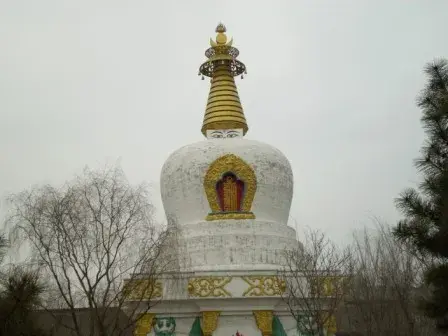
The four towers, like most of Shenyang’s historical sites, were built around 1643 during the early Qing Dynasty. The towers symbolize the four Buddhist Heaven Kings, and originally marked the borders of the city. The four towers, aptly named “North Tower”, “South Tower”, “East Tower”, and “West Tower”, do in fact appear quite similar to each other. The towers themselves are white, bulb-shaped structures, with gold decoration on the top. Each one is surrounded by a small Buddhist temple. Reportedly the North Tower is the best restored and maintained tower. 
 
The towers are pretty unspectacular, so don’t plan a whole day around visiting them. Entrance is free, however, so if you happen to be in the area of one of the towers, they are worth a look. The official operating hours are a bit unclear. The apparently sometimes close a bit early, so it’s best to go in the morning. 
 
Locations: (click on pictures for larger images)
 
North Tower 北塔 běi tǎ:
  
Useful Bus Routes:
131 to/from Beiling Park East Gate, Shenyang University
213 to/from Beiling Park, Orthopedic Hospital, Middle Street, Imperial Palace, Wu Ai Market, South Tower
245 to/from Beiling Park, Orthopedic Hospital, South Tower
 
 
South Tower 南塔 nán tǎ:
South Tower is located in Shenhe District (沈河区) on Wencui Lu (文萃路) just behind Shoe City. 
Useful Bus Routes:
113 to/from Shenyang University
135 to/from Tiexi Square, Heping Square, San Hao Street, Exhibition Center
213 to/from Beiling Park, North Tower, Middle Street, Imperial Palace
239 to/from San Hao Street, Exhibition Center, Heping Square
282 to/from Xi Ta, Fangxing Square, Nanhu Park, San Hao Street, Exhibition Center, Sports Park
286 to/from Summer Palace
  
  
West Tower 西塔 xī tǎ:
The area surrounding the West Tower is known as “Korea Town”, and is home to a large population of Koreans, as well as many Korean bars, restaurants, massage parlors, etc. click for more info on "Korea Town". The tower is at the east end of Shifu Road, at the beginning of Xi Ta Korea street. 
 
 
Useful Bus Routes:
611 to/from South Station, Taiyuan Street, South Tower, Huigong Square
  
  
East Tower 东塔 dōng tǎ:
Located in Da Dong District (大东区) on Chang An Lu (长安路). 
Useful Bus Routes:
237 to/from Wu Ai Market, Ma Lu Wan, Taiyuan Street, South Station, Tiexi Square
 

North Market--Huang Temple

The North Market is comprised of two perpendicular pedestrian-only streets. The market includes an array of food vendors selling meat sticks (肉串, ròu chuàr), dumplings (饺子), baozi (包子), beer, and other goodies. The street is surrounded by several shops, including a jade marke...
The North Market is comprised of two perpendicular pedestrian-only streets. The market includes an array of food vendors selling meat sticks (肉串, ròu chuàr), dumplings (饺子), baozi (包子), beer, and other goodies. The street is surrounded by several shops, including a jade market, while other street merchants sell books, artwork, decorations, and miscellaneous trinkets. 
   
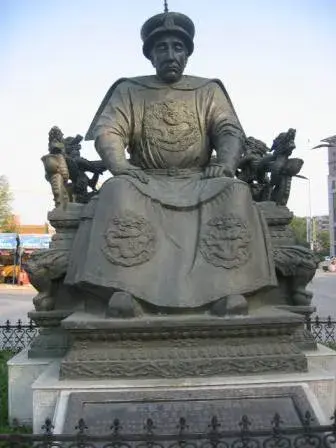
Adjacent to the market is the “True Victory” Temple (实胜寺庙 shí shèng sìmiào). This Buddhist temple was built in 1636 by the second Qing Dynasty emperor, Huang Taiji (皇太极), and is also known by the name “huáng sìmiào” (皇寺庙). The temple houses the cremated remains of a high-ranking Buddhist monk, and sometimes visitors are lucky enough to witness a performance of a traditional ceremonial Buddhist dance. Just outside the temple, there are large stone statues of all 12 Qing Dynasty emperors seated proudly upon their thrones. Entrance to the temple is 15 yuan.
 
 
     (Huang Temple from above)                                  (Emperor Nurhachi, first Qing emperor)

During the New Year’s Holiday and the October Holiday, the area holds a “Temple Fair” (庙会). Each year the area becomes crowded with people buying food, and tying red prayer-ribbons around the trees in the temple. There are also some special performances. The Fair starts about one week before Spring Festival, and lasts for 15 more days afterwards. 
    
Location: The market itself is Huang Si Lu (皇寺路), between San Jing Jie (三经街) and Nanjing Jie (南京街). From Government Square, go one block west on Shi Fu Lu (市府路) and you will see a large stone archway for the entrance.  From Xi Ta, go 1 km east on Shi Fu Lu. All taxi drivers will know "běi shìchǎng". 
 
 
      (Huang Temple from above)                                  (Statues of all Qing Dynasty Emperors)

(Photos by David de Jesus, 2007)    


Zhang Xue Liang's Mansion

Zhang Xue Liang is one of modern China’s most honored figures. He is something of a folk hero in Northeastern China. Born into a powerful warlord family at the e...


History buffs should enjoy the way in which the museum provides an interesting look at the development of northeastern China. Unfortunately, most of the signs have little or no English, so if you can’t read any Chinese you might be a bit bored. 


The museum has three main parts: The old Zhang residence, built in ancient Chinese style, a newer mansion (1930’s) built mimicking ancient Roman design, and another house for one of Zhang Xue Liang’s father’s wives. The buildings themselves are interesting, but the main focus of the museum is on Zhang Xue Liang’s life and accomplishments. 
           
If you enjoy history and can read a bit of Chinese, the museum is worth a visit. Those on the tourist circuit should be able to visit Middle Street, the Imperial Palace, and Zhang’s Mansion all in one day. 
     
Location: The Mansion is near Middle Street (中街) just two blocks south of the Imperial Palace. The main entrance is on nán shùn chéng lù (南顺城路). Look for a large statue of Zhang Xue Liang in military uniform. The following buses will take you there: 134, 237, 250, 330, 133, 168. There is another entrance on the east side of the museum on cháo yáng jiē (朝阳街). The following buses stop there:292, 294, 290, 222, 213, 296, 287, 257, 118, 132, 276, 117, 228, 环. The bus stop for both entrances is called dà nán mén (大南门). If you’re asking for directions or taking a taxi, the mansion is commonly known as “dà shuài fǔ”(大帅府). 
 
Offical Website (in Chinese)
   
 
Photos by Jerry Wang, 2007