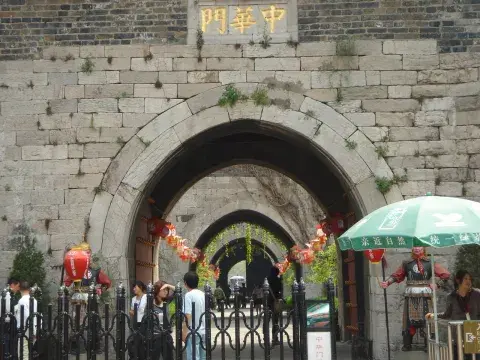
Zhonghua Gate

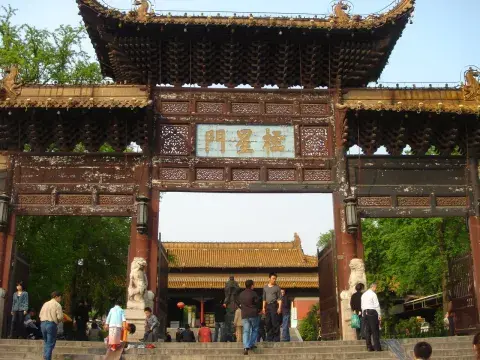
This gate is the Southern gate of the whole city wall, as well as the largest castle gate in the world. The whole city wall is about 33km and took about 20 years to finish it.

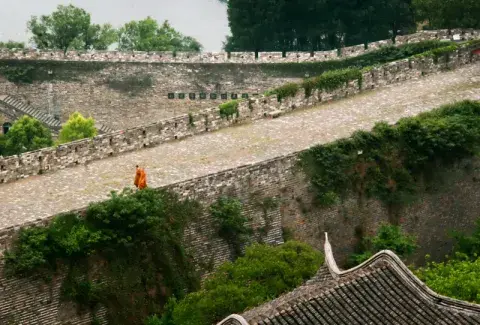
You can walk on the wall or even biking on it, super nice!

More introduction you can see here Nanjing City Wall.

There have many buses there: Y4, 2, 16, 26, 33, 49, 88, 101. And alll the taxi drivers know where it is.

Nanjing Yangtze River Tunnel

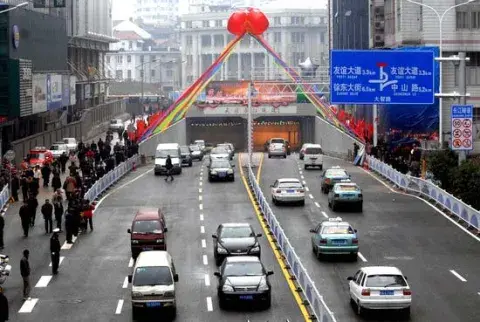
Nanjing Yangtze River Tunnel finally finished, let`s driver there and have a look of this amazing tunnel in Nanjing, which made many generations dream come true, no more traffic jam on Yangtze River Bridge, no more slow ferry, it will only take 5 minutes to cross Yangtze River.

Maybe it will be good to go there by taking the Yangtze River Tunnel, and come back by taking the Yangtze River Bridge, so that will be a lot of fun and to see two sides of Yangtze River in Nanjing.


Nanjing City Wall

Nanjing City Wall, constructed during the Yuan and Ming Dynasties between 1365 and 1386, originally stretched over 30km which made it the longest city wall in the world.  Now, with about two thirds of the wall still intact it still remains the longest city wall in China.  It reaches all...

Nanjing City Wall, constructed during the Yuan and Ming Dynasties between 1365 and 1386, originally stretched over 30km which made it the longest city wall in the world.  Now, with about two thirds of the wall still intact it still remains the longest city wall in China.  It reaches all the way from the North end of Xuanwu Lake to the south-west corner of Purple Mountain.  It snakes along the edge of Qinhuai River and heads back north all the way up to Yuejiang Tower (阅江楼).

 
Touring the Wall
 
Zhonghua Men Fortress (Zhonghua Men Chengbao, 中华门城堡)
 
Zhonghua Men is the most famous and most fortified gate of the wall.  It was constructed with 1000kg vertically sliding doors and contained 27 vaults that could hold thousands of soldiers.  The idea was that if an enemy entered, the doors could be slammed shut. The enemy, trapped inside, would then be ambushed by soldiers inside.  Enemy armies avoided this super-fortified gate in favour of attacking Nanjing via weaker points along the wall.
 
Zhonghua Men fortress is located across the bridge from Yuhua Lu (雨花路) and about 500 meters east of Zhongshan Nan Lu (中山南路).  There are several buses that stop within view of this gate.
 
For 20 yuan you can climb up to the top of this fortress to get a good view of the city near Qinhuai river.
 
Qinhuai River - A 10 minute walk east of Zhonghuamen
 
West of Zhonghua Men Fortress
 
About 2 blocks to the west of Zhonghua Men Fortress, there is an entrance to the top of the wall that goes almost unnoticed.  There is no entrance fee here and the gate seems to always be open.  Perhaps the scattering of construction materials on top are an indication of more development to come.  However, this location is not considered to be very safe since there have been robberies here.
 
This part of the wall runs along Xigan Chang Xiang (西干长巷).  One the south side of the wall to see the Qinhuai River and the road below. On the other side is old-style housing and factories and Xinjiekou in the distance.
 
 
To get to this portion of the wall, you must enter from the east corner.  To get there from Zhonghua Men, first walk (bike, skip, whatever) towards the river, follow the road to the west and cross under the bridge.  There are signs prohibiting bicycles from entering this road but they are the type of signs that nobody really pays attention to, including the guards.  Once you get to the east corner, follow the stairs on the North side of the road up to the entrance.
 
There is also an entrance to Xigan Chang Xiang on the west end just off of Fengtai Lu (风台路).  If you come from this direction, it would be about a ten minute walk to the east corner.
 
Jiefang Men
Admission fee: 15 yuan.
 
Jiefang Gate is located on the south side of Xuanwu Lake and just north of Jiming Temple (Jiming Si, 鸡鸣寺).  This small gate is another point where it is possible to walk on top of the wall.
 
Walking upwards from the entrance point leads to a small display about the city wall in which there is a model of how the wall and the rest of Nanjing looked in the past.  Walking west leads towards Jiming Temple.  Walking north-west leads towards Xuanwu Men.  Walking east leads towards a store located inside the wall that sells crystal and then Jiuhuashan (九华山), both of which are also entrances to the top of the wall.
 
Xuanwu Men
 
Xuanwu Gate is the most popular entrance to Xuanwu Lake.  You cannot get on top of the wall at this point.  For many people this gate will be the most convenient to reach since it is just one block east of the aptly named Xuanwu Men subway station.
 
The 13 Original Gates
 
Originally there were 13 gates (门, men): 
Taiping Men (太平门)
Chaoyang Men (朝阳门) - Now called Zhongshan Men (中山门)
Zhengyang Men (正阳门) - Now called Guanghua Men (光华门)
Tongji Men (通济门)
Jubao Men (聚宝门) - Now called Zhonghua Men (中华门)
Sanshan Men (三山门) - Now called Shuixi Men (水西门)
Shicheng Men (石城门) - Now called Hanzhong Men (汉中门)
Qingliang Men (清凉门)
Dinghuai Men (定淮门)
Yifeng Men (仪风门) - Now called Jinxing Zhong Men (今兴中门)
Zhongfu Men (钟阜门)
Jinchuan Men (金川门)
Shence Men (神策门) - Now called Heping Men (和平门)
 
Link: Xi’an City Wall
Yuejiang Tower (Yuejiang Lou)

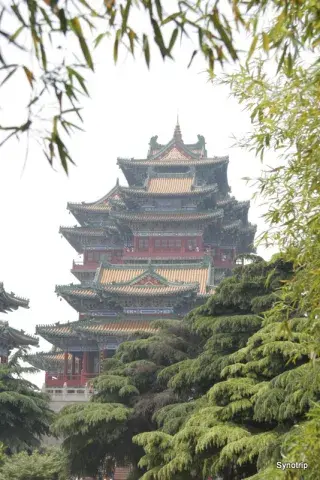
Yuejiang Tower (Yuejiang Lou, 阅江楼) sits on Lion Hill (Shizi Shan, 狮子山) in the northwest part of Nanjing near the banks of the Chang Jiang (Yangzi, Yangtze, 长江) River.  It is one of the best places in Nanjing to enjoy a view of the river.  Inside the 52 meter tower are displays re...
 
History of Yuejiang Tower
 
In 1360, Lion Hill (Shizi Shan, 狮子山) was the site of a battle that helped pave the way for the ascension of the Ming Dynasty.  A force of 80,000 soldiers under the command of emperor-to-be Zhu Yuanzhang defeated the 400,000 strong force of Chen Youliang (陈友谅).  A few years later in 1374,  Zhu Yuanzhang (Emperor Hongwu) decided to build the Yuejiang Tower. He composed a poem about the tower and also ordered many scholars to write about the project.  Unfortunately, the construction was soon suspended indefinitely and Yuejiang Tower existed only on paper for over 600 years.  Construction finally began in 1999 and it was opened to the public in 2001.
 
How to Get There
 
Buses 10, 12, 16, 18, 21, 39, 54 and 95 stop near Yuejiang Tower.  It should cost about 10-15 yuan to take a cab from Hunan Road (湖南路) or 20-25 yuan to take a cab from Xinjiekou (新街口).
 
There are two south-facing entrances on Jianning Road (建宁路).  The entrance to the west is next to cement stairs and an elevator that goes up to the top of the hill.  The entrance on the east allows for a scenic walk to the top of the hill.  The tower itself also has an elevator.
 
View from Yuejiang Tower.  Look closely to see the impressive bridge in the distance.
 
Outside of Yue Jiang Lou
 
Links
 
 
Places to Get a Closer View of Chang Jiang River
  Swallow Rock (Yanzi Ji, 燕子矶)
  Nanjing Chang Jiang Bridge (Nanjing Chang Jiang Daqiao, 南京长江大桥)
  Nanjing 2nd Bridge (南京二桥)
 
www.yuejiangtower.com - No English, but the site does have a few more pictures of the tower.

Rain Flower Terrace (Yu Hua Tai)

Introduction

...

Introduction

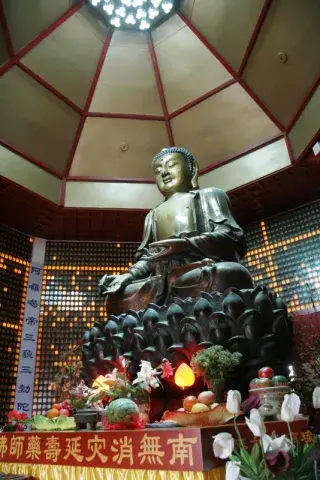
Legend has it that in the 6th century AD, the monk Yun Guang delivered such a powerful sermon that God himself was moved to let flowers rain down upon this area. This story explains how the stones at this site received their unique color and their name, “yu hua shi,” which means rain flower stone.
 
In the 1930s, Yuhua Tai was put to use as an execution ground by the Chinese Nationalist Party.  Thousands of their left-wing opponents were detained and put to death here.  After the revolution the park was converted into a memorial ground. The park includes a museum, statues, tombs, and a great obelisk which can be viewed from afar stretching skyward above the trees.
 
 
Buying Rain Flower Stones
 
The main store for purchasing Rain Flower Stones is located in the eastern part of the park.  The stones vary wildly in price from under 10 yuan to over 1000 yuan.  The stone’s value increases if:
- The stones are more finely grained. 
- The stones look like something.  For example, a pattern that looks similar to a flower would be worth more than one that doesn’t look like anything.
- The colors are particualrly vibrant.
 
Despite these general indications of price, it is impossible for anybody except a true expert to assess the actual value of a Rain Flower Stone.
 
Park Layout
 
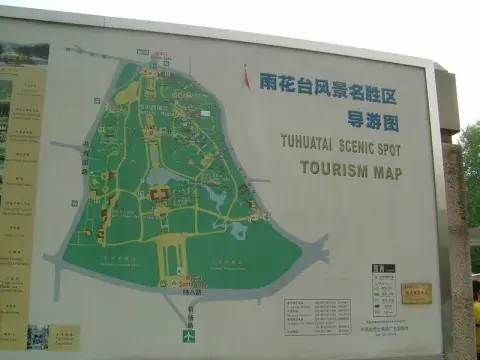
The Martyrs Museum is located near the south entrance of the park.  Directly in front of the north entrance is the Statue of Martyrs.  On the east side is a variety of smaller attractions including the Rain Flower Stone “Museum” (store) and Yuhua Pavilion.  To the west is a small amusement park for children which includes an additional 5 yuan entrance fee.
 
How to Get There
 
Rain Flower Terrace is located along the western edge of Yuhua Dong Lu (雨华东路) and the northern edge of Yuhua Nan Lu (雨花南路). 
 
To reach the north entrance of the park via the subway, get off at Zhonghua Men (中华门) station. Then exit from the south side of the station and walk a couple blocks east along Yuhua Xi Lu (雨花西路).
 
There are many buses that go straight to the south and north entrance of the park.
 
If you were to come by bicycle it is important to note that there are train tracks just north of the park.  If you are coming from the north and do not want to ride in a huge circle, you should carry your bike up a few flights of stairs to cross the bridge next to Zhonghua Men subway station.


Construction
 
New additions to the park are being built in the southeast and southwest corners.  Construction is scheduled to be completed in August.  There is no need to worry as all of the main attractions described above can still be accessed.  Currently, the only inconvenience is that the east entrance of the park is not yet accessible.

Chaotian Palace and Nanjing City Museum

The Nanjing City Museum focuses on Nanjing’s history.  A range of exhibits are featured within the halls of Chaotian Palace.  Since there is a lot of walking to be done outside, it is best to visit when the weather is nice.
 
Most of the general...
The Nanjing City Museum focuses on Nanjing’s history.  A range of exhibits are featured within the halls of Chaotian Palace.  Since there is a lot of walking to be done outside, it is best to visit when the weather is nice.
 
Most of the general signs are in English, but many of the artifact labels are not translated into English.  English speaking tour guides are occasionally available for 60 yuan.
 

Artifacts from the Shipyard

 
From 1405 to 1433 Zheng He (郑和) made seven voyages west of China. These adventurs carried Zheng He and his crew to Southeast Asia, India, and even as far as Africa.  At the time Nanjing was the capital of China’s Ming Dynasty, and Zheng He’s ships were built in Nanjing.  The shipyard has since been excavated, and remains from the ships and the tools used to build them are on display at the museum. It was said to be the only ancient ship building excavation site in China.
 

Six Dynasties Period

 
Located in Dacheng Hall is an exhibit focused on Nanjing during the Six Dynasties period.
 

Exhibition of Nanjing History and Culture

 
This exhibition is worth a look, but it is easy to miss as it is hidden in a building with a relatively insignificant appearance just to the west of Dacheng Hall.  The exhibitions contain information on Nanjing’s history from as early as the time of “Nanjing homo erectus” all the way up to the present.
 

How to Get There

Chaotian Palace is located between Mochou Lu (莫愁路), Jianye Lu (建业路), and Wangfu Street (王府大街).  It is a 10 minute walk west of Zhangfuyuan Subway Station.
 
Remember not to confuse Nanjing City Museum with Nanjing Museum which is a totally different museum.
 

Nanjing Brocade Museum of China

What is Nanjing Brocade?
 
Nanjing brocade is regarded as one of the best forms of silk. It boasts a history of more than 1500 years and was originally formed by a merging of Northern and Southern Chinese technologies.  It is&nbs...