Shiwan Art Ceramic Factory

“World Famous Ceramics-Bring art,culture and love into your home.”

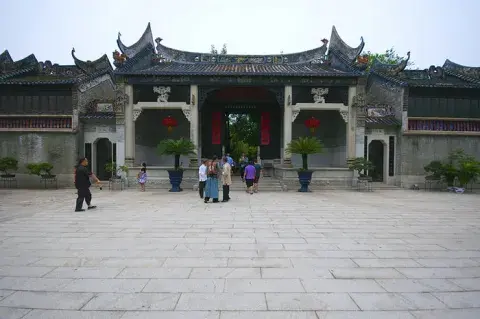
An hour drive from Guangzhou one arrives at Foshan and then the famous Shiwan Ceramics Factory.Foshan is famous for Bruce Lee-Kungfu and of course Ceramics.You need to keep at least four hours aside for this lovely tour. T...

“World Famous Ceramics-Bring art,culture and love into your home.”

An hour drive from Guangzhou one arrives at Foshan and then the famous Shiwan Ceramics Factory.Foshan is famous for Bruce Lee-Kungfu and of course Ceramics.You need to keep at least four hours aside for this lovely tour. The place has a museum full of ancient artifacts from the Tang dynasty all made from wood and porcelain. Seeing Porcelain in so many forms is very enlightening.There is also an old factory which allows one to tour and see how Porcelain was made in olden days - as old as 1000 years. One can see the difference between machine and hand made porcelain which is a super experience.Needless to say one can shop a lot of porcelain decoration items and larger items can also be shipped if required. Small lanes are dotted with shops where craftsmen are busy in their trade, can try your hand at making too. Aviod a sunny day as it can get very hot but a great place to travel, make an hand or a feet impression on wet clay. Great photo opportunities in front of Bruce Lee Statues and the famous three wise men of China(depicting Health, Wealth and Happiness). Do visit this place and you will not regret it.

South China Botanical Garden

The South China Botanical Garden is located about 8 kilometers (about 5 miles) to the north of Guangzhou city and covers 4,500 mu (about 741 acres). Initially built in 1929, it is the oldest and largest South Asian tropical botanical garden in China. It is also the botanical garden containing the...

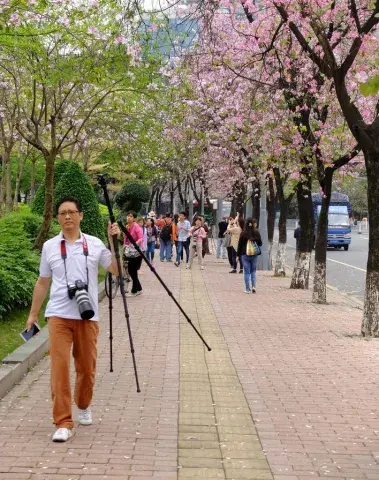
The South China Botanical Garden is located about 8 kilometers (about 5 miles) to the north of Guangzhou city and covers 4,500 mu (about 741 acres). Initially built in 1929, it is the oldest and largest South Asian tropical botanical garden in China. It is also the botanical garden containing the most species in China, thus reputed as 'Tropical and Sub-tropical Botanic Museum'.

The South China Botanical Garden consists of three parts: the Nursery and Exhibition Zone, the Research and the Residential Zone, and the Dinghushan Nature Reserve. In the Nursery and Exhibition Zone there are modern conservatories, an education hall, and about 30 specialized gardens.

The Research and Residential Zone covers 552 mu (about 91 acres). It includes a herbarium with 1,000,000 plant specimens, a library with 200,000 books, and a network center.

Built in 1956, the Dinghushan Nature Reserve is the first nature reserve in China and the only nature reserve of the Chinese Academy of Sciences. It cultivates more than 2,400 types of plants. Additionally, the Dinghushan National Field Research Station of Forest Ecosystem is located here.

Attraction Sites

'Long Dong Magic Forest' is one of the most representative sites inside and was chosen as one of 'Eight Top Scenic Spots in Guangzhou' in 1986. It consists of two peninsulas and one man-made lake. Being one of the peninsulas, the Palm Garden is green all year round while the Relic Garden, the other peninsulas, has four distinctive seasons like a changing picture.

'Guangzhou's Oldest Village' has been rebuilt on Neolithic age ruins, which were the birthplace of the people of Guangzhou. There is a square, ruins appreciation and protection sites, sculptures, reproductions of a primitive village, an archeological site, and History and Culture Exhibition Halls. Visitors may make pottery, experience slash-and-burn cultivation, and relax in 'tree houses' in order to experience life in primitive times.

Covering an area of 1,000 square meters (about 10,764 square feet), South China Botanical Garden Conservatory is the largest comprehensive conservatory for research, education and tourism in Asia presently. It showcases rainforest plants, desert plants, alpine plants, and exotic and rare plants. This conservatory is in the shape of a kapok tree, whose flower is Guangzhou's city flower. The main conservatory and another three conservatories are flowers and the man-made rivers are branches and leaves.

The Science Education and Information Center is divided into four areas to display knowledge concerning plants. They are 'Time Tunnel', 'Plants and Human Beings', 'Botanical Ecology' and 'Botanical Resource Protection and Sustainable Utilization'. With the use of real objects, models, pictures, and videos, the exhibition aims to create an immersed scene. It is especially suitable for primary and high school students.

Specialty gardens such as the lily magnolia garden, the palm garden, and the ginger garden are constructed according to botanical species, their ecological characteristics, and function. There is also a hall for a history and culture exhibition, an area for education, and an area for eminent persons to plant trees.

The South China Botanical Garden also includes entertainment places such as a paintball club, a fishing club, and some restaurants.

Baishui Village (White Water Village)

Noted for the Baishui Fairy Waterfall, the highest in China, Guangzhou Baishui Village (White Water Village) is situated in Paitan Town, Zengcheng District of Guangzhou, and 44 miles (70 kilometers) from the city center. The whole area is surrounded by the Southern Kun Mountain in the east and Co...

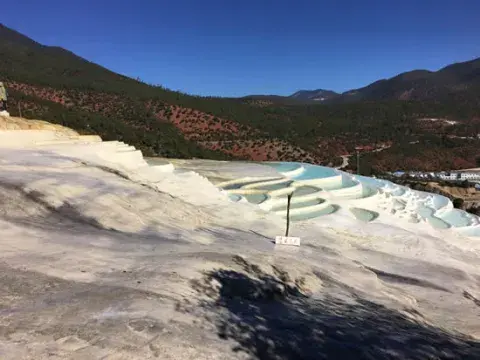
Noted for the Baishui Fairy Waterfall, the highest in China, Guangzhou Baishui Village (White Water Village) is situated in Paitan Town, Zengcheng District of Guangzhou, and 44 miles (70 kilometers) from the city center. The whole area is surrounded by the Southern Kun Mountain in the east and Conghua Hot Spring Town in the west. The village consists of several mountains, and the main peak is 2,700 feet (828 meters) high. Now it is a scenic area of provincial level which covers an area of about 66 square miles (170 square kilometers). Baishui Villages’ chief feature is its beautiful waterfall, and because the Tropic of Cancer goes through the scenic area, it is also famed as “a magnificent jade on the Tropic of Cancer”.

There is no doubt that Baishui Fairy Waterfall is the most famous site in the scenic area. Its fall reaches 1,400 feet (428.5 meters). The charm of the waterfall can be perceived from quite a distance. Tourist can catch sight of it on the way to Baishui Village, along the Zengpai Road (from Zengcheng to Paitan).

The pure white waterfall is divided into three sections with different shapes and features from the top to the bottom. The upper section looks like a dragon dancing in the air; the middle one is like a huge silk curtain hanging on the mountains; while the lowest one looks like thousands of white pearls scattered in the green woods. Though each of them has its own characteristics, together they form a spectacular waterfall. Just as Li Bai (a famous poet in Tang Dynasty (618-907)) wrote in his poem “Cataract on Mount Lu”, in which he says “The water runs down from three thousand feet high, just like the Milky Way dropping down the sky.”

From a nearer viewpoint, the waterfall looks like a beautiful fairy who stands gracefully, dancing gently in the wind. A legend goes that this graceful waterfall is the incarnation of the woman immortal, He Xiangu (a member of Eight Immortals in the Chinese traditional culture). According to the local people, He Xiangu’s home was located next to Paitan Town; and it was in this beautiful place that she became an immortal. Because of the legend, as well as the beautiful and elegant shape of the waterfall, it came to be known as Baishui Fairy Waterfall.

Tourists have two routes to choose from when they arrive at the foot of the hill. If one enjoys mountain climbing, he can choose the First Stair; if he wants to be close to the water he should choose the Plank Road.

The First Stair is build along the Baishui Fairy Waterfall from the bottom to the mountaintop. It is the longest mountain path in Guangdong Province, having altogether 9,999 stairs, with the total length of 4.1 miles (6.6 kilometers). The path stretches over three mountains and bonds two heaven lakes (lakes that located in the high mountain). It includes six parts, respectively named Xunxian (journey to fairyland), Yijing (pleasant mood in beautiful nature), Zhinan (realize the difficulty and still have tenacity), Lansheng (enjoy the beauty in the mountains), Yongshi (men of courage and ambition), and Dengfeng (stand on the mountaintop). Along the path, tourists have the chance to enjoy the green mountains and waters.

Close to the First Stair, there are several stages at different altitude for tourists to view the waterfall from different points of view. The first stage is on the 1,499th stair, Puming Stage, which means that one can hear the sound of the waterfall falling down. The second, Qinpu stage is on the 2,199th stair. On this stage, one will have the chance to touch the waterfall with his own hands. Besides, it is high enough to view the mountains in the distance. The third stage, Mupu Stage is on the 3,299th stair, where one can “take a shower” in the waterfall mist in zero distance. At that time, surrounded by the cold mist of the waterfall and breathing the fresh air, it’s really enjoyable experience.

Continuing the climb, going through the Immortal Gully, one will reach the headstream of the waterfall - Xiangu Heavenly Lake and another lake - Seven Fairies Lake. With a total volume of 41.5 million barrels (4.8 million cubic meters), they are like two green gems set in the mountains, clear and sparkling. The 9,999th stair is the zenith of the path. It is said that if lovers climb to the 9,999th together, their love would be forever.

Instead of the First Stair, one can choose the Plank Road. Every plank in the Plank Road is made of ship wood. It complies with the ups and downs of the mountains. On the Plank Road, tourists will have the chance to be close to the waterfall and streams, and see other beautiful scenery. There are Magical Water Valley, the Tree House and Huixian Bridge on this road. Also, along the Plank Road, one can go to the 1,499th stair, Puming Stage too. If following a path on the cliff, one can even reach to 2,199th stair, Qinpu Stage. What’s more, all years round there are different flowers blossoming in the mountains in a riot of colors.

Tips and cautions:
1. Pay attention to personal safety when you are close to the water and taking photos.
2. Be sure your energy and physical strength are sufficient if you want to climb to the mountaintop.
3. There are tourist buses in the village. It can take you from the foot of the mountain to the 899th stair for CNY 20 for single pass each person.