
Batticaloa

The magnificent beaches of Pasikuda and Kalkuda flank Batticaloa as two beautiful consorts protecting a dowager queen. Batticaloa is situated in the east coast of Sri Lanka with a great lagoon and a beach. On moonlit nights a melodious sound emanated from the picturesque lagoon is attributed to i...

The magnificent beaches of Pasikuda and Kalkuda flank Batticaloa as two beautiful consorts protecting a dowager queen. Batticaloa is situated in the east coast of Sri Lanka with a great lagoon and a beach. On moonlit nights a melodious sound emanated from the picturesque lagoon is attributed to its singing fish.Fascinating facets of culture include the small community of descendents of Portuguese soldiers who still cling on to a fast vanishing dialect of Creole Portuguese that is said to be similar to Medieval Portuguese. The curved coves of the beach of Pasikuda resembles the shiny edge of a serrated sickle.


The white sand is composed of granules so fine, it gives you the sensation of walking on a warm wooly surface.The longer, darker hued Kalkuda Bay is one of those whimsical picture perfect scenes with sailing boats, coconut palms and azure water that tells you “come wade in” with a naughty wink.Pasikuda, Kalkuda and Baticaloa offer safe swimming and snorkeling with clean beaches. The small number of visitors makes keeping them clean a given, which you will find out when you travel to Sri Lanka.The Dutch made their first footstep in Sri Lanka here in 1602. The Dutch fort built in 1665 near the Batticoloa Lagoon houses government offices at present. The 6m thick walls of the fort now encloses the government offices still referred to as the “Kachcheri” a Dutch word that has been corrupted in pronunciation denoting an office of some sort. Excavations on the site of the Dutch fort have found evidence of a Buddhist Stupa and Shatra traced to 1st century BC.


The ancient edifices of St Joseph’s Convent, St Michael’s College compete for attention with the Methodist Church built in 1838.The Hindu temple of Anipandi Sitivigniswara Alayar with its ornate tower entrance is the most impressive of the Hindu shrines.The descendants of the Portuguese and other foreign mercenaries who speak Creole Portuguese are today carpenters, barbers and fisherman assimilated. They have intermarried yet have preserved such customs as celebrating Christmas and dancing the Kafringa and carry names such as De Lima, Ragel, Barthelot, Andrado and Sela. Kafringa is a type of music that is cherished by the Portuguese descendants of Batticaloa quite popular with many in Sri Lanka with its strange combination of la bamba and calypso. You will hear it often at dinner time at some of the Sri Lanka beach hotels. The bands in the luxury hotels of Sri Lanka will play Kafringa if requested. Baticaloa is definitely worth a visit during your Sri Lanka tour.
Heritage

Heritage

With a history expanding over 3000years, Sri Lanka holds some of world’s ancient cities including Anuradhapura, Polonnaruwa and Digamadulla; their once glorious townships, palaces, temples, monasteries, hospitals and theaters intricately carved and modeled out of stone lay...

Heritage

With a history expanding over 3000years, Sri Lanka holds some of world’s ancient cities including Anuradhapura, Polonnaruwa and Digamadulla; their once glorious townships, palaces, temples, monasteries, hospitals and theaters intricately carved and modeled out of stone lay and abandoned and forgotten with time amidst the soaring jungles. 

Of all the ancient cities of Lanka, the most famed and most exquisite is the Kingdom of Anuradhapura. Sri Lanka’s third and the longest serving capital and one of the oldest continuously inhabited cities in the world is also one of the most sacred cities of World Buddhists. It was the capital of Sri Lanka from the Fourth Century BC up to the turn of the eleventh Century and was one of the most stable and durable centers of political power and urban life in South Asia.

Sigiriya, a fifth century AD fortress and a water garden displays some of the most futuristic elements of landscaping and some of the oldest murals recorded in the country.

Polonnaruwa, the second most ancient kingdom of the country boasts of Irrigation systems that are far superior to those of the and they still provide irrigation water to the farmers in and around Polonnaruwa.Digamadulla, the Eastern kingdom of Sri Lanka was the agricultural and spiritual capital of the country during the Anuradhapura kingdom.

Sri Lanka’s last kingdom the Kingdome of Kandy is a testament to the Sri Lankan’s ability to pick up and rise from ashes. After being burned and ravaged more than thrice by the invading Portuguese the Kandyan Kingdom still holds beautifully carved and built houses, palaces and temple preserved for nearly 500 years.

Sri Lanka Rising

Sri Lanka Rising

With the end of the three decade long war Sri Lanka is seeing a sudden burst in infrastructure development and a of a new Sri Lanka rising.

Today post-war Sri Lanka is seeing a rapid and wide spread infrastructure development within rural and urban areas as never seen...

Sri Lanka Rising

With the end of the three decade long war Sri Lanka is seeing a sudden burst in infrastructure development and a of a new Sri Lanka rising.

Today post-war Sri Lanka is seeing a rapid and wide spread infrastructure development within rural and urban areas as never seen in the country before.

The island-wide road development program is at the center of this effort.

The improved connectivity enabled by road development, particularly rural roads, generates significant economic and social returns. It is having a transformative impact on the lives of people around the country. The completion of the highway network (commencing with the Southern Highway, Katunayake Expressway and Colombo Ring Road) will bring about significant cost-savings that will boost the competitiveness of the economy.

The rural electrification program has now extended power to 91% of the country’s households. It is bringing considerable benefits, particularly to poor and vulnerable households (not least through the improved environment for children’s studies). The completion of the much delayed Norochcholai coal power station has helped to avoid power cuts or recourse to hiring exceedingly expensive barges for thermal generation.

The rehabilitation of the railway network and rolling stock, combined with the road development, will increase mobility and help to contain transport costs which are an important determinant of an economy’s competitiveness.

Port and airport development is also creating the potential for Sri Lanka to become a key transport and tourist/transit hub for Asia. The completion of the Hambantota Port and the Colombo Southport Expansion will increase the capacity to take advantage of the country’s strategic location on the major international shipping lanes.

Muthurajawela Wetland

Muthurajawela Wetland :  is a marshy land situated in north of Colombo in the Negombo lagoon. There are many variates of flora and fauna which are interdependant in this coastal ecosystem. The meaning can be translated in to English simply as “Swamp of Royal Treasure”. Treasures of kings in ...

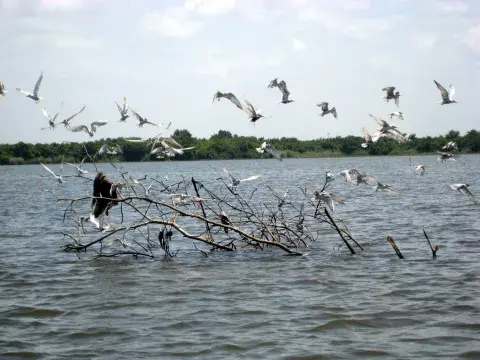
Muthurajawela Wetland :  is a marshy land situated in north of Colombo in the Negombo lagoon. There are many variates of flora and fauna which are interdependant in this coastal ecosystem. The meaning can be translated in to English simply as “Swamp of Royal Treasure”. Treasures of kings in olden days are believed to be buried in that area. Muthurajawela Marsh is said to be the island’s largest saline peat bog. It is believed to have originated about 7000 years ago. There are some residuals which extend up to 500 years towards the history from now. Muthurajawela bears staggering species of flora and fauna. Numerically 192 flora and 209 fauna, excluding 102 species of birds have been discovered. Some indigenous floras and faunas have also been found in Muthurajawela marsh. Visitors may see water birds such as herons, egrets in abundance in the lagoon and the marsh. It is also a residence for 40 different species of fish, of which 15 falls under the category of indigenous fauna. The nocturnal animal, slender Loris, which is believed to be endangered, can be seen once in a blue moon.