The House of Virgin Mary

The House of Virgin Mary

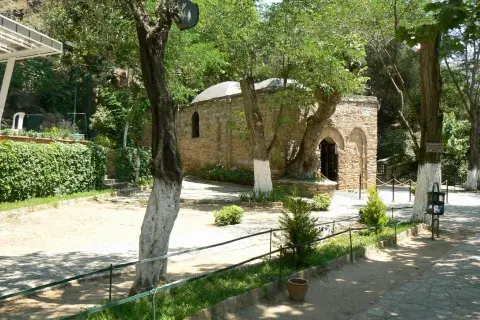
Located on the top of the "Bulbul" mountain 9 km from Ephesus, the shrine of the Virgin Mary enjoys a marvelous atmosphere hidden in the green. It is the place where Mary may have spent her last days. Indeed, she may hav...

The House of Virgin Mary

Located on the top of the "Bulbul" mountain 9 km from Ephesus, the shrine of the Virgin Mary enjoys a marvelous atmosphere hidden in the green. It is the place where Mary may have spent her last days. Indeed, she may have come in the area together with Saint John, who spent several years at Ephesus to spread Christianity. Mary preferred this remote place rather than living in the crowded town.

The house is a typical Roman architectural example, entirely made of stones. In the 4th century AD, a church, combining her house and grave, was built. The original two-story house consisted of an anteroom (where today candles are lit), bedroom and praying room (Christian church area) and a room with a fireplace (chapel for Muslims). A front kitchen fell into ruins and was restored in the 1940's. Today, only the central part and a room on the right of the altar are open to visitors. From there one can understand that this building looks more like a church than a house. Another interesting find is the "Water of Mary", a well source to be found at the exit of the church area and where a rather salty water, with curative properties, can be drunk by all.

Paul VI was the first pope to visit this place in the 1960's. Later, in the 1980's, during his visit, Pope John-Paul II declared the Shrine of theVirgin Mary as a pilgrimage place for Christians. It is also visited by Muslims who recognize Mary as the mother of one of their prophets. Every year, on August 15th a ceremony is organized to commemorate Mary's Assumption

Temple of Artemis

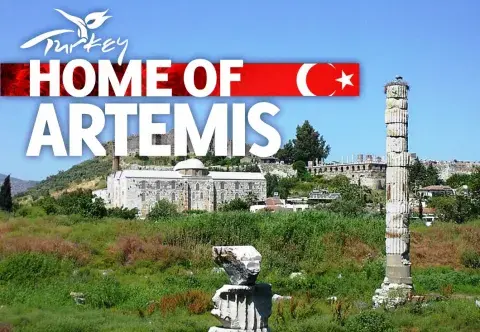
The temple of Artemision is known as one of the Seven Wonders of the Ancient world. It had been built in the vicinity of Ephesus on a flat area which has over the centuries turned into a swamp. Today one can only see the ruins of the foun...

The temple of Artemision is known as one of the Seven Wonders of the Ancient world. It had been built in the vicinity of Ephesus on a flat area which has over the centuries turned into a swamp. Today one can only see the ruins of the foundations of this marvelous construction of the Hellenistic Age, entirely made of marble and full of sculptured columns, capitals and shafts. The most beautiful remains of this temple are today exhibited in the London British Museum.


The oldest remains found date back to the 6th century BC. The structure originally consisted of 36 huge columns, later enlarged upon from the orders of the Lydian King, Kreisos, during the 6th century BC. Most of the exhibits in the London British Museum belong to this period.


A new Artemision was rebuilt in the 2nd century BC. Located on top of the previous one, it had tremendous dimensions: 125 columns each 17,5 meters high. Unfortunately this one was also destroyed by fire, reconstructed and again demolished by earthquakes, rebuilt and at last looted by Goths one year later.


The statue of the many-breasted Artemision was the symbol of the temple but also of abundance, hunting and wild life. The genuine statue of Artemision, removed during the fire, is today exhibited in the Selcuk Museum. Many copies of this statue were found during the latest excavations and date back to the Roman period. 


Aphrodisias was changed to Stayropolis and then to Caria which became Geyre years after. The ruins which are worth seeing inAphrodisias are listed below:


When the Greeks first arrived under the leadership of Androklos, Kybele (Rhea) was the major deity in all of Anatolia. The Greeks introduced the worship of Artemis and later Artemis and Kybele eventually became the same goddess. Artemis is the goddess of hunting, wild animals, childbirth, and nature.


According to the famous historian Strabon, the Temple of Artemis was built and destroyed seven times. It was always rebuilt on the same site. Some of the different architects were Theodoros from Samos, Chersiphon and his son Metagenes from Knossos of Crete, and Dinocrates.

The temple foundations date back to the 7th century BC. At first, it was a small shrine to Kybele. In around 550 BC Cretan Chersiphon, a Greek architect, designed the final temple. This initial building was sponsored by the Lydian king Croesus.

Seven Sleepers

Seven Sleepers 0f Ephesus
Located on the northern slopes of Mount Pion, near Ephesus, The Grotto of Seven Sleepers has been discovered by both Christians and Muslims with a growing interest. According to the Chris...
Seven Sleepers 0f Ephesus
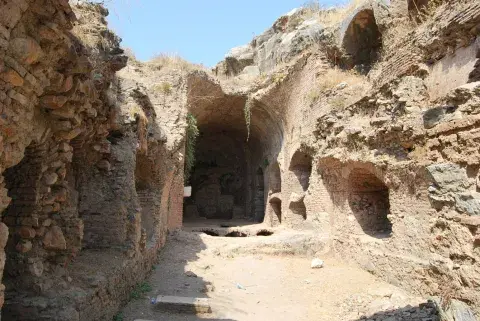
Located on the northern slopes of Mount Pion, near Ephesus, The Grotto of Seven Sleepers has been discovered by both Christians and Muslims with a growing interest. According to the Christian legend seven young men were walled in during the reign of Decius (250) and yet were seen alive in the streets of Ephesus during the reign of Theodosius II some years after the Council of Ephesus (431). In the Koran, it is claimed that the sleepers slept 309 years in their tombs. 
 
During excavations in the area, the church and several tombs have been discovered. Some inscriptions of the Seven Sleepers have been discovered on the walls of the church.  

This cave is located to the east of Mount Pion and is an important site to the world of Christianity. In the  year 250AD seven Christian youths fled the city of Ephesus to avoid persecution and took refuge in this cave. They slept for two hundred years here. When they awoke after two hundred years they saw that Christianity was now the official religion. When the youths died it is believed they were buried in the same cave and a church was built at the site.


It is thought that the Christians  were in a dispute with the Roman state over the subject of an imperial cult where they refused to sacrifice animals at an imperial temple. The young men fled to a cave and after a while they fell asleep and when they woke up they went to city to buy food. To their amazement, they found out that they had slept not for one night but for two hundred years, and that Christianity had spread to every corner of the Roman Empire. When Emperor Theodosius II heard of the incident, he accepted it as evidence of resurrection which was being discussed in the churches at the time.

When these young men died, following an impressive funeral, they were buried in the cave on which a church was built later. The excavations carried on here during 1927-28 brought to light a church and several hundred graves which were dated to the 5th and 6th centuries. Inscriptions dedicated to the Seven Sleepers were found on the walls of the church and in the graves.

It is likely that the youths were tortured to death in various ways and buried in the cave. The resurrection story confusion came from the phrase “went to sleep in the Lord” which was used to describe the death of Christians, and 479 is when their relics were discovered. Their names were

  • Constantinus
  • Dionysius
  • Joannes
  • Malchus
  • Martinianus
  • Maximianus
  • Serapion

Church of Ephesus - Church of St. Mary

The Church of St. John &  The Church of Mary  

                      The Double Church


The Church of Mary not only counts among the most significant of the historical monuments at Ephesus, ...

The Church of St. John &  The Church of Mary  

                      The Double Church


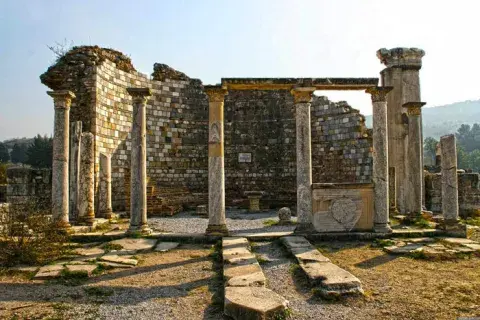
The Church of Mary not only counts among the most significant of the historical monuments at Ephesus, it is also visited by thousands of tourists and pilgrims annually.

This church was the site of the Third Ecumenical Council, convened by Emperor Theodosius II at Ephesus in 431 A.D. 
The Council was held to resolve a theological debate between two schools of thought about the nature of Christ and of His mother, Mary. 

One school, led by Nestorius, the Bishop of Constantinople, advocated that Christ was born human and became God, and that His mother should be called merely “Christ-bearer” or Christotokos (Χριστοτόκος).  The more popular view, however, was that Jesus was the Son of God, was born God and, therefore, Mary was deserving of the honor of being called the Mother of God, (Θεοτόκος) or “Theotokos.” 

This view was led by  Cyrill, Bishop of Alexandria, which united two natures – human and divine – in Christ.  Approximately 250 bishops journeyed to Ephesus from all over and took part in a heated debate over the divine nature of Jesus at birth.  In the end, the Council concluded that Jesus was God, born God and Mary was rightly called “Mother of God.”  Nestorius was denounced and excommunicated from the Church for his heresy.  A torch-light parade exited the church proclaiming Mary as “Theotokos” and it is from this place that today Christians pray, “Holy Mary, Mother of God, pray for us sinners.”
A lesser Council was held here in 449 A.D.  However, because of the controversial proceedings this second council was not accepted as ecumenical, and was labeled a “Robber Synod” and later repudiated at the Council of Chalcedon.  From the 5th Century on, the Church of Mary served without doubt as the seat of the Bishop of Ephesus. Baptismal ceremonies were held in the polygonal Baptistery where thousands of Pagans were converted. This building is without doubt one of the most important testimonials of Early Christianity.
The Church of St. Mary, named for the Blessed Virgin herself, was discovered early in the 20th century and is believed to be the very first church in the world named for Mary. A passage in the synodal letter of the first Council of Ephesus reads: “Wherefore also Nestorius, the renewer of the impious heresy, when he had come to the city of the Ephesians, where John the Theologian and the Virgin Mother of God, the Holy Mary . . . from the assembly of the Holy Fathers and Bishops.” Since St. John lived in Ephesus and was buried there (according to Eusebius), it has been inferred that the ellipsis of the synodal letter means either, “where John. . .and the Virgin. . . Mary lived,” or perhaps, “where John. . .and the Virgin. . . Mary lived and are buried.”  This passage gives witness to the oral tradition and belief held at that time that both St. John the Apostle and the Blessed Virgin Mary both lived and died at Ephesus.
The building received the canonical name of the “holiest church of the most holy, most honoured and eternal virgin Mary.” In later years, a complete alteration of the complex and a massive reconstruction was made necessary due to an earthquake which severely damaged the church. During this renovation, in the region in front of the apse, free-standing stone pilasters were erected instead of the columns; and the west part of the church was rebuilt as a vaulted dome church, with its own apse, using massive brick construction. The church was divided in two, with one part dedicated to St. John the Evangelist and the remainder to Mary, resulting in the name the “Double Church” by some.   The Church of St. Mary served as a cemetery church until at least the 11th century, and many graves can be found at the entry plaza.

Pope John XXIII (1958-1963) visited ancient Ephesus in 1931 on the 50th Centenary of the Council of Ephesus, held in 431 A.D. as the papal legate in Bulgaria.  During that visit, he toured the ruins of the Church of Mary, the site of the famous ecumenical council which declared Mary to be Theotokos, or “Mother of God.”
Sirince

Sirince
This pretty old Orthodox village, 12 km away from Ephesus and 30 km from Kusadasi, was once Cirkince ("ugly"). Indeed its habitants gave this name on purpose as they did not want to be bother...

Sirince
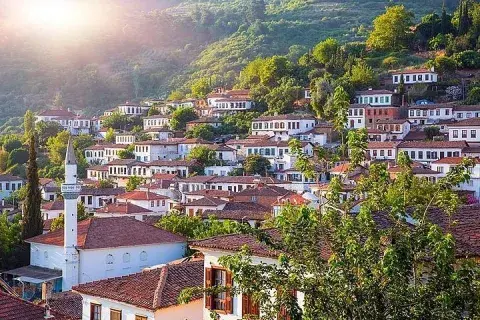
This pretty old Orthodox village, 12 km away from Ephesus and 30 km from Kusadasi, was once Cirkince ("ugly"). Indeed its habitants gave this name on purpose as they did not want to be bothered by foreigners nor to share the beauty of their village.Still after years, visitors understood that the village was not ugly at all and called it Sirince ("pretty"). As the village is located on the top of a mountain, anyone will enjoy the impressive wine yards' and peach trees' views on his way. Today the village is a perfect synthesis of Turk-Greek culture as of the 1920's: after the Independence War, people exchange between Greek and Turks has occurred and all those typical Greek houses, though they kept their original outside characteristics, have received the local layout inside.  And even in the courtyard of one of them, one will discover a nicely restorated Orthodox church.


All the narrow streets of the village belong to the women, selling handcrafts of all kinds. Sit in one of the small  terrace restaurants and enjoy some local gozleme ( turkish pancake). Another attraction of Sirince is its home grown fruit and grape wines. Enjoy some taste testing in the small cafés or in the beautifully restored former municipal school.

Saint John Basilica

Saint John Basilica

It is believed that the evangelist St. John had spent his last years in the region around Ephesus and was buried in the southern slope of Ayosolug Hill. Three hundred years after his death, a small chapel was constructed o...

Saint John Basilica

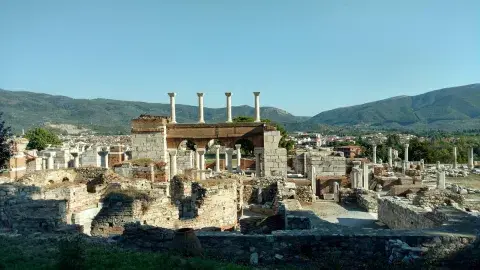
It is believed that the evangelist St. John had spent his last years in the region around Ephesus and was buried in the southern slope of Ayosolug Hill. Three hundred years after his death, a small chapel was constructed over the grave in the 4th century. The church was changed into a marvelous basilica during the region of Emperor Justinian (527 -565 AD).


The monumental basilica was in the shape of a cross and was covered with six domes. Its construction, being of stone and brick, is an extremely rare find amongst the architecture of its time. Raised by two steps and covered with marble, the tomb of St John was under the central dome, that was once carried by the four columns at the corners. The columns in the courtyard reveal the monograms of Emperor Justinian and his wife Theodora. Constructed in the 5th century AD, the baptistery is north of the nave, with its key hole shape. Rampart walls around the church were constructed for protection from the Arabian attacts in the 7th-8th centuries AD. The impressive 10thcentury AD frescoes representing St John, Jesus and a Saint, ornament the chapel. With the invasion of  the Turks, the chapel was used as a mosque in the 14th century. Unfortunately the Basilica of Saint John  became unusable due to a serious earthquake in the same century.


This church was built over the tomb of St. John. The presently-visible church is cruciform and roofed with six massive domes, and was donated by the Emperor Justinian and his wife Theodora. The capitals facing the nave (central aisle) bear their monograms.