Yueyang Pavilion

The Yueyang Pavilion is an ancient architectural treasure which is located on the shores of Dongting Lake in Yueyang City, Hunan Province. It is one of four famous Chinese pavilions. The other three are the Tengwang Pavilion in Hubei Province, the Yellow Crane Tower in Jiangxi Province and the Pe...

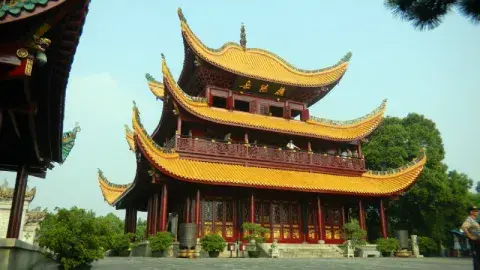
The Yueyang Pavilion is an ancient architectural treasure which is located on the shores of Dongting Lake in Yueyang City, Hunan Province. It is one of four famous Chinese pavilions. The other three are the Tengwang Pavilion in Hubei Province, the Yellow Crane Tower in Jiangxi Province and the Penglai Pavilion in Shandong Province.

The Yueyang Pavilion is a three storey, rectangular building which reaches 15 meters (about 49 feet) high and is constructed entirely from wood. Surprisingly, no nails or beams have been used in its construction. This is a rare feature in classical architecture. Pillars have been included in the construction to ensure the strength of the building. Four pillars made of 'Nanmu' wood support the entire pavilion; twelve pillars of catalpa wood support the eaves of the first storey and a further twelve pillars have been included to support the second storey. The roof is built using unusual curved lines which are similar to the shape of a helmet used by a knight of ancient times.

Seen from a distance, the Yueyang Pavilion seems like a giant bird which is in flight. The red building with its yellow glazed roof tiles is a splendid and colorful sight. Views here are spectacular. You will see the pavilion glowing in the sunshine together with the drifting clouds as reflections on the glimmering surface of the Dongting Lake. You will also see the white sails of passing boats contrasting with the blue sky. Couplets and carved screens are hung on the wall inside the building providing the visitors with the history of this pavilion.

The age of the pavilion is disputed. However, it is generally believed that it was built more than 1,700 years ago. During the Three Kingdoms Period (220-280) the rudimentary form of the building was that of a parade (ceremonial) pavilion. During the Western Jin (265-316) and the Northern and Southern Dynasties (386-589), it was used by the military with the name of 'Baling Tower'. It was not until the Tang Dynasty that it was renamed as the Yueyang Pavilion. The pavilion was damaged in the chaos of wars and was rebuilt in the Song Dynasty (960-1127). Since then, it has become a tourist attraction and a place of inspiration for both poets and writers. It was made very famous during the Northern Song Dynasty (960-1127) by the works of Fan Zhongyan who was a great politician and writer.


Admission Fee:  CNY 80
Opening Hours:  07:00 to 18:30 (May 1 to September 30)
07:30 to 18:00 (October 1 to April 30)
Bus Route:  take bus no. 10, 19, 20, 21, 22, 23, 24, 31, 50, tourism bus line 2 and 15, and get off at Yueyanglou Park Station.

Brief introduction for the Ancient Town of Fenghuang

  The ancient town of Fenghuang is located in the southwest part of the western Hunan Autonomous Prefecture. It is named so because one of the mountain is shaped like a flying phoenix which in Chinese is called Fenghuang. Fenghuang ancient town has a history of ...

  The ancient town of Fenghuang is located in the southwest part of the western Hunan Autonomous Prefecture. It is named so because one of the mountain is shaped like a flying phoenix which in Chinese is called Fenghuang. Fenghuang ancient town has a history of over one thousand years. It is surrounded by mountains and Tuojiang River runs through.

  Since ancient times, Fenghuang ancient city has been inhabited by Miao and Tujia people with a total area of 1759 square kilometers.

  Its history can be dated back to Ming dynasty. At that time, it was built as Wuzai Chief Division. Latter in Qing dynasty, it was known as Phoenix Division. In 1913 it changed its name into Fenghuang County. The typical ancient southern architectural style makes it unique. Fenghuang is famous for its description in Shen Congwen’s novel “The Border Town”, which depicted a vivid picture of Western Hunan. The New Zealand writer Louise Rewi Ally also names it one of the most beautiful town in China. In 2001, it was listed as one of the national historical and cultural cities by the Sate Council.

  The beautiful scenery contributed to the birth of genius. According to statistics, from 1840 to 1875, during 36 years, there were more than 110 provincial chief commanders, so on. After the Republic of China, a group of great men were born here. They are Xiong Xilin, who was the first prime minister, as well as politician state men, educationalist and philanthropist, Shen Congwen, a famous writer who twice won the nomination of the Nobel Prize in Literature for his masterpiece of “The Border Town”, Huang Yongyu, the outstanding artist, especially good at drawing Lotus flower. Fenghuang Stars to the world.

  There are four Fenghuang Cities in the world, wandering in Shen Congwen’ work The Border Town, plunging into the painting Lotus of Huang Yongyu, evading in the back basket of Song Zuying, the last walking in the travels of Rewi Alley.

  The small city is full of Paul Simon affection voice—The Scarborough Fair, following with his old guitar. The little girl with a basket full of colorful flowers is hawking for sale. Every street smells the faint scent. Fenghuang City becomes a big garland. She has forgotten completely that once she was called as Widows City. More than7000 Miao men went to Jiashan, Zhejiang Province to resist the Japanese aggression in 1937. The force is called Division 128. That mutilated commander was Gu Jiaqi, a local Fenghuang citizen. He commanded this powerful army and attacked the enemy tens of thousands miles away, but he also kneed down at Hongqiao crying for his dead fellows and 7000 young wives and old mothers. In that winter mourning apparels and paper flowers filled the city together with the snow. They were as white as the Wild Chrysanthemum which that little girl is selling.

Mt. Hengshan Scenic Spot

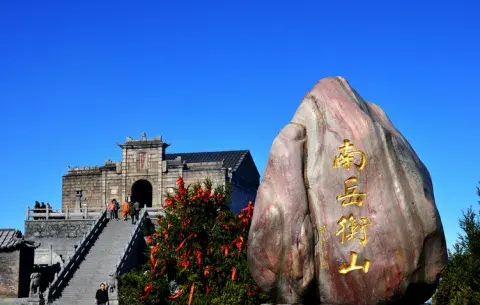
Being one of the famous mountains Wuyue (a collective name given to five famous mountains in China), Mt. Hengshan is found in Hengyang City in Hunan Province, it is also referred as Nanyue, meaning South Mountain. It has eminent mountain peaks and wonderful mountain scenery.

Mt. Hengshan ...

Being one of the famous mountains Wuyue (a collective name given to five famous mountains in China), Mt. Hengshan is found in Hengyang City in Hunan Province, it is also referred as Nanyue, meaning South Mountain. It has eminent mountain peaks and wonderful mountain scenery.

Mt. Hengshan is composed of 72 peaks, among which the first mountain peak you will see when climbing is Huiyan Peak. Going further toward the north, you will feast your eyes on all the graceful scenery. Here in Mt. Hengshan, no mountain peaks are without trees. It is green all over. There are various kinds of precious trees and a vast area of primeval forest. Among all these trees here, some are 300 - 400 years old, which still bloom when spring comes. Some trees are even over 1,000 years old. The trees in the primeval forest are bending with lichen growing on the trunks, resembling old men wearing tattered clothes. From the mountain peaks, you can see the grand view of sunrise, the rolling cloud and the oceans of trees. There magnificent views are called 'four oceans' on Mt. Hengshan: ocean of flowers, ocean of trees, ocean of cloud and ocean of snow.

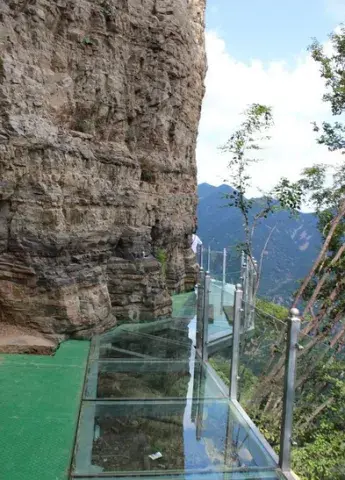
People summarize all the spectacles here as 'the eight marvels in Mt. Hengshan'. They are the height of the Zhurong Peak, the grace of the Sutra Collection Hall, the profundity of Fangguang Temple, the quietness of Mojingtai, the magic of the Shuilian Cave, the antiquity of Dayu Stele, the majesty of the Nanyue Temple and the steepness of Huixian Bridge. Zhurong Peak is the highest mountain peak of this scenic area. Sutra Collection Hall is located deep in the glen and is surrounded by towering trees. The running spring and flying birds make this place very peaceful and leisurely. Huixian Bridge is in fact a bridge on a big stone. It is narrow and dangerous, and few people are brave enough to go over it.

This scenic area is also a well known and hallowed Buddhist ground. It has abundant temples including nunneries and Taoist temples. The most notable one is Nanyue Damiao, the largest temple in Wuyue. It was originally built in the Tang Dynasty (618-907), but was destroyed by fire. In the Qing Dynasty (1644-1911), it was renovated imitating the design of the Forbidden City.

Various reputations were gained at this scenic area: a particular religious hallowed ground and a marvelous scenic locale for both summering and touring. Here you can watch blooming flowers in spring, prevent sunstroke in summer, watch sunrises in autumn and enjoy the beautiful prospect of snow in winter. If you are traveling in China or going to travel in China, do not miss the wonderful trip to Mt. Hengshan.

Transportation: Take the bus No.1 in the urban area of Hengyang, getting off when you reach the last stop (Western Bus Stop), transferring to a coach to get the Hengyang County, then you will reach the scenic area.
Admission Fee:  CNY 100 (Entrance Charge)
CNY 50 (Nanyue Damiao)
CNY 70 (cable car, round-trip)
CNY 40 (cable car, single-trip)
Phoenix Nanhua Mountain National Forest Park

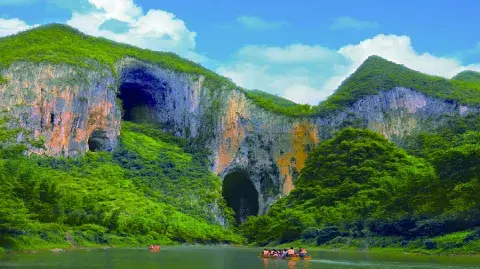
Nanhua Mountain National Forest Park, situated in Fenghuang County in Western Hunan, is projected by combing the advantages of human landscape of famous Ancient Phoenix Town and natural scenery of Nanhua Mountain together and creatively build five large thematic scenic spots wh...

Nanhua Mountain National Forest Park, situated in Fenghuang County in Western Hunan, is projected by combing the advantages of human landscape of famous Ancient Phoenix Town and natural scenery of Nanhua Mountain together and creatively build five large thematic scenic spots which are Shrine Phoenix Cultural Zone, Nanhua Buddhist Temple, Border Town Cultural Zone, Ancient Cultural Zone of Hmong Kingdom and Qifeng Temple. Besides, five-star hotel conference center, golf course, automobile camp and other facilities will be supplied. After the whole project finished, it will be the first overall experiential zone of phoenix culture and Hmong culture. A demonstration zone of eco-tourism in western Hunan will be built in not far future.

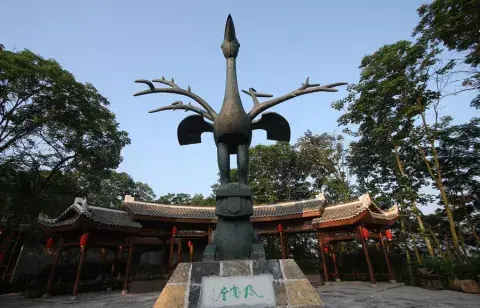
At present, the first project of Nanhua Mountain scenic zone, Shrine Phoenix Cultural Zone has been built and is welcoming tourists abroad and at home. 7800-year phoenix culture, as Shrine Phoenix Cultural Zone’s theme, is innovatively utilized into the ancient architectures and thematic scenes like pavilion, platform, hall, cabinet, corridor, pillar, bridge, storied building and so on. Several thematic scenic spots like Sea of Phoenix Bamboo, Luck Phoenix Pavilion, Phoenix Forwarding Bridge, Birds Worshipping Phoenix, Shrine Phoenix Hall, Life Relieving Stand and so on are included in the Shrine Phoenix Cultural Zone.

Here, Ancient Phoenix Town has waited for you for a thousand year. Here, phoenix culture has waited for you for eighty-seven hundred years.