Italy Attractions

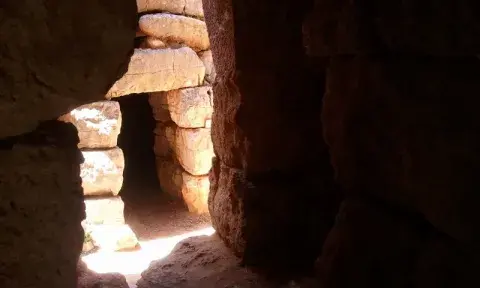
Palmavera nuraghe
Nuraghe Palmavera is one of 7000 nuraghe scattered all over the island of Sardinia, which means there are at least 3 of them any square kilometer. Most of them are almost completely destroyed, but many still stand majestically - mute witnesses of their own inscrutable destination and mysterious p...
Nuraghe Palmavera is one of 7000 nuraghe scattered all over the island of Sardinia, which means there are at least 3 of them any square kilometer. Most of them are almost completely destroyed, but many still stand majestically - mute witnesses of their own inscrutable destination and mysterious people who built them. They were dated back at 1900 BC to 700 BC. So unique and unexampled, in the modern era they became the symbol of Sardinia. What are they? In the most immediate definition they are cone-shaped towers built of stone boulders without use of any mortar. Nobody really know what they were for. All different kinds of theories were invented: nuraghi would be religious temples, military strongholds, rulers' residences or simply common dwelling etc. Not so common though... Nuraghe Palmavera is one of better preserved. It is easily accessible from Alghero - if yo have a car first go to Fertilia, then proceed in the direction of Capo Caccia. You will find Palmavera on your right hand side, just next to the road. Be careful parking - there is really little room. As an alternative you could go there on a bike. In Alghero you will find many to rent.

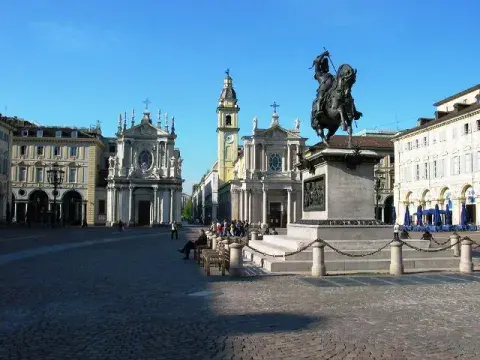
San Carlo Square
Piazza San Carlo is the current name of one of the most vivid squares of this marvelous city. During its long history it had several names, such as Piazza Reale, Piazza d´Armi, Place Napoléon. It has been known as Piazza San Carlo Borromeo since 1618.
In the sole center of th...
Piazza San Carlo is the current name of one of the most vivid squares of this marvelous city. During its long history it had several names, such as Piazza Reale, Piazza d´Armi, Place Napoléon. It has been known as Piazza San Carlo Borromeo since 1618.
In the sole center of this spacious square one can see the statue of Emanuele Filiberto on a horse made by Carlo Marocchetti. Twin churches can be see on its south west side; Church of Santa Cristina and the church of San Carlo.
Besides the churches one can also take a look on the large Palace of San Carlo.
Another beautiful thing on this square are the coffee bars where even almost hundred years ago famous artists, writers and politicians came to have their preferred cup of coffee and meet their friends.

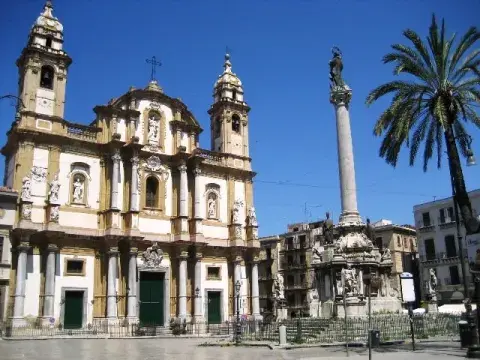
Saint Dominic Church
If we were to choose churches by importance this church one would surely be the second after the Palermo cathedral. It was firs erected in the 15th century but then was completely reconstructed in the mid 17th century so it can even be considered as if it dates back to the period of its latest re...
If we were to choose churches by importance this church one would surely be the second after the Palermo cathedral. It was firs erected in the 15th century but then was completely reconstructed in the mid 17th century so it can even be considered as if it dates back to the period of its latest reconstruction.
It is built in the barocco style. The front façade is marked by two bell towers.
The principal altar is built in marble. The church preserves some manuscripts and tombs of some notable people like the blessed Pietro Geremia, who was a Dominican writer from Palermo.
The interior of the church is nicely decorated, there are several chapels like the chapel dedicated to Mary (Cappella della Madonna), chapel of Saint Tommaso D´Aquino, chapel of Saint Joseph (Cappella di San Giuseppe), chapel os Saint Anna, chapel dedicated to Saint Domenico, to Vicenzo Ferrer…
In all these chapels one can see various works of art and spend an entire day looking at all the details.

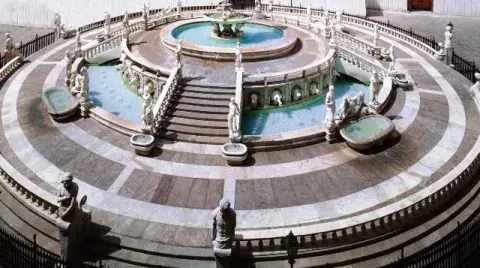
Pretoria Fountain
Fontana Pretoria is a large fountain built by Francesco Camilliani in the mid 16th century. One interesting fact about this fountain is that it wasn´t actually built in Palermo but in Florence and later on transported to Palermo on Pretoria Square. It was intended to be a private fountain i...
Fontana Pretoria is a large fountain built by Francesco Camilliani in the mid 16th century. One interesting fact about this fountain is that it wasn´t actually built in Palermo but in Florence and later on transported to Palermo on Pretoria Square. It was intended to be a private fountain in the Florentine park but was transferred because of exhibition causes and it stayed there until the present day.
The fountain isn´t the only beautiful thing on this square. There are also two churches around it; Church of Saint Catherina and Saint Joseph.
This fountain is richly decorated. One can see all kinds of decorations when walking around it. There are various gods and goddesses, animal heads, monsters, etc.
Due to some nude figures on the fountain, the residents of Palermo weren´t as satisfied with the fountain and it was even called the fountain of shame. It was like the representation of the corruption of people in the city. Even the entire square was, for some period of time, called the Square of Shame.
The fountain was restored about 10 years ago.

Holy Mary of Grace
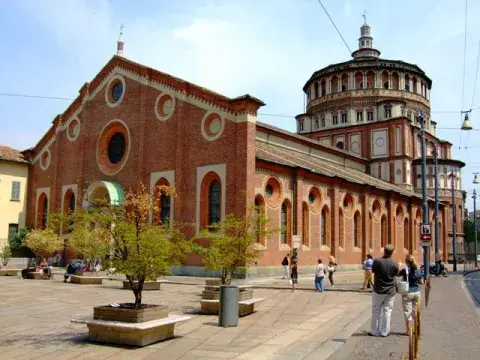
This church built during the Renissance period is really special. It is not only the beautiful church that attracts so many visitors but also the Dominican monastery and the Da Vinci´s masterpiece ´Last Supper´ within the church.
It is of course enlisted on a UNESCO Worl...
This church built during the Renissance period is really special. It is not only the beautiful church that attracts so many visitors but also the Dominican monastery and the Da Vinci´s masterpiece ´Last Supper´ within the church.
It is of course enlisted on a UNESCO World Heritage List.
This church is another landmark owned to the Visconti family. Count Gaspar Vimercati, started the construction in the 15th century.
Donato Bramante designed the church that was destined to be a sepulchre for the duke of Milan, Ludovico il Moro. Finally, the duke´s wife was buried here but the duke himself was ousted from church so he couldn´t buried with his wife.Even though the church suffered some damage during the World War II it was restored soon after.
Even though the church is built mostly in Renaissance style there are still some Gothic elements visible both on the exterior and interior. The ´Last Supper´ isn´t the only work of Da Vinci. He also painted part of the portico which shows the duke Ludovico with Beatrice, Ludovico´s wife.
Some of the most prominent parts of the exterior are the work of the famous designer Bramante. He skillfully built the medallions of saints and various coats of arms.
Besides the central or principal altar one can see several chapels built along the aisles and a great choir.
Even though the ´Last Supper´ is maybe the principal attraction of the church one can not neglect the beautifully painted frescos showing the Stories of the Passion (Storie della Passione) painted by Gaudenzio Ferrari.

Semplon Park
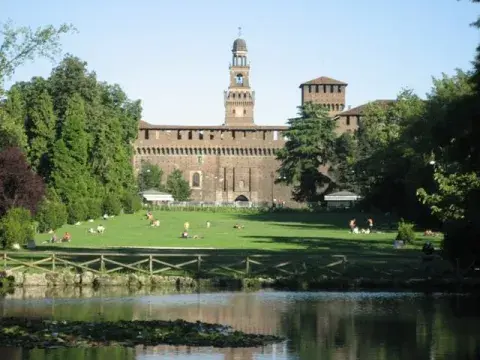
This is really a large park in the city that spreads on an anrea of about 386,000 square meters. The park was established during the Napoleonic Empire, more exactly in 1888. Another speciality of the park is its location. It is located bwterrn the Sforza Casle and the Arch of Piece.
Even ...
This is really a large park in the city that spreads on an anrea of about 386,000 square meters. The park was established during the Napoleonic Empire, more exactly in 1888. Another speciality of the park is its location. It is located bwterrn the Sforza Casle and the Arch of Piece.
Even within the park there are some monuments, like the Palace of art that often houses interesting exhibitions. There are also the acquarium the Torre Branca, the Arena Civica and others.
Arena civica was built in the 19th century and even today it houses various sports events and maches.
For modern people who want to check their emails while on vacation there is a free wireless network in the park.

Sforza Castle
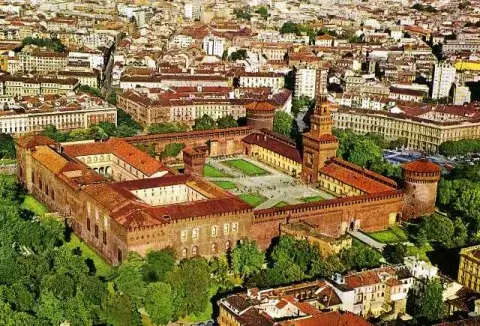
Even though this palace mostly serves as a museum it used to be the homo of the Milan dukes. The original building was first completed by Galeazzo il Visonti in the second half of the 14th century. It was later altered by his successors. They converted the fortress into a palace which was then us...
Even though this palace mostly serves as a museum it used to be the homo of the Milan dukes. The original building was first completed by Galeazzo il Visonti in the second half of the 14th century. It was later altered by his successors. They converted the fortress into a palace which was then used as a residence.
After the death of the owners who left no heir the Milanese people raised the castle which is to day a large edifice characterized by three large courtyards around which one can see imposing towers.
Today many of the castle rooms serve as museum halls. One can see here a variety of museum exhibition categories. From furniture, archeological exponents, Egyptian artifacts and some unfinished Michelangelo´s works.
The palace is really amazing even without the museum exhibits but the museum gives another powerful reason to visit this particular palace.

Mercanti Square
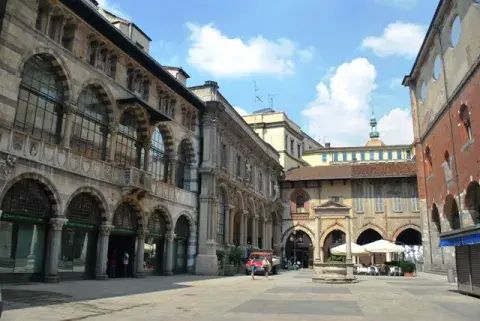
Piazza Mercanti is a central city square. It is located between the two other important squares. Cathedral square which could be considered as another central square and the Cordusio square. Piazza Mercanti lived its most glorious days in the Middle ages when it was the real city centre. There ar...
Piazza Mercanti is a central city square. It is located between the two other important squares. Cathedral square which could be considered as another central square and the Cordusio square. Piazza Mercanti lived its most glorious days in the Middle ages when it was the real city centre. There are many important historical monuments that are build on the edges of the square.
These are the Ragione palace, Panigarola house and la Loggia degli Orsi, and Scuole Palatine. The square is made of stone as well as the surrounding buildings.
The oldest of these building is the Ragiona Palace that dates back to the 13th century.
Pagination
Top Italy Tours

Taormina and its Ancient Theatre
At 200 meters above sea level rises Taormina, rich in history and traditions. It is a small but charming town with an enchanting atmosphere. Taormina is a typical Sicilian town with narrow streets and all the buildings close one to another. Walk along its main street and discover its secrets. Discover the many ancient buildings and churches dating back to the 15th or 17th century. Don’t miss the chance to visit to the Greek-Roman theatre which offers an incomparable view on Mount Etna and the Gulf of Naxos. It is really a small but charming town.
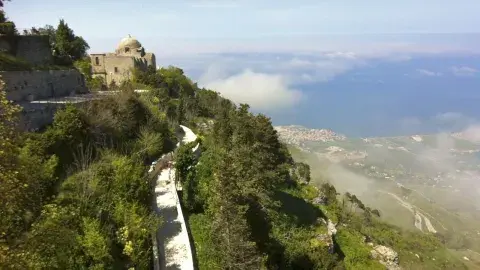
Erice and Segesta - Perfect for First Time Visitors
Segesta, founded by the prehistoric Elymians, according to the traditional legend, had a Trojan origin. It is located on the isolated hill called Barbaro and washed by the river Crimiso, nearby Calatafimi. The well preserved temple and the greek theater were built in the late 5th century BC. The mythical heroes Hercules and Aeneas are associated with ancient Segesta.
...Read moreSegesta, founded by the prehistoric Elymians, according to the traditional legend, had a Trojan origin. It is located on the isolated hill called Barbaro and washed by the river Crimiso, nearby Calatafimi. The well preserved temple and the greek theater were built in the late 5th century BC. The mythical heroes Hercules and Aeneas are associated with ancient Segesta.
Erice, About 2, 500 feet above sea level. It overlooks nearby Trapani and the salt flats, and is surrounded by a lush park and hilltop castles, which offer charming old stone streets to stroll and several medieval churches to investigate. Discoveries abound in this delightful town, which is the epitome of the Middle Ages, even though the town is much older than the castles, walls and streets suggest. The mythical heroes Hercules and Aeneas are associated with ancient Erice.
Includes private guided tours inside archeologiacl areas and towns. Private transport by Premium Mercedes Minivan. Almond pastry tasting. Pick up/drop off at the hotel.
Does not inlcude entrance fees and meals.
The excursion may be customized according to your schedule.

Visit Sicily - Enjoy a Private Tour around the Island
Tour around Sicily with a private guide and a private car, visiting the highlights of the island, enjoying the Sicilian food and wine.
Discover Sicily where Greek, Roman, Arabic, Norman, Swabian and Spanish influences can be found in religious architecture, in archeology, in the dialect, in the popular traditions and in a unique cuisine.
The island is full of archeological wonders, splendid Baroque cities and ancient traditions. Its variety of excellent wines, ancient cellars and vineyards, typical dishes and traditional foods makes this destination a special place.
...Read moreTour around Sicily with a private guide and a private car, visiting the highlights of the island, enjoying the Sicilian food and wine.
Discover Sicily where Greek, Roman, Arabic, Norman, Swabian and Spanish influences can be found in religious architecture, in archeology, in the dialect, in the popular traditions and in a unique cuisine.
The island is full of archeological wonders, splendid Baroque cities and ancient traditions. Its variety of excellent wines, ancient cellars and vineyards, typical dishes and traditional foods makes this destination a special place.
Tour Example:
Day 1) Arrival in Palermo (or Catania)
Day 2) Marsala, Erice, Selinunte
Day 3) Palermo, Monreale
Day 4) Madonie Park, Cefalù & Castelbuono
Day 5) Syracuse
Day 6) Ragusa, Noto
Day 7) Mount Etna, Taormina
Day 8) Departure
Rate includes:
• Guided tour of Siracusa
• Guided tour of Taormina
• Guided tour of Selinunte
• Guided tour of Palermo and Monreale
• Professional licensed local guide as per itinerary
• Transportation in modern vehicle with fully a/c
The rates do not include:
Cities tax, transfers from/to airport, travel insurance, hotels, meals, entrance fees, tips and anything not specifically mentioned in "The rate include"