Croatia Attractions

Historical Complex of Split with the Palace of Diocletian

The ruins of Diocletian's Palace, built between the late 3rd and the early 4th centuries A.D., can be found throughout the city. The cathedral was built in the Middle Ages, reusing materials from the ancient mausoleum. Twelfth- and 13th-century Romanesque churches, medieval fortifications, 15th-c...

The ruins of Diocletian's Palace, built between the late 3rd and the early 4th centuries A.D., can be found throughout the city. The cathedral was built in the Middle Ages, reusing materials from the ancient mausoleum. Twelfth- and 13th-century Romanesque churches, medieval fortifications, 15th-century Gothic palaces and other palaces in Renaissance and Baroque style make up the rest of the protected area.

The importance of Diocletian's Palace far transcends local significance because of its level of preservation and the buildings of succeeding historical periods, starting in the Roman period, which form the very tissue of old Split. The palace is one of the most famous and integral architectural and cultural buildings on the Croatian Adriatic coast.

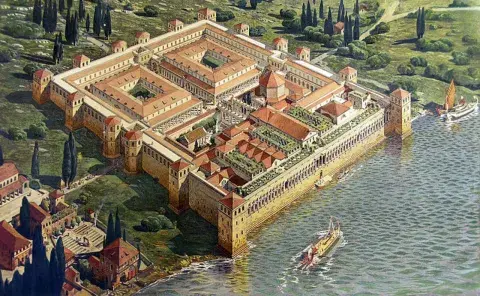
The ruins of Diocletian's Palace, built between the late 3rd and the early 4th centuries AD, can be found throughout the city. The Roman Emperor Diocletian spent his declining years in an enormous palace that he had built near his birthplace, Aspalthos, in Dalmatia. The palace represents the most valuable example of Roman architecture on the eastern coast of the Adriatic. Its form and the arrangement of the buildings within the palace represent a transitional style of imperial villa, Hellenistic town and Roman camp.

On the eastern side of the palace lies the Porta Argentea (Silver Gate) with the church of St Dominic on the opposite side, it was reconstructed between 1932 and 1934. The Silver Gate gives access to the Plain of King Tomislav and thence to the Peristil (peristyle), the central open-air area of the palace. Its longitudinal sides are surrounded by an arched colonnade; the arches in the west are closed by Gothic and Renaissance houses. monumental port with four columns carrying a gable closes the Peristyle in the south.

The Mausoleum of Diocletian (today's Cathedral of St Doimus dedicated to St Mary) lies in the eastern part of the peristyle. The mausoleum has almost completely preserved its original octagonal form, encircled by 24 columns which supported the roof; the interior is round, with two rows of Corinthian columns and a frieze. A dome, once covered with mosaics, roofs the mausoleum. The monumental wooden gateposts and the stone pulpit from the 13th century represent the oldest monuments in the cathedral. The choir, constructed in the 18th century, is furnished with Romanesque seating from the 13th century and ornamented with a painting representing the Mother of God with the saints and donors.

A small temple opposite the mausoleum, probably dedicated to Jupiter, became the baptistry in the early Middle Ages. Only the closed part of the temple (cella) with a richly decorated portal has been preserved; the interior is roofed with a barrel-coffered vault.

Diocletian Street runs from the Peristyle to the north at the Porta Aurea (Golden Gate); Agubio Palace, with a Gothic portal and inner yard is to the left. To the right, in Papaliceva Street, is the Papalic Palace (15th century), the most important example of Gothic architecture in Split.

Kresimir Street leads from the Peristyle to the Porta Ferrea (Iron Gate) in the west; Cindro Palace (17th century), the most beautiful Baroque palace in Split, lies on the right. Beyond the Iron Gate is the square Narodni Trg (Piaca), centre of the medieval commune and the liveliest square of the modern city. Of the Gothic houses which used to close the northern end of the square, only the Town Hall (1443), with a loggia in the ground floor, has survived.

In the early Middle Ages the town was built within the palace. Commercial prosperity of the 13th and the 14th centuries inspired more intensive building. The town spread outside the palace, and a new centre developed along the western walls of the palace, which was fortified in the 14th century; in the 17th century a new defence system with projecting bastions was erected.
Cathedral of Saint Lawrence

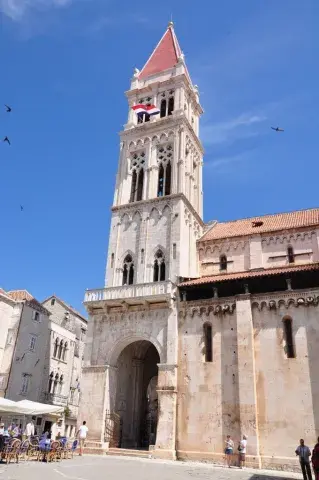
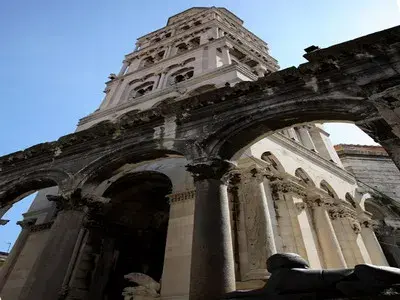
The Cathedral of St. Lawrence is a Roman Catholic cathedral located on the main square in Trogir, Croatia. The construction of this amazing monument lasted for several centuries nut the mains style could be determined as Romanesque-Gothic.
Before the construction of this cathedral there e...

The Cathedral of St. Lawrence is a Roman Catholic cathedral located on the main square in Trogir, Croatia. The construction of this amazing monument lasted for several centuries nut the mains style could be determined as Romanesque-Gothic.
Before the construction of this cathedral there existed another Christian cathedral that was destroyed by the Saracens in the early 12th century.

The most famous part of the cathedral is its portal named after the sculptor Radovan who built it.

The portal is divided into the upper and lower part. The upper part has several arches on which are shown scenes from the life of Christ.

The statues representing Adam and Eve are located each on each side. They are covered with the leaves and two lions are stepping on the heads of the serpents who offered the apple to Eve.

On top, above the upper part one can see a sculpture of Saint Lawrence holding a grill that is used in order to prepare food on burned wood. There is a reason for which Saint Lawrence holds a grill: the Roman emperor ordered his execution by burning him on a grill.

Another beautiful part of the cathedral is the chapel within the cathedral dedicated to Saint John. The chapel is built in the Renaissance style. The chapel is remarkably beautiful, especially its roof with sculpted heads of seraphs and a larger sculpture representing God seeing us from the heaven.

Croatia Articles

Top Croatia Tours

$25 Per Day

Extended Diocletian Palace Walking Tour

This tour is an extension of the Classic Diocletian's Palace Walking Tour including all major attractions in the Palace and near the city walls. Diocletian's Palace is a world heritage site listed and protected by UNESCO, one of the rarest examples of that kind dating back to Roman Age. Built more than 1.700 years ago, it is still inhabited as it was for centuries which makes it unique on the Earth.

In addition to the Traditional Classic tour, the Extended one foresees the entrances to the most interesting sites inside the Diocletian's Palace:

St. Domnius Cathedral - one of the oldest cathedrals in the world, with it's magnificent interior actually a small museum.

Substructure halls of the Diocletian's Palace - the unique basement complex that witnesses today the original size of the palace together with the above chambers, where famous Roman emperor was enjoying his retirement days.

Temple of Jupiter / Baptistery of St. John - built inside the Palace as Diocletian considered the highest roman god, Jupiter, to be his divine father. Later, transformed into christian baptistery this temple became one of the best preserved remains from the Split ancient period.

The entrance to the St. Domnius Tower (60 meters high) can also be programmed during this tour, as the substitution of one of the entrances or as the additional tour opportunity. From the peak of the Bell Tower you can enjoy spectacular scenario over the Diocletian's palace, old houses, Split Port and nearby islands! The cost of the ticket is approx. 2 € / person. Please note: there are lot of stairs and dizzy heights, therefore this option is not recommended to everybody.

What to see:

Roman Emperor Diocletian's Palace, built more than 1.700 years ago; today the world heritage site protected by UNESCO

Diocletian's Palace Walls and Gates: Golden, Iron and Brass Gate - Vestibul - Perystile - St. Domnius Cathedral - Temple of Jupiter- The substructure (cellars) - Cardo and Decumanus street - Remains of the Benedictine monastery of St. Eufemia - Statue of Gregory of Nin

Please note  
This is a private Split walking tour: only you and/or your group will be attending it, no other persons will be with you during this tour. Departure time and date as well as the pace of the tour can be easily adjusted according to your personal preferences. Tour time approx. 2 hours.

Prices of the entrance tickets:
Cathedral of St. Domnius and Temple of Jupiter: 3,5 € / person
Substructure halls: 5,5 € / person
St. Domnius Bell Tower (optional): 2 € / person

$29 Per Day

Samobor carnival

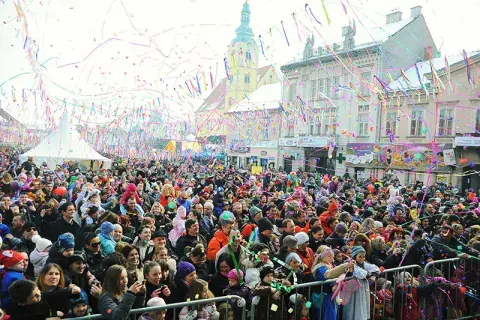
Samobor carnival is one of Croatia's best known and most authentic festivals, dating back to 1820's.

On the weekend before Shrove Tuesday locals run around in masks in lively parade, creating a party atmosphere. On Shrove Tuesday itself, an effigy named Princ Fašnik (“prince of the carnival”) is blamed for everything that has gone wrong over the previous twelve months and is ritually burned on the main square.

Take a trip to the Carnival Republic and enjoy the masks, music and dance!

PLEASE NOTE:

Available dates for the carnival: Feb 17th- Feb 28th

Minimum 4 people required for trip.

Price includes transportation, tour leader, driver fees

Price DOES NOT include meals and drinks