China Attractions

Purple Mountain

 
Purple Mountain is known as the “lung of Nanjing” and for good reason.  This massive, forested park area situated within Nanjing boasts fresh and cool air compared to the muggy, polluted ...
 
Purple Mountain is known as the “lung of Nanjing” and for good reason.  This massive, forested park area situated within Nanjing boasts fresh and cool air compared to the muggy, polluted city center.
 
There are loads of tourist attractions within Purple Mountain.  Each of these destinations may be considered a go-to destination on its own.  It is not possible to visit every last site on Purple Mountain in one day or even in a couple of days.
 
Most of the main tourist attractions are on the south side of the mountain.  Hiking trails crisscross the mountain in every direction.
 

Hiking

 
The mountain contains a huge network of paths.  There are several entrances and from each entrance, paths converge and criss-cross all the way to the top of the mountain. Neither English nor Chinese maps encompass the entire network of paths on Purple Mountain.  Signs along the paths on Purple Mountain are difficult to decipher even for people fluent in Chinese. 
 
Taiping Road Entrance and the Tramline
 
The most popular spot to begin a hike is close to the entrance of the tramline.  This route starts at the westernmost point of the mountain area and is a relatively easy hike.
 
There are many buses that stop at White Horse Park (白马公园) on Taiping Road (太平路) and Longpan Road (龙蟠路).  Buses that stop at White Horse Park include numbers 125, 44, 79, 48, 308 and 315.  
 
From the White Horse Park bus stop a 15 minute walk up the road takes you to the tramline station and marks the official beginning of the trail.  Buses 20 and Y3 (游3) travel right past White Horse Park on Taiping Lu (太平路) and up to the tramline entrance.
 
The Tramline
 
The tramline runs from 9:00am-4:30pm Monday to Friday and 8:30am-5:30pm Saturday and Sunday.  The ride takes about 30 minutes to reach the mountain top and about 15 minutes to reach the observatory.  Tram tickets cost 25 yuan per adult and 15 yuan for children under 1.3 meters tall.
 
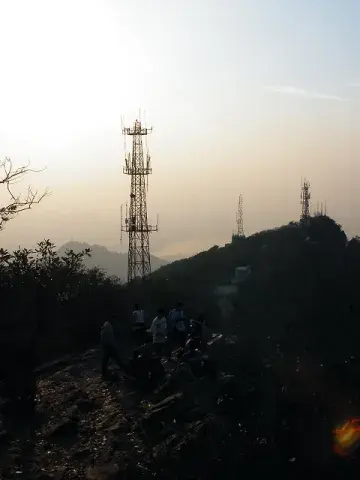
The tramline in the late afternoon.
 
Hiking from the Tramline Entrance Area to The Observatory and Mountain Top
 
Walking up the slowly ascending road to the observatory takes 45 minutes if you maintain a brisk pace and do not take any breaks.  If you are not sure whether or not you want to hike all the way up the mountain, remember that you will have another opportunity to hop on the tramline from the observatory.  If you want to continue hiking, follow the small, unkept path just to the left of the entrance to the observatory.  This path leads to a 3-path intersection.  Turn right and walk about 50 meters to get to the tramline.  Keep going straight to head for the main peak of the mountain.  From this point on, just keep heading upwards on the main path or on one of the several smaller trails.  Hiking up the main path should take another 45 minutes without breaks.  Another spot on the main path leads down towards the Ming Xiaoling Tomb.
 
 
Yingtuo Village Entrance
 
On the northwest side of Purple Mountain, the Yingtuo Village entrance leads to a steeper and more direct route to the peak.  Thin stairways lead all the way to the top of the mountain. However, these stairs can become fairly busy when the weather is pleasant.
 
To find the Yingtuo Village entrance, follow Bancang Street (板仓街) to Yingtuo Cun, (Yingtuo Village, 樱驼村).  The entrance is rather insignificant (see picture).  If you don’t watch for the road you might think it’s just another alley.
 
There’s not much fanfare about  
the Cherry Village Entrance.  
 
The trails are busy when the weather is nice.
 
Linggu Pagoda to The Mountain Peak
 
A gently sloping cement and stone road leads all the way from the mountain peak to the Linggu Pagoda.  It takes 1.5 hours to walk this route if you do not take breaks.  Likely because there are no notable viewpoints along this route, it is very lightly travelled.
 
 
Mountaintop Park (山顶公园)
 
The park at the top contains a large Buddha statue and a small clearing.  Tickets to this park cost 4 yuan.  Tickets are free for children under 1 meter, adults over 70, and people with physical handicaps.  Those seeking only the premiere, most worthwhile attractions can certainly skip this one.
 
Tips
 
For 120 yuan you can purchase a year card that allows you to access all of the attractions listed below except for Underwater World.  This card is well worth the money even if you are only planning to visit these attractions once.  The card can be purchased at the entrances to any of these areas, however you must bring a passport sized photo.  If you do not have a photo you can pick up 8 photos for 20 yuan at a store near the ticket booth for Sun Yat-sen’s Mausoleum.  You can also pick up photos at a booth which is in front of Underwater World and near one of the entrance gates to the Ming Xiaoling Scenic Area.
 
Water and other refreshments cost about twice as much on the mountain as they do nearer to the ground.  For example, a bottle of water costs 2 yuan near the bottom but costs 3.5 yuan at the top.
 
Nanjing is almost always foggy and/or smoggy, but if you plan on staying in Nanjing for an extended period of time, try to wait for a clear day to hike up the mountain.
 

Tourist Attractions

 
Most tourist attractions are on the south side of the mountain.  Most can be reached by bus and some require a short hike as well.
 
  Ming Xiaoling (明孝陵)
  Plum Blossom Hill (梅花山)
  Purple Cloud Lake (紫霞湖)
  Sun Yat-sen Museum (孙中山纪念馆)
  Music Stage (音乐台)
  Linggu Temple and Linggu Pagoda (灵谷寺和灵谷塔)
  Beamless Hall (无梁殿)
  Tomb of Tan, Yankai (谭延墓)
Meiling Villa (美龄宫)
Purple Mountain Observatory (紫金山天文台)
Underwater World (海底世界)
Drum Tower (Gu Lou)

The drum tower (Gulou, 鼓楼) was built in 1382 during the Ming Dynasty.  It was later damaged and rebuilt during the Qing Dynasty.

Originally, the drum tower was used to signify the changing of the guard. On rare instances it was also used to warn the populace of an emergency such as a...

The drum tower (Gulou, 鼓楼) was built in 1382 during the Ming Dynasty.  It was later damaged and rebuilt during the Qing Dynasty.

Originally, the drum tower was used to signify the changing of the guard. On rare instances it was also used to warn the populace of an emergency such as an impending attack or fire. From its hilltop setting, the drum tower allowed for an incredible view of the city in years past. However, the view now seems quite limited due to the high rise office and apartment buildings.

On the third floor there is a collection of photos depicting the old Nanjing. Some photos date back to as early as 1888. For a bit of a fun challenge, examine the old pictures and try to figure out which area of Nanjing they are from.

The drum tower lies on Beijing Xi Lu (北京西路) in the Drum Tower district (Gulou, 鼓楼区). It is adjacent to a large traffic circle that is at the junction of Beijing Dong Lu (北京东路), Beijing Xi Lu (北京西路), Central Road (Zhongyang Lu, 中央路), Zhongshan Bei Lu (中山北路) and Zhongshan Lu(中山路). It is also within walking distance of the Gulou subway station.

Tian Tan Buddha (Big Buddha)

Tian Tan Buddha (Big Buddha)
One of Hong Kong’s premiere attractions is the world’s tallest outdoor seated Buddha; the great looming statu...

Tian Tan Buddha (Big Buddha)
One of Hong Kong’s premiere attractions is the world’s tallest outdoor seated Buddha; the great looming statue of the Buddhist deity Sakyamuni. Seated on a summit in
Lantau, the Buddha measures over 100 feet in height and weighs 275.5 tons. There is a large automated bell within the Buddha that rings 108 times everyday, with the number ’108’ symbolizing escape from 108 troubles of mankind. For a closer look at the statue and its surrounding views, you will have to ascend 260 or-so steps. It is well worth the effort though, as there is a museum at the top and you will be able to look out over the spectacular view of the surrounding Ngong Ping plateau and Lantau Peak. 

Tip:
A lively time to visit the Buddha is on the Buddha’s Birthday, a public holiday in late April or May. Each year thousands of people make the pilgrimage which makes for an inspiring scene at the site. However, if you seek a quiet, peaceful moment with the Buddha, try to avoid visiting on Sundays or public holidays.

Po Lin Monastery
Known as the ’Buddhist Kingdom of the South,’ this extensive monastery is one of the main Buddhist monasteries in Hong Kong. Po Lin can be translated as ’precious lotus’ (with the lotus flower being the Buddhist symbol of purity). The monastery itself was founded by three monks in 1920 and was renamed and developed into the Po Lin Monastery that now exists today in 1924. Although many monks still seek refuge there today, the area attracts much more outside visitors these days.

Tip:
Visitors should not bring meat or alcohol to the area as a measure of respect.

Dining:
There are three good-value vegetarian restaurants around the area. You can buy meal tickets at the entrance to the Buddha statue and this ticket gives one access to the displays inside the Buddha and what is basically the monk’s canteen. For the carnivorous, Buddhists chefs specialize in mock meat dishes, which is basically sweetened to-fu.

Tea Gardens
To the west of the Buddha statue are some Tea Gardens, which have their own plantation. A quaint Tea Garden café serves up simple dishes and tea, with the dated overhanging parasols providing shade and relief from the sun. The café also sells tea leaves fresh from the bush. To get there walk from Po Lin Monastery and follow the signs to the Tea Gardens entrance.

The Wisdom Path
From the Tea Gardens, a 15 minute walk along a hiking trail will bring you to the Wisdom Path. Recently refurbished, here there is a large outdoor installation representing of the Buddhist prayer; the Heart Sutra. The prayer is creatively displayed on escalating wooden pillars. Together, the pillars form the symbol of ’Infinity,’ which exemplifies the limitless and boundlessness of Buddhism and enlightenment.

Estimated duration of the trip:
Sightseeing and lunch: 4 hours

Directions:
There are numerous ways to reach the Buddha, with the recently added and popularly acclaimed Ngong Ping 360 Cable Car providing the most scenic and effortless route. 

The longest, but most ecological route involves taking a ferry to Lantau from Central. Take the MTR to Hong Kong Station / Airport Express Line, but leave the station at exit E1, towards the signs for the IFC Mall and the outlying islands ferry pier. After exit E1 walk through the IFC Mall to the outlying islands Ferry Pier 6. Take the ferry to Mui Wo, Lantau Island, then bus 2 from the bus terminus outside the pier.

Or alternatively, the most mediocre route is to take the Tung Chung line in the MTR to the end of the line - Tung Chung Station. Get out at exit B and walk towards the bus terminus to find bus 23 from Tung Chung to Po Lin Monastery. 

Big Buddha

Convenience Stores

Chain Convenience Stores

There are a few different convenience store chains in Nanjing. There is no real noticeable difference between them in terms of the products they carry. Here’s a list of some basic categories of items found at these convenience stores.

...

Chain Convenience Stores

There are a few different convenience store chains in Nanjing. There is no real noticeable difference between them in terms of the products they carry. Here’s a list of some basic categories of items found at these convenience stores.

-Edibles such as beverages, treats, chips, etc.
-Some drug-store items such as pads and tampons.
-Beer, wine and baijiu. There are even some fairly expensive bottles of liquor there at times. Note that the beer is usually not kept cold.
-Some hot food such as meat balls on a stick and tea eggs.

Su Guo is the largest chain of convenience stores in Nanjing. They have stores that range from convenience store size to grocery store size.

A little known fact about Su Guo is that they will rent umbrellas for free! Give Su Guo a 10 yuan deposit to borrow the umbrella and they return to you the 10 yuan when you bring it back.

Holes in the Wall

Little “holes in the wall” sell beverages, alcohol, and assorted snacks and treats. A "hole in the wall’ is the often the smallest shop imaginable and are found everywhere. Most of these holes in the wall are not very busy, because Chinese people don’t trust them. However the ones next to the Nanjing University foreign students dormitory (Xiyuan) are always busy thanks to the reliable foreign customers.

There are other types of “holes in the wall” including ones that specialize in cigarettes and liquor.

Temple of heaven

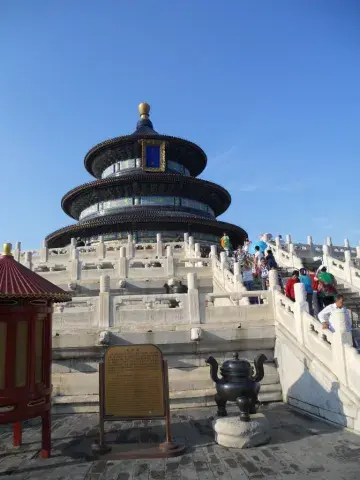
The Temple of Heaven Park is located in the Chongwen District, Beijing. Originally, this was the place where emperors of the Ming Dynasty (1368 - 1644) and Qing Dynasty (1644 - 1911) held the Heaven Worship Ceremony. It is the largest and m...

The Temple of Heaven Park is located in the Chongwen District, Beijing. Originally, this was the place where emperors of the Ming Dynasty (1368 - 1644) and Qing Dynasty (1644 - 1911) held the Heaven Worship Ceremony. It is the largest and most representative existing masterpiece among China's ancient sacrificial buildings. First built in 1420, the 18th year of the reign of Emperor Yongle of the Ming Dynasty (1368 - 1644), it was enlarged and rebuilt during the reigns of the Ming emperor Jiajing and the Qing emperor Qianlong. In 1988, it was opened to the public as a park, showing ancient philosophy, history and religion. Its grand architectural style and profound cultural connotation give an insight into the practices of the ancient Eastern civilization.

Covering an area of 2,700,000 square meters (3,529,412 square yards), it is larger than the Forbidden City. As the 'Sons of Heaven’, Chinese emperors were precluded from building a dwelling for themselves that was greater than the earthly residence dedicated to Heaven hence the difference in overall size of the two complexes. The temple is enclosed by a long wall. The northern part within the wall is semicircular symbolizing the heavens and the southern part is square symbolizing the earth. The northern part is higher than the southern part. This design shows that the heaven is high and the earth is low and the design reflected an ancient Chinese thought of 'the heaven is round and the earth is square'.

The Temple is divided by two encircling walls into an inner part and outer part. The main buildings lie at the south and north ends of the middle axis of the inner part. The most magnificent buildings are the Circular Mound Altar (Huanqiutan), the Imperial Vault of Heaven (Huangqiongyu) and the Hall of Prayer for Good Harvest (Qiniandian) from south to north.

Take subway line 5 arrive staision at Tiantandongmen get out from exit A 

China Articles

Top China Tours

$238 Per Day

Private Hangzhou Day Trip from Shanghai by Bullet Train

Take in the highlights of beautiful Hangzhou on a private full-day tour from Shanghai. After hotel pickup and transfer by high-speed train to Hangzhou, your private guide takes you to see some city attractions, such as Faxi temple. Moreover, enjoy a tasty lunch at a local restaurant before heading to Longjing village. There, learn about the process of farming and producing dragonwell tea, the region’s most famous product. Finally, enjoy a scenic boat cruise on UNESCO World Heritage-listed West Lake before returning to Shanghai.

This is a private, full-day trip from Shanghai to Hangzhou. After you are picked up in your hotel lobby in the early morning, you will take a bullet train to Hangzhou. This is the fastest way to Hangzhou and you can experience train speeds of up to 300 kilometers per hour. Your tour begins at one of Hangzhou's signature sites, the West Lake. Enjoy a lake cruise to see the top ten West Lake scenic views. You will then be taken to experience the wonderful cuisine of Hangzhou at a local restaurant. After lunch, you will visit Faxi temple, a well-known Temple dating back to the Jin Dynasty. See its famous wooden Buddha. Here, you will see fewer tourists and more locals. Finally, enjoy a cup of green tea when you visit the famous Longjing village to see wild fields of Longjing tea bushes where the locals produce the world famous green tea- Longjing Tea. In the village, all locals are tea farmers and you will see the entire procedure of making the famous tea and will get the chance to taste the best quality emperor tea. Afterwards, you will take the bullet train back to Shanghai and you will be returned to your hotel.


$150 Per Day

Guangzhou

Day 1 Arrive in Guangzhou

Arrive in Guangzhou in the morning, you will be met and transferred to hotel, then visit Sun Yat-sen Memorial Hall. The Memorial Hall is a very famous historical scenic spot. It is in memory of Sun Yat-sen, the great revolutionary forerunner. After that proceed to visit the Ancestral Temple of the Chen Family. It is a unique site for offering up sacrifices to worship ancestors of 72 Chen families in Guangdong. This ancestral temple is also the largest, best preserved and best decorated ancient architecture existing in Guangdong province.

Day 2 Guanzhou Tour 

After breakfast, you will go to Yuexiu Park first, the largest and the most famous park in downtown Guangzhou. There are three artificial lakes and seven hills of Yuexiu Mountain. Then you will visit Temple of Six Banyan Trees, which is one of the four best Buddhist temples in Guangzhou and located on the Liurong Road (meaning the Six Banyan Trees Road). The Nanyue King Tomb Museum is a must-see Guangzhou attraction, which dates back to 2,000 years ago, is the earliest large scale painted stone chamber tomb ever found south of the Five Ridges. Buried with the tomb owner in a jade shroud are a gold seal and a lot of exquisite jade adornments. It has become a world famous museum. After the day tour you will be transferred to airport for your next destination.

$53 Per Day

Pingyao Highlights Walking Tour

Pingyao Highlights Walking Day Tour

With our guide to know the Ancient Pingyao better!

Our guide will meet you at your hotel lobby at 08:00 or 08:30, then show you the ticket office to get the ticket for the museums we will visit later.

First we will visit the 700 years old City wall, We will climb up from south gate and have a walk on the wall. We are not sure how many km we can walk, because of the renovating of the wall. Normally we will walk from south gate to the Yunlu Exit.

Then visit the Confucius temple, there is a old building named Dacheng Hall which is over 840 years old. From outside, we can see the big wood joints to lift the big roof around the building which is named Dougong. Due to this design, there are less columns inside the hall for giving the big space for the statues and the prayer. We have chance to see the Confucius statue and learn the philosophy of Confucius. If you like, you can pray for you and your children to get better study.

There is the Paper Cutting master named Wentao nearby the exit of Confucius temple. She is very smart and create the new style paper cutting with much more details and good wishes on it. Her products are made by hanks. It is worth to visit and buy as a souvenir from Pingyao. From the table standing and wall hangings. Please remember, take the red one because of red is the traditional and happy color. But the white one is the best. It is really difficult to choose, because of all of them are really nice.

Then you can have coffee break or tea break if you need at Chummy coffee, after this, visit the City god temple (ChenghuangMiao) which is most beautiful temple inside the wall. Because of the roof is covered by the colorful glazed tiles. There is not only city god and also the three money gods, Now you know why pingyao was the financial center.

Next we will visit the Ancient government building, to see the pingyao politics center in the ancient time. It is the complete building with officials bed room, kitchen and private garden. Follow the guide to look the official’s life from the 250km far away from the hometown.

Have a stroll in the alley to the Rishengchang exchange bank, which is the first bank all of china.You can not miss it.

After lunch, walk to the Ming and Qing street, this is the shopping street full of the stores on the both side of street. You can find alot things here , from post card to lacquered boxes, and wall panels. One more place to see, it is the Armed escort agency also named security and transport service for the business man before the bank founded.

Inlcusions

1.private english speaking tour guide servcie

2.bottle water for the tour