Beijing Attractions
National Art Museum of China
The National Art Museum of China (NAMOC) is a national museum dedicated to the collection, research and exhibitions of modern and contemporary artistic works in China. In June 1963, Chairman Mao Zedong inscribed the Chinese-language title board of the museum, which demonstrated its...
The National Art Museum of China (NAMOC) is a national museum dedicated to the collection, research and exhibitions of modern and contemporary artistic works in China. In June 1963, Chairman Mao Zedong inscribed the Chinese-language title board of the museum, which demonstrated its position as a national art museum and the nature of its establishment. The main building features the styles of ancient Chinese attics and ethnic architecture, which is roofed with yellow glazed tiles and surrounded by corridors and pavilions.
The building covers an area of more than 18,000 square meters with 17 exhibition halls from the first floor to the fifth. The museum boasts an exhibition area of 8,300 square meters and a length of 2,110 meters. Nine halls on the first floor cover an area of 5,100 square meters and a length of 1,400 meters; five halls on the third floor have an area of 2,000 square meters and a length of 429 meters, and three halls on the fifth floor cover an area of 1,200 square meters and a length of 235 meters. A modern storeroom founded in 1995 covers an area of 4,100 square meters.
The museum houses more than 100,000 pieces of various collections, most of which are creations around the establishment of new China. Some collections are masterpieces from the late Ming Dynasty, the Qing Dynasty and the early Republic of China. Most collections are modern and contemporary works, including masterpieces of renowned contemporary Chinese artists, award-winning works from major art exhibitions, and various folk works. Included are such painters as Ren Bonian, Wu Changshuo, Huang Binhong, Qi Baishi, Xu Beihong, Jiang Zhaohe, Situ Qiao, Li Keran, Wu Zuoren, Ye Qianyu, Luo Gongliu and Wu Guanzhong. The museum also collects hundreds of foreign artistic works. German collectors Mr. and Mrs. Peter Ludwig donated 117 pieces of foreign works in 1999, including four oil paintings by Picasso.
Bus: 2, 3, 8, 60, 101, 103, 104, 108, 109, 111, 112, 420, 810, 814, 819
National Art Museum of China
The National Art Museum of China (NAMOC) is a national museum dedicated to the collection, research and exhibitions of modern and contemporary artistic works in China. In June 1963, Chairman Mao Zedong inscribed the Chinese-language title board of the museum, which demonstrated its...
The National Art Museum of China (NAMOC) is a national museum dedicated to the collection, research and exhibitions of modern and contemporary artistic works in China. In June 1963, Chairman Mao Zedong inscribed the Chinese-language title board of the museum, which demonstrated its position as a national art museum and the nature of its establishment. The main building features the styles of ancient Chinese attics and ethnic architecture, which is roofed with yellow glazed tiles and surrounded by corridors and pavilions.
The building covers an area of more than 18,000 square meters with 17 exhibition halls from the first floor to the fifth. The museum boasts an exhibition area of 8,300 square meters and a length of 2,110 meters. Nine halls on the first floor cover an area of 5,100 square meters and a length of 1,400 meters; five halls on the third floor have an area of 2,000 square meters and a length of 429 meters, and three halls on the fifth floor cover an area of 1,200 square meters and a length of 235 meters. A modern storeroom founded in 1995 covers an area of 4,100 square meters.
The museum houses more than 100,000 pieces of various collections, most of which are creations around the establishment of new China. Some collections are masterpieces from the late Ming Dynasty, the Qing Dynasty and the early Republic of China. Most collections are modern and contemporary works, including masterpieces of renowned contemporary Chinese artists, award-winning works from major art exhibitions, and various folk works. Included are such painters as Ren Bonian, Wu Changshuo, Huang Binhong, Qi Baishi, Xu Beihong, Jiang Zhaohe, Situ Qiao, Li Keran, Wu Zuoren, Ye Qianyu, Luo Gongliu and Wu Guanzhong. The museum also collects hundreds of foreign artistic works. German collectors Mr. and Mrs. Peter Ludwig donated 117 pieces of foreign works in 1999, including four oil paintings by Picasso.
The robust development of the museum benefits greatly from the support of the Central government and the direct leadership of the Ministry of Culture. The Central government established a special collection fund, which laid a solid foundation for the museum's collection of precious works. Quite a few collectors and artists donated their collections to the museum as an act of social responsibility and a strong belief in offering art to the masses, which provided rich resources for the collection. In recent years, the museum has constantly accepted ever-larger donations from such artists and their families as Li Pingfan, Liu Xun, Zhang Ding, Hua Junwu, Zao Wangyun, Tang Yihe, Hua Tianyou, Wen Lou, Wu Zuoren, Jin Shangyi, Wu Guanzhong
Over the past four decades, the museum has held thousands of influential exhibitions of different kinds featuring renowned artists from home and abroad. Apart from influential domestic exhibitions, numerous international exhibitions are as follows: "Original Works Exhibition of 500 Years Collected by Armand Hammer", "Rural Landscape Painting Exhibition of the 19th Century in France", "Original Works Exhibition of Pablo Picasso", "Engraved Painting Exhibition of German Expressionism", "Art Exhibition of Auguste Rodin", "Art Exhibition of Marc Chagall", "Oriental Spirit: Art Exhibition of Joan Miro", "Collection Exhibition of Austrian National Museum", "Grand Exhibition of African Art", "Art Exhibition of Salvador Dali", "Painting Exhibition of French Impressionism", "300 Years of Russian Arts--State-run Terichekov Fine Arts Museum Treasures Exhibition" (an important exhibition of "Year of Russia" in 2006), "Art in America 300 Years of Innovation", "Italian art- Italian life "(an important exhibition of "Year of Italy" in 2006) and "From Titian to Goya Masterpieces from the Prado Museum"(an important exhibition of "Year of Spain" in 2007). “The Lights of Dun Huang”, held in 2008, set three new records for the number of daily, monthly and singular visitors, attracting 660,000 visitors in two months. The museum has established itself as an important shrine of art bringing aesthetic education to the people.
In order to become a national modern museum with international standards, the museum began reconstruction of the main building in May 2002. A variety of facilities have achieved the national leading level after it was completed in May 2003, including exhibition halls, illumination, self-control, constant temperature and humidity, fire control and alarm, and security control system. The new museum has adopted new technology of modern construction, expanded the traditional pattern and enriched new connotations of the ethnic construction tradition. At its 40th anniversary on July 23, 2003, the museum reopened to the public and attracted great attention from artistic circles from home and abroad.
In line with the request of the national cultural construction, the museum has gained recognition from the State Council in its expansion, which has been enlisted in the national 11th five-year plan and is in good preparation.
The leaders of the museum are Director Fan Di'an along with Yin Fu, Ma Shulin and Liang Jiang.
Bus: 2, 3, 8, 60, 101, 103, 104, 108, 109, 111, 112, 420, 810, 814, 819
Beijing Articles

a coat with one hundreds children
This was a coat of one empress in Ming dynasty. The empress in the old days were the most powerful woman, she was also the model of the women. So she should do very kind to every person. She made a coat with one hundred different children on it....
This was a coat of one empress in Ming dynasty. The empress in the old days were the most powerful woman, she was also the model of the women. So she should do very kind to every person. She made a coat with one hundred different children on it. Actually, as the folklore, this empress could not give a baby, so she laid her hope on the coat.
three-inch-lotus feet
May be many friends once heard the foot binding custom in the ancient China。Today that me talk about the history about foot binding as I knew. It starts from the Song dynasty, may be around AD 960-1279. Even today, you can see the women with very small feet walking on the street....
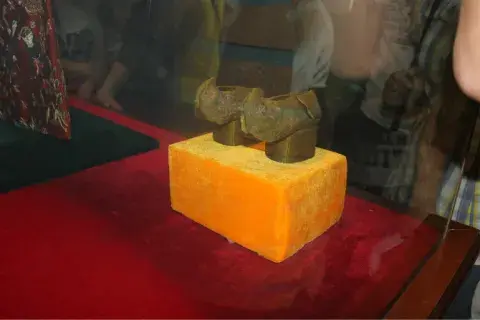
May be many friends once heard the foot binding custom in the ancient China。Today that me talk about the history about foot binding as I knew. It starts from the Song dynasty, may be around AD 960-1279. Even today, you can see the women with very small feet walking on the street. But they are at least above 80 years old. The people in my grandparent’s generation could see the procedure of foot binding. In the old days, the standard to judge whether you are a good woman is how much you know literature, politics, mathematics, etc. The less you know, the better you are. It sounds strange, right? But that is the true judgment of that time. At that time, women were not allow go outside very often. The women with binding feet can not walk fast. They start bind their feet when they were children. Using cloth bind their feet closely, protecting from grow, the painful could lasts until they were adult. The picture below are the shoes women wore in old days. They were smaller than a palm.
The most popular shopping area in Beijing
The most popular shopping street in Beijing
1.wangfujing. It is the oldest street in Beijing ,close to the forbidden city ,you can find the chinese style , western style here , it is a walking street .
...The most popular shopping street in Beijing
1.wangfujing. It is the oldest street in Beijing ,close to the forbidden city ,you can find the chinese style , western style here , it is a walking street .
2. Qianmen .located on the south of the tiananmen square,it is a combination of modern and tradition.you can also find the traditional bus there , take your mind back to 50years ago.
3.silk street ,.you can find all kinds of the world brand ,such as Gucci Armani , Herman's ,Louis Vuitton .rolex .but they are all copy , bargain is very important if you are here,
4.pearl market , it is the samiliar as the silk street. You can also find many pearls here.
Top Beijing Tours
$200 Per Day
Private Beijing Antique Shopping Tour with Lunch
Start your private tour with pickup from your central Beijing hotel, and meet your private guide.
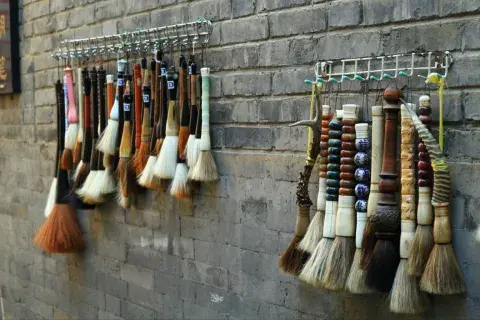
Hop inside your private, climate-controlled vehicle and travel to your first stop: Liulichang Antique Street. Situated in old Beijing, this history-steeped street is lined with stone shop-houses selling antique books, handicrafts, paintings, rubbings, glazed pottery, and other treasures.
Hear about Liulichang’s history, and get advice from your guide as to the best shopping opportunities....Read more
Start your private tour with pickup from your central Beijing hotel, and meet your private guide.
Hop inside your private, climate-controlled vehicle and travel to your first stop: Liulichang Antique Street. Situated in old Beijing, this history-steeped street is lined with stone shop-houses selling antique books, handicrafts, paintings, rubbings, glazed pottery, and other treasures.
Hear about Liulichang’s history, and get advice from your guide as to the best shopping opportunities. Sift through the traditional shops and stands, and explore the side lanes (hutongs), where the shops still bear original Ming and Qing architectural features like ornately carved doors and upswept roofs.
Next, drive to Panjiayuan Market, a so-called ‘weekend market’ that’s open daily. Weave through the throng of stands, perusing the huge array of antiques, curios, ceramics, Tibetan rugs, calligraphy, and other finds.
After shopping here, refuel with lunch at a Chinese restaurant, and continue to Baoguosi Cultural Market, set around an old temple. Scour the courtyards of vendors hawking stamps, books, coins and jade, and get tips on scouting out and clinching the best deals from your guide.
If time allows, squeeze in a visit to Hongqiao Market, a mall known for its pearl traders, and electronics, art, clothes, and accessories shops. Trawl for bargains, and haggle over pearls and other precious gems as perfect keepsakes of your time in Beijing.
After seven hours, your tour concludes with a hotel drop-off.
$50 Per Day
One day tirp to Bajiao Zhai, a noticeable Danxia Landform.
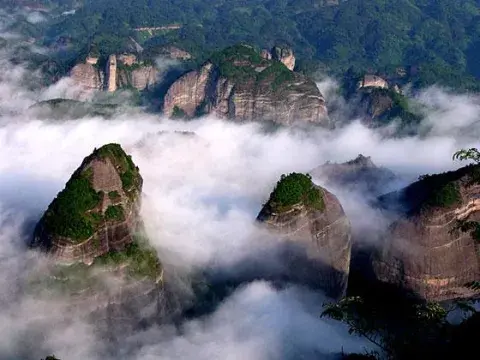
This is a tailor-made trip for nature-lovers and fans of photography. Danxia rock formation in the inland basin is a red rock debris, and later uplift due to the movement of the earth-crust, erosion of rocks by the water and weathering, which was dominant in the hillside to collapse back, kept down the rocks to form the red mountain block. This area was listed in the Natural Heritage of the world in 2009 by UNESCO. Bajiao Zhai Village is a combination of strategic place, steepy mountian, elegant scenery and secluded remote....Read more
This is a tailor-made trip for nature-lovers and fans of photography. Danxia rock formation in the inland basin is a red rock debris, and later uplift due to the movement of the earth-crust, erosion of rocks by the water and weathering, which was dominant in the hillside to collapse back, kept down the rocks to form the red mountain block. This area was listed in the Natural Heritage of the world in 2009 by UNESCO. Bajiao Zhai Village is a combination of strategic place, steepy mountian, elegant scenery and secluded remote. It is reputed as the "Soul of Danxia Landform". Here you can enjoy the sunrise or sunset and the sea-cloud. 1. I'll pick you up at 8:00 am in your hotel, and transfer to Bajiao Zhai Village by our private van. On the way, you can enjoy some terraced fields, bamboo groves and the wooden residences of the natives.(3.5 hours by ride) 2. First, we'll visit the village and have lunch in the village, and then we'll hike the mountains, the scenery including the group of snails looking up the sky, the ancient trail, Eye-stone, Joss stick of dragon's head and the Treasured sword Peak.(4 hours by hike) 3. After appreciating the sunset, after dinner in Ziyuan county, we'll take the bus back to your hotel around 10:00 pm.