Beijing Attractions
Beijing Articles
Circular City
Circular City
...Circular City
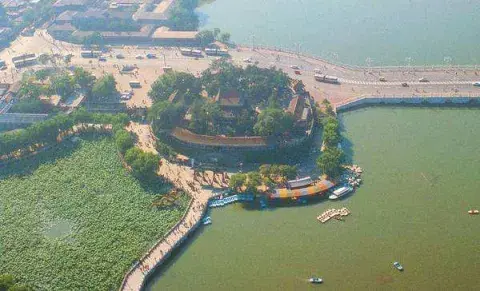
Finally you can visit the Circular City right at the southwestern corner. The city wall stands about 15 feet (4.6 meters) high and has a circumference of 910 feet (277 meters). Among the various places to visit in the Circular City including halls, towers and pavilions, the most important construction is the Chengguang Hall which holds the extremely precious white jade statue of Buddha introduced from Burma at the end of Qing Dynasty. In front of the hall is a grand urn made of variegated dark jade. With a diameter of 4.9 feet (1.5 meters), a circumference of 16.4 feet (5 meters), a height of 2.3 feet (0.7 meters) and a weighing 3.5 tons, the urn used to be the vessel of Kublai Khan for storing wine.
While visiting these famous and interesting places in it, you could have a meal and rest in Fangshan Restaurant located at the northern shore of the lake. This restaurant was started in 1925 by a cook who formerly worked in the Qing court, so the food there is said to be of delicious imperial flavor.
Besides these places of interest, there are plenty of exhibitions to see. These include the yearly exhibition of water lilies and other water plants in the Botanical Garden, the exhibition of peonies, and varied picture shows, making it not only the center of history and culture in Beijing, but also the center of ecological and natural beauty. Now, an ancient but modern park welcomes you from all over the world.
Nine-Dragon Screen
Nine-Dragon Screen
...
Nine-Dragon Screen
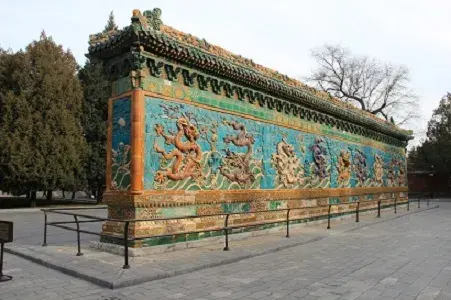
To the northwest lies the well-known Nine-Dragon Screen, which is the only screen having nine huge dragons on both sides among the most famous three Nine-Dragon Screens in China (the other two are respectively in the Forbidden City and Datong, Shanxi Province). Built in 1756, the Nine-Dragon Screen is about 90 feet (27 meters) long, 21.8 feet (6.65 meters) high and 4.7 feet (1.42 meters) thick. It is composed of 424 seven-color glazed tiles that embossing the screen. There are nine huge coiling dragons on each side of the screen and big or small dragons in different postures decorating the two ends and the eaves, making a surprising total of 635 dragons. Even after 200 years, the Nine-Dragon Screen is still bright in color and complete in appearance, showing the high techniques of Chinese arts and crafts in ancient times.
Hao Pu Creek (Haopujian) Garden
Hao Pu Creek (Haopujian) Garden
...
Hao Pu Creek (Haopujian) Garden
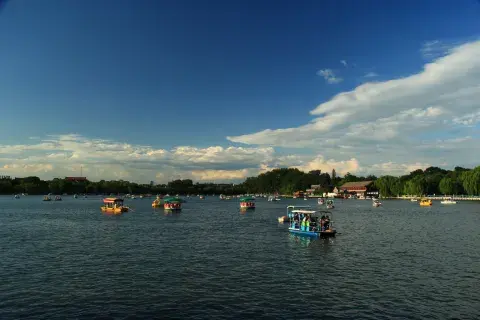
After visiting the Qionghua Islet, you can cross the Zhishan Bridge to the Eastern Shore Scenic Area which has many independent gardens within it such as the Painted Boat (Huafang) Studio and the Hao Pu Creek Garden.
Created in 1757, the Hao Pu Creek Garden is one of the best gardens-within-gardens of the existing imperial gardens in China. 'Hao' and 'Pu' were the ancient names of two rivers in Anhui Province. There is a story that goes like this: in the Warring States Period (475 - 221 B.C.), Zhuangzi and Huizi (two famous philosophers of ancient China) argued with each other on the bridge over the Hao River. Zhuangzi said: 'How happy are the fish in the river!' Huizi responded: 'You are not a fish. Then how can you know whether the fish are happy or not?' Zhuangzi answered: 'You are not me. Then how can you know that I don't know the happiness of the fish?' This story inspired Emperor Qianlong to build the Hao Pu Creek Garden to seek happiness and relaxation as free as fish in the river. So the garden is designed for tranquility and happiness, featuring a special mountain-water structure to give the impression of a deep valley which gives seclusion from society.
Top Beijing Tours
$200 Per Day
Private Beijing Antique Shopping Tour with Lunch
Start your private tour with pickup from your central Beijing hotel, and meet your private guide.
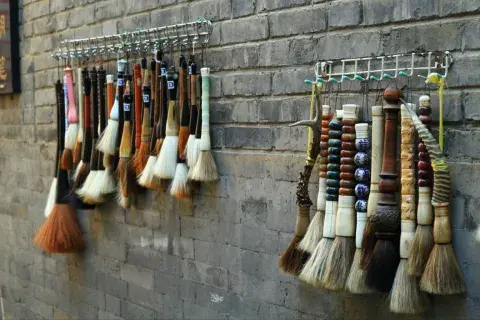
Hop inside your private, climate-controlled vehicle and travel to your first stop: Liulichang Antique Street. Situated in old Beijing, this history-steeped street is lined with stone shop-houses selling antique books, handicrafts, paintings, rubbings, glazed pottery, and other treasures.
Hear about Liulichang’s history, and get advice from your guide as to the best shopping opportunities....Read more
Start your private tour with pickup from your central Beijing hotel, and meet your private guide.
Hop inside your private, climate-controlled vehicle and travel to your first stop: Liulichang Antique Street. Situated in old Beijing, this history-steeped street is lined with stone shop-houses selling antique books, handicrafts, paintings, rubbings, glazed pottery, and other treasures.
Hear about Liulichang’s history, and get advice from your guide as to the best shopping opportunities. Sift through the traditional shops and stands, and explore the side lanes (hutongs), where the shops still bear original Ming and Qing architectural features like ornately carved doors and upswept roofs.
Next, drive to Panjiayuan Market, a so-called ‘weekend market’ that’s open daily. Weave through the throng of stands, perusing the huge array of antiques, curios, ceramics, Tibetan rugs, calligraphy, and other finds.
After shopping here, refuel with lunch at a Chinese restaurant, and continue to Baoguosi Cultural Market, set around an old temple. Scour the courtyards of vendors hawking stamps, books, coins and jade, and get tips on scouting out and clinching the best deals from your guide.
If time allows, squeeze in a visit to Hongqiao Market, a mall known for its pearl traders, and electronics, art, clothes, and accessories shops. Trawl for bargains, and haggle over pearls and other precious gems as perfect keepsakes of your time in Beijing.
After seven hours, your tour concludes with a hotel drop-off.
$50 Per Day
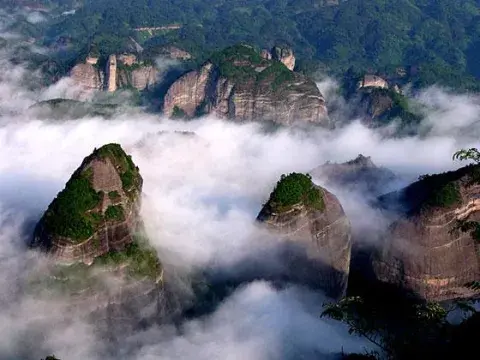
One day tirp to Bajiao Zhai, a noticeable Danxia Landform.
This is a tailor-made trip for nature-lovers and fans of photography. Danxia rock formation in the inland basin is a red rock debris, and later uplift due to the movement of the earth-crust, erosion of rocks by the water and weathering, which was dominant in the hillside to collapse back, kept down the rocks to form the red mountain block. This area was listed in the Natural Heritage of the world in 2009 by UNESCO. Bajiao Zhai Village is a combination of strategic place, steepy mountian, elegant scenery and secluded remote....Read more
This is a tailor-made trip for nature-lovers and fans of photography. Danxia rock formation in the inland basin is a red rock debris, and later uplift due to the movement of the earth-crust, erosion of rocks by the water and weathering, which was dominant in the hillside to collapse back, kept down the rocks to form the red mountain block. This area was listed in the Natural Heritage of the world in 2009 by UNESCO. Bajiao Zhai Village is a combination of strategic place, steepy mountian, elegant scenery and secluded remote. It is reputed as the "Soul of Danxia Landform". Here you can enjoy the sunrise or sunset and the sea-cloud. 1. I'll pick you up at 8:00 am in your hotel, and transfer to Bajiao Zhai Village by our private van. On the way, you can enjoy some terraced fields, bamboo groves and the wooden residences of the natives.(3.5 hours by ride) 2. First, we'll visit the village and have lunch in the village, and then we'll hike the mountains, the scenery including the group of snails looking up the sky, the ancient trail, Eye-stone, Joss stick of dragon's head and the Treasured sword Peak.(4 hours by hike) 3. After appreciating the sunset, after dinner in Ziyuan county, we'll take the bus back to your hotel around 10:00 pm.