Jiuzhaigou Valley

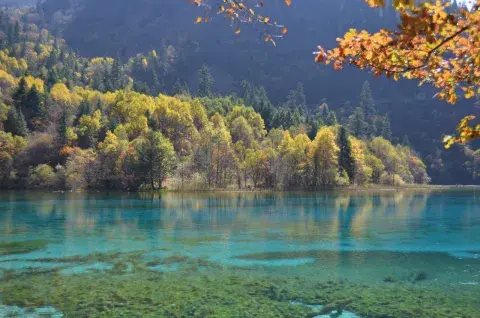
There is a chinese saying: "九寨归来不看水." It means: You have no wish to visit any other lakes after viewing the Jiuzhaigou Valley. The colourful lakes and snow mountains in Jiuzhaigou make it like a fairyland in the world, espacially in autumn, the leaves change colour into yellow, orange, red...make...

There is a chinese saying: "九寨归来不看水." It means: You have no wish to visit any other lakes after viewing the Jiuzhaigou Valley. The colourful lakes and snow mountains in Jiuzhaigou make it like a fairyland in the world, espacially in autumn, the leaves change colour into yellow, orange, red...make the whole valley looks like a colourful painting!

Jiuzhaigou takes it's name from the nine tibetan villages in the valley. Jiu means nine, zhai means village, gou means valley.

As a most popular scenic spot in China, the per day visitors number was once up to 30,000 in the national day of 2013! This made a big trouble for the park at that time, so as such popular place to go in China, you'd better not to go there in chinese national holiday, otherwise you can only see people mountain and people sea(人山人海)!

And the last thing to remind you is: even the park is close at 5:30pm, but usaully the workers in the park will ask you to take the last sightseeing bus at 4:30 in the park to go down  if you are still at somewhere far from the gate , because it is really a big park, it gonna take you quite a long time to visit along the way back. So if you want to visit the whole spots in the park, better to hurry up when visiting.
 

Mt.Siguniang( four girls)

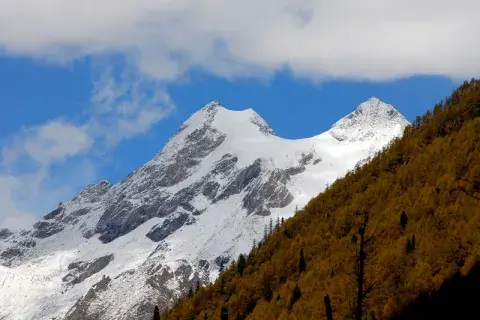
Mt. Siguniang( Four Maidens Mountain) is situated  in the middle of Mt.Qionglai Range in the buffer zone between the west Sichuan Plateau and the mountainous area on the rim of Sichuan Basin, where Xiaojin County and Wenchuan County of Aba Tibetan and Qiang Autonomous Prefecture in Sichuan P...

Mt. Siguniang( Four Maidens Mountain) is situated  in the middle of Mt.Qionglai Range in the buffer zone between the west Sichuan Plateau and the mountainous area on the rim of Sichuan Basin, where Xiaojin County and Wenchuan County of Aba Tibetan and Qiang Autonomous Prefecture in Sichuan Province meet. The whole scenic area covers 2,000 square kilometers.

The name of Siguniang( four maidens , means the guardian deity of mountains in the Jiarong dialect of Tibetan language. In fact, the mountain is comprised of four peaks standing side by side like four girls. The peak of the Fourth Sister, with a summit elevation of 6,250 meters above sealevel, is the highest of Mt.Qionglai Range. Of all the mountains in Sichuan, it ranks second only to Mt.Gonga, “King of Mountains in Sichuan”, which is 7,556 meters above sea level. Its reputation is “Queen of Mountains in Sichuan”. The other three peaks, Mt. Third Sister, Mt.Second Sister, and Mt. Elder Sister, are 5,664, 5,454, and 5,355 meters above sea level.

As a region inhabited by the Tibetan, Qiang, Hui, Yi and Han People, with the Tibetans as the major ethnic group, Mt. Siguniang also nurthres and cherishes the old and simple folk customs of the ethnic minorities.

Taoping Qiang Village

Taoping Qiang Village is located in Aba Tibetan and Qiang Autonomous Prefecture,220km away from Chengdu.

Qiang people is one of the lodest people of 56 Peoples of China.

with the hills at its back and a river in front of it, facing the south, has a systematic and intricate layout....

Taoping Qiang Village is located in Aba Tibetan and Qiang Autonomous Prefecture,220km away from Chengdu.

Qiang people is one of the lodest people of 56 Peoples of China.

with the hills at its back and a river in front of it, facing the south, has a systematic and intricate layout. it is a

typical example of the Qiang architectural art. the stockaded village is known as "a mysterious ancient castle in the

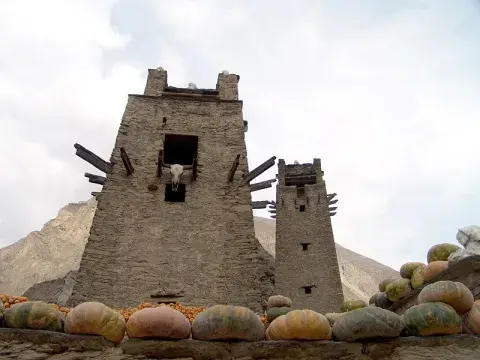
East". Among all the buildings, the blockhouse is the landmark of the Qiang village. it is the tallest building, a

stronghold which was contrusted to fight against invaders.

The Qiang blockhouses are contrusted in shapes of different kinds, such as the tetragonal, hexagonal or octagonal shapes;

some of them have thirteen or even fourteen storey, more than 30 meters in height. Most of them are made of flagstones

stuck with clay mud. The edges of the blockhouse look sharp and straight as if they were cut with a knife, and the surface

of the walls are smooth, solid and durable. They have stood aloft there for thousands of years.

Qiang Village is like a maze
When you stand on the house roof, you will find the village presents a layout of houses adjoinhing houses which are

accessible to one another. Entering the village lanes, you may think that each house is seperated, but when you wanl on the flat roofs, you will find that all the houses are connected by the roofs. with such an effective dfense system the villagers could help each other in case that someone is in trouble. The whole village is built just like a maze, where the villagers might set up ambushes and the intruders were likely to lose their way and therefore dared not dash about. Below the village, is hidden a great water network.
underground ditch that leads to every household. The ditch is lined and covered with greenish stones slabs. Spring water flows through the ditch to every household from the mountaintop so that the people can fetch water indoors. In time of war they were not afraid of being surrounded by enemy forces, as the water supply system  might help them hold fast to their post for a long time. Beside, this water network serves as a perfect fire-fighting facility and a safe underground passageway.

Looking at such plain and solid blockhouses, you can imagine how this old ethnic group has managed to survive with great tenacity and willpower in this narrow space enclosed by ranges of mountains.
Huanglong Nature Reserve

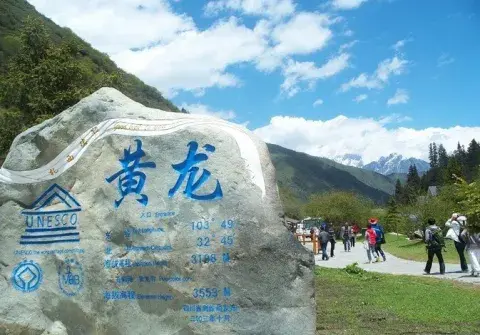
Local legend claims this area is the manifestation of a yellow dragon after its victory over a demon. In fact, Huanglong got its color from the terraced land, where water, containing rich Calcium Carbonate, flows down from the higher part of the mountain.  After millions of years of geograph...

Local legend claims this area is the manifestation of a yellow dragon after its victory over a demon. In fact, Huanglong got its color from the terraced land, where water, containing rich Calcium Carbonate, flows down from the higher part of the mountain.  After millions of years of geographical sedimentation and natural oxidation, various types of sedimentary rocks are formed under the water, and from afar, looks like a yellow dragon lying in water. Hence, its name “Huanglong – Yellow Dragon”.
Huanglong, a smaller, isolated version of Jiuzhaigou, is famed for its mountainous landscapes, colorful pools of limestone formations, diverse forest ecosystems, as well as waterf alls and hot springs. The Huanglong area also has a population of endangered animals, including the giant panda and the Sichuan golden snub-nosed monkey.
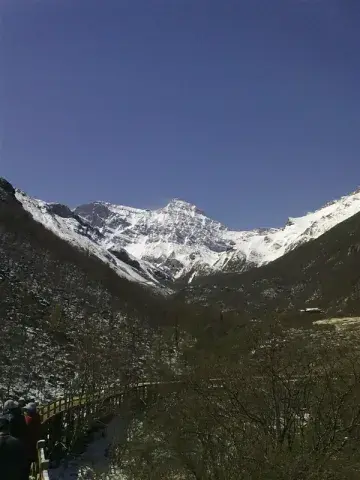
Unlike Jiuzhaigou, the Huanglong valley is filled with fascinating limestone formations formed by the water that constantly flows from the melting snow of the surrounding mountains. Xuebaoding, the main peak of the snow-capped Minshan, rising 5,588m above sea level, is covered in snow all year-round.  As the attitude here is high (at around 4,000 meters), we will take a cable car and take short walks around the park to conserve energy.