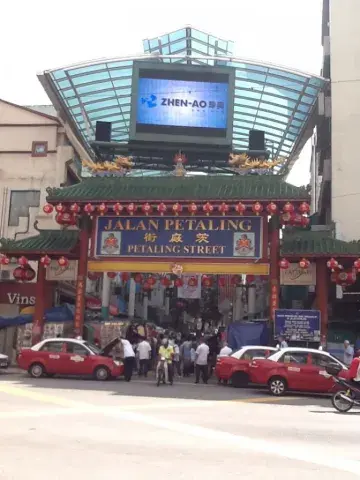
Petaling Street, Chinatown, Kuala Lumpur

Petaling Street is the Chinatown of Kuala Lumpur.

This famous street cuts through Jalan Pudu and Jalan Sultan with various hotels in Kuala Lumpur like Swiss Inn Kuala Lumpur, Ancasa Hotel and Spa and Alamanda Hotel surrounding it. There are also other budget hotels in Petaling Street such...

Petaling Street is the Chinatown of Kuala Lumpur.

This famous street cuts through Jalan Pudu and Jalan Sultan with various hotels in Kuala Lumpur like Swiss Inn Kuala Lumpur, Ancasa Hotel and Spa and Alamanda Hotel surrounding it. There are also other budget hotels in Petaling Street such as the Hotel City and Hotel China Town 2. At walking distance from Petaling Street is the Pudu Central which recently renovated to serve the public better. The Petaling Street being so close to the central hub of Kuala Lumpur, makes it a famous destination for both local and foreign tourists.

The Petaling Street (Chinatown) in Kuala Lumpur is a place where the hustling and bustling never comes to an end. Day or night, visitors keep coming to Petaling Street to either dine on the famous street foods here or to get some good bargains on things sold here.

Petaling Street is the shoppers' paradise if you want to bargain your way to some cheap things. There is almost everything here from clothes, souvenirs to electronic items to fabrics. Other than cheap stuff, Petaling Street is renowned for selling imitation goods like handbags, wallets, watches and shoes from brands like Adidas, Louis Vuitton, Calvin Klein, Nike and so on. Food here is also aplenty.

There aren't many proper shops here. Most of the shops here are the little stalls but many locals claim that at these stalls are where the best street foods can be found. A famous delicacy in Petaling Street is the salted roast duck which is sold at a mobile stall- the stall is built on a motorcycle. Be sure to be there early as the roast ducks are sold out by lunch time. Other than shopping and eating here in the Chinatown, there are other attractions nearby as well.

Two places not to be missed are the Central Market Kuala Lumpur and the Sri Mahamariamman Temple, Kuala Lumpur.

At the Central Market you can get great souvenirs which are all locally made such as kebaya, batik, songket and handicrafts. 

The Sri Mahamariamman Temple which is located at the edge of Petaling Street is the richest and oldest Hindu temple you can find in Kuala Lumpur. Its history dates back to the year of 1873 and has since been an important place of worship for the Indians here. Due to its history and influence, this temple is a vital part of the culture and heritage of Malaysia

Central Market KL

The Central Market was built in 1888 by the British Colonial Government to be used as a wet market for Kuala Lumpur's early citizens. It was here that the tin-miners bought their fresh produce and other food ingredients to feed their mine workers. It is located beside the Kla...

The Central Market was built in 1888 by the British Colonial Government to be used as a wet market for Kuala Lumpur's early citizens. It was here that the tin-miners bought their fresh produce and other food ingredients to feed their mine workers. It is located beside the Klang River as road communications were insufficient and the river was used as a main transport channel.

By 1933, further expansions were made to the market to include warehouses. As KL experienced rapid development in the 1970s, plans were made by the authorities  to demolish the site in order to make way for the Dayabumi Complex. However, there was much objection to this move to eradicate the Market and intervention by the Malaysian Heritage Society proved timely as they successfully petitioned against the destruction of the building and the site was declared as a "Heritage Site".

This wet market was very convenient to the early city dwellers because it was within the vicinity of the Klang Bus Station, a feeder bus service for KL and PJ as well as Klang. The KL Railway Station was also within walking distance. There was always the presence of fishy smells in both the buses and trains as commuters took home their provisions.

In 1985, the Central Market was renovated and renamed Pasar Seni. It ceased being a wet market and was transformed into a indoor bazaar with more than a hundred small shops, hawker centre, restaurant, fast-food outlet, selling all kinds of souvenirs and crafts, batiks etcetera. 

The Annexe building at the back of the main building houses art galleries, theatre and performing arts centre beside housing many arts & crafts shops. It is one of the major art spaces in KL and is a hotspot for creative arts activities all year round. 

The walking mall, also known as Kasturi Walk is an open-air bazaar which also sells many souvenirs besides housing street musicians and buskers.