Avatar Mountains are real, they are in Zhangjiajie China
Avatar Mountains are real, they are in Zhangjiajie China
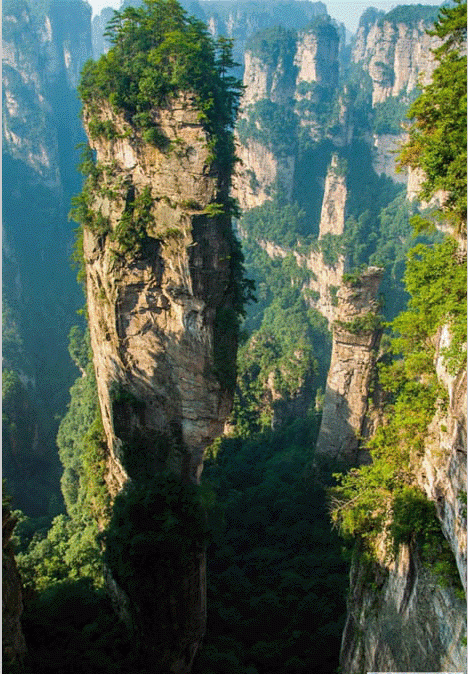
THE SOUTHERN heaven pillar, got another name called the Yuanjiajie-Avatar Mount discoved in Zhangjiajie National Forest Park Western Hunan province, central China.
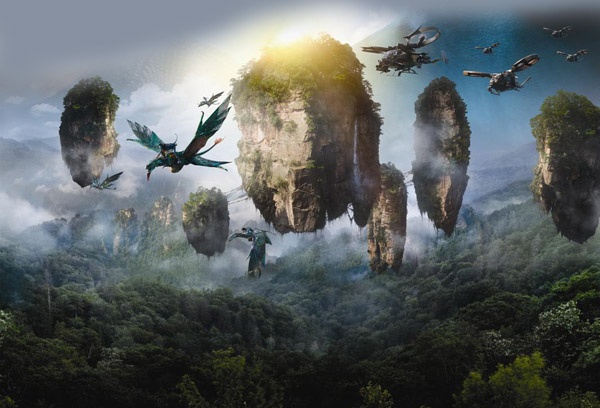
They’re not the floating, suspended-in-midair computer-generated imagery creations, of course, that director James Cameron gave wrong credit in his blockbuster movie as the planet Pandora’s Hallelujah Mountains.
But they’re the original inspiration—an immense, scenic spread of mountain pillars in Zhangjiajie National Forest Park in the south-central Chinese Hunan province that served as the prototype for “Avatar’s” fictive diorama of hanging, mist-shrouded peaks where Pandora’s fearsome “ikran” dragon birds had their nesting grounds.
The 2010 Hollywood movie opted to make the mountains even more otherworldly-looking, but the real ones can very well stand on their own in terms of jaw-dropping impact.
Zhangjiajie sunrise &sunset is one of the four wonders in Zhangjiajie, it is very important to know the right time of sunrise, so you will not have to wait long time or miss the sunrise, Zhangjiajie sunrise is usually at around 06:15 in June, it will be 8 minutes delay every month from June. Weather is also very important, stars twinkling night indicates good sunrise in the morning. The best location to see the sunrise is grand platform (Daguantai 大观台), the second best location is Laowuchang (老屋场) and one step to heaven ( 一步登天)。
Sunrise days are less than 100 days, Yuanjiajie-Avatar Mount, Tianzi Mountain, Huangshizhai village are good places, Tianzi mount top cable station and Grand platform are most recommended sunrise location.
The most reasonable time in Spring is from 05:40 to 07:20,
05:00 to 06:30 in Summer and Autumn;
06:30 to 08:00 in Winter.
Sunset
Sunset time is usually at 07:30 pm in June, it will be 24 minutes early every month after June or before June,
The best location is Tianbo fu (天波府),the second best places are Laowuchang (老屋场),one step to heaven (一步登天) and sky corridor (空中走廊)
The best time to see the Sun set is the third sunny day after heavy rain, there is blue sky with white clouds, and the sun is at the best time, we can 5-color Sunset.
Tianzi Mountain, from where the best vistas of the giant rock columns can be had, is merely part of the larger Zhangjiajie National Park, which in turn is within Hunan’s sprawling Wulingyuan Scenic Zone, declared a Unesco World Heritage Site in 1992 for its topography, found nowhere else in the world, of some 3,000 freestanding sandstone pillars that soar into the sky, their peaks capped with green foliage defiantly clinging to the sheer cliff walls.
The natural scenery, wild and rugged and pretty much untouched, is as far as possible from the sights travelers now normally associate with modern China—the headlong bustle of Beijing or the glitter of Shanghai and Macau, for instance. Once visitors to Tianzi have gone up to the view decks via the Bailong Lift, a glass lift that park authority claim is the tallest and fastest of its kind in the world (a plausible claim—the ride shoots to the top of the mountain range within a couple of minutes), they can be forgiven for thinking they’ve stepped indeed into another planet. The view is absolutely heart-stopping.
.
Hollywood association
The tour is so named because the Chinese themselves have had no qualms appropriating the Hollywood movie to draw more interest to the natural wonder in their midst. Everywhere in the park are reminders of its now ineradicable association with a pop artifact: huge billboard blending images of the finger-like mountain pillars with “Avatar” actor Sam Worthington’s Na’vi visage; “Avatar” memorabilia in every gift shop; even life-size replicas of a Na’vi strategically perched on a cliff, and a dragon bird in another part of the park.
More tellingly, the Tujia people of Hunan province have themselves given assent to the official renaming of an iconic rock pillar called the Southern Sky Column into, that’s it, the Avatar Hallelujah Mountain, in acknowledgment of the movie that has significantly improved tourism to their province and city.
One’s sense of vastness and immensity will continually be challenged in this part of China. Tianzi Mountain’s giant stelae, for instance, find their underground echo in Yellow Dragon Cave , a 48-hectare system of cavernous passageways, pools and waterfalls, cathedral-like halls and domes, and millennia-old stalactites and stalagmites, the imposing rock altars eerily (alright, garishly) lit in various colors.
The entire cave system, it turns out, is wired; and some 2,000 man-made steps have been constructed—discreetly, the growing mounds of stalagmite left in their places, sometimes in the middle of a passageway—to help visitors navigate the bowels of the cave. The exhausting but exhilarating tour ends with a boat ride on an underground river.
Sky-high
From deep underneath, one can go sky-high again at the nearby Tianmen Mountain, at nearly 5,000 feet (the highest peak in Zhangjiajie city) an impressively well-developed scenic spot that is a testament to the Chinese’s technological and commercial savvy. The 30-minute cable car ride going up allows visitors to glide over the sheer sides of mountains, over pristine forests and streams, up into a park whose main pull is twofold.
There’s the Glass walkway, a path built into the mountainside with a see-through floor, the view underneath a sheer drop into milky nothingness on a misty day (“If you are bold enough, why not challenge this ‘transparent stimulation?’”, goes the inscription by the entrance); and a 999-step climb into “Heaven’s Gate,” a venerated natural giant hole at the top of the mountain that veritably looks like a gateway to another dimension.
That dramatic natural monument, already suffused with local mythology and romance, becomes even more compelling a sight at night, when a musical production created by famed director Zhang Yimou, based on an old folk tale about a woodman and a fairy fox, plays at a specially made open-air theater at the foot of the mountain. The sheer scale of the show—some 500 performers, magnificent costumes, a sprawling set that transforms into a waterfall, LED technology and special effects that seamlessly meld with the human actors onstage—is topped only by the final colossal flourish: the facade of the mountain blasted with light, creating the kind of engorged backdrop only the director of “Hero,” “House of Flying Daggers,” “Curse of the Golden Flower,” and the Beijing Olympics opening ceremonies—aided by China’s tremendous wealth, of course—could conjure.
Compared to these two, Zhangjiajie and its variety of mountain lures remain the rarer destination; but thanks to a Hollywood blockbuster that is changing fast. See them now, before those long-silent mountain pillars begin resounding with even more human din.