A'chang Nationality
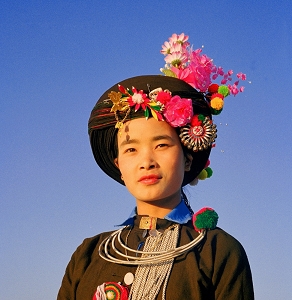
The population of the A’chang nationality is only 29,000. They live in compact communities in Jiubao, Xiangsong of Lianghe County; Husa of Longchuan County in Dehong Prefecture. A small number of them are distributed in Mangshi, Yingjiang, Tengchong and Longling counties. A'chang group developed from the ancient “Xunchuan” Tribe. They were called “E’chang” and "A'chang” before the Yuan and Ming dynasties. Those living in Husa called themselves "Mengsa”, "Mengsashan” or “Chensa”, while those in Lianghe County addressed themselves as “Hansan” and "A’chang”. After liberation, they were collectively named A’chang Nationality.
A’chang people have their own language which belongs to A’chang Branch in Tibeto-Burman Family of Sino-Tibetan Language System. Many A’chang people speak Mandarin and Dai language. Some speak Jingpo language and Burmese. They use Han and Dai written systems.
A’chang people are good at casting ironware. Their swords and knives are sharp and beautiful, and sought after by different ethnic groups. Husa Swords are known to all.
A’chang people believe in supernatural beings and worship their ancestors. They also believe in Hinayana Buddhism. Their major festival is the Water Splashing Festival. But they also celebrate Huijie Festival in mid lunar September; on this occasion, besides trading, they perform with blue dragons and white elephants made of bamboo and paper, as well as the elephant-leg-shaped musical instrument. But the grandest of all is Woluo Festival which falls on lunar January 4th. They dance and sing far into the night. A’chang people are good at singing folk songs. There is a saying that when three A’chang people sing, the whole mountain will be filled with their songs.
A’chang girls often coil their hair up. They wear coats with buttons down the front and long trousers. Married women wear pleated skirts. Men wear turbans, black, white or blue coats, and black trousers. They take their bags and long swords with them wherever they go.