Hani Nationality: Creator Of Terraced Fields
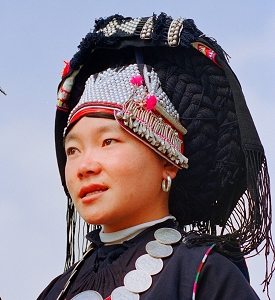
Hani Nationality has a population of 1,425,000 who are unique to Yunnan and are the descendants of the ancient Di-Qiang ethnic group in northwest China. Hanis now live mainly in Ailao Mountain along Honghe River (the Red River) in South Yunnan and are a typical ethnic group on Yunnan-Guizhou Plateau specializing in growing terraced-field rice. With great creativity, Hanis, skillful at adapting to the local geographical features, have created the world-famous terraced-field culture.
Hani Terraced-Field: A Magnificent Art on Land
In Ailao Mountain along the southern bank of Honghe River in south Yunnan, you can see such a picture: the dense forests grow near the mountain top, Hani villages are situated on the mountainside, and from near Hani villages to the valley the terraced fields are found everywhere. This reveals the recycling use of water by Hanis. The streams nurtured by forests run down to Hani villages, and then to the paddy fields before running into the lakes and rivers in the valley. Evaporation helps water come back to the forests. Hani terraced field is a magnificent art on land and reveals the diligence and wisdom of Hanis.
Public House and Weeping: Hani’s Marriage Custom
Hani youth enjoy great freedom before marriage. Each Hani village has a public house where the youth can express their love and enjoy themselves. Ainis, a branch of Hani, have such a custom: when a girl is over 17, she will decorate her corsage and her round cap with silver ornaments and beautiful flowers made of colorful chicken feathers and threads. Hanis in Mojiang County have the custom of weeping at the wedding ceremony. During the ceremony, the more miserable the bride cries, the more love she has for her family. Accompanied by her family members and relatives on the wedding day, the bride will weep all the way to the bridegroom’s house.
Street Banquet: The A.A. System at of Hanis
Every February on the lunar calendar, when “Offering Sacrifices to Dragon” is in progress, Hanis will hold a grand street banquet. Every family will take their best foods to the village center, and the tables will be arranged in a snake-like style around which all the villagers will sit, drinking, eating and blessing each other. This street banquet has a history of hundreds of years and embodies the traits of Hani dietary culture which relies on terraced-field farming.
Mushroom-shaped House: Representation of Hani Villages in Ailao Mountain
The grass-roof is a typical trait and an inseparable part of the Hani house. Because most Hani villages are located on the mountainside, these Hani houses with steeple-like roofs, seen from a distance, look much like bunches of mushrooms in forests, thus “mushroom-shaped house”. This kind of houses with thick earthen walls and heavy grass-roofs is well ventilated and dry inside, offering a shelter cool in summer and warm in winter.
Kuzhazha Festival: Hani’s “Masquerade”
Kuzhazha Festival of Hani Nationality is held from June 24th to June 26th on the lunar calendar. This festival aims to hold religious ceremonies on the one hand and to provide great entertainment to all people on the other. When the people walking in procession have arrived at each playground, they will play on the swing to their hearts’ content.