Dai Nationality: An Ethnic Group Living Harmoniously With Water
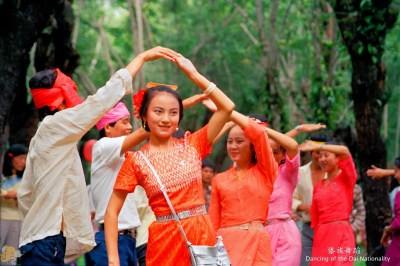
Dai Nationality has a population of 1,142,100 who are the descendants of the ancient Baiyue ethnic group living in Fujian, Guangdong and Guangxi. Most of Dais in Yunnan live in Xishuangbanna Dai Autonomous Prefecture in South Yunnan and Dehong Dai-Jingpo Autonomous Prefecture in west Yunnan. Dais believe in Hinayana (Southern Buddhism, Small Wheel or Therevada Buddhism). The Pattra-leaf Scripture is regarded as the Dais’ encyclopedia. The Water-Sprinkling Festival, The Peacock Dance, the Dai house on poles and the Dai tight skirts reveal to the world their ethnic culture.
Water-Sprinkling Festival: The Blessing from Dais
This annual festival is held from April 13th to April 15th, during which people sprinkle water on each other as a blessing. Besides, the Dai youth will hold “throwing-bag contest” for finding a sweetheart. On Lancang River there is a dragon-boat race and at night “Kongming Lanterns” will be sent up to the sky. It has been proved that this festival emerged in India and was introduced to the Dai-inhabited area of Yunnan via Burma 700 years ago. The Dais worship water and the Water-Sprinkling Festival embodies the prayer for a timely rain and a good harvest.
"Courting the Girl” and “Hearts-tying Ceremony”: The Dai Marriage Custom
The Dai youth enjoy great freedom in finding love and the Dai lads can court Dai girls whom they love. If a lad and a lass are in love with each other, the parents of the Dai lad will ask a matchmaker to propose a marriage, which will usually meet no refusal. The main activity of the Dai wedding is “Hearts-tying Ceremony” which symbolizes a life-long devotion through symbolically tying the two hearts together and is often held in the bride’s house.
Dai Bamboo House on Poles in the Shape of Zhu Geliang’s Cap
Dai bamboo house on poles is usually built on a plain or on a small hill near a plain. This two-storied house is built on poles. The first floor has no walls and is used for keeping domestic animals and farming tools while the second floor is used as the dwelling-place. A legend about the shape of the Dai house goes that when Zhu Ge liang (prime minister of the Shu Kingdom) led his army on the southern expedition, he found the Dais did not know how to build a house. Then Zhuge Liang asked the Dais to build their houses in the shape of his cap, thus the name.
"Congratulations on the New House": Dais Housewarming Celebration.
Many Dai customs are closely related to their bamboo house on poles, of which “Congratulations on the New House” is of the most impressive. When anyone is building a new house, all the villagers will come to help. Upon the completion of the new house, this ceremony will be held. According to the tradition, the first to come upstairs is a lad carrying the head of an ox and other people will follow him while singing blessings. An elderly person will be invited to put the cooking tripod over the new fire-pit before lighting it, which expresses their blessing for the host.
Dai’s “Bikini”: Colorful Clothes and Costumes of Huayao Dais
Huayao Dais (Flowery Dai), a branch of the Dais, live in Xinping and Yuanjiiang of south Yunnan, whose clothes and ornaments are regarded as “bikini” of the Dais. The girls wear a short sleeveless vest and a tight skirt reaching the shank with silver bubble-shaped decorations. When going out, the girls like wearing a special bamboo hat with a raised rim and a delicate bamboo basket which is varied in style and reveals the Dai girls’ beauty and wisdom.
Buddhist Temple: The School of Dai Boys
Dais believe in Hinayana. When a Dai boy is about 7~8 years old, he will become a monk who will learn Dai writing, Buddhist scriptures, math, history and law. When about 15 years old, he needs to pray silently before a senior monk and read Buddhist scriptures after the senior monk. After the senior monk has taken off his kasaya, he can resume his secular life. Thus, the Buddhist temple is in fact the school of the Dai boys.