The Nanzhao-Dali Culture
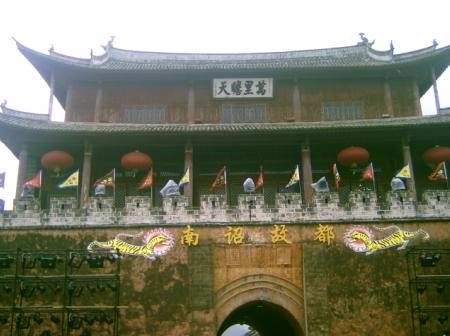
During the Tang and Song dynasties (960-1279 A.D), local cultures developed successively around Er'hai Lake in the kingdoms of Nanzhao (748-902) and Dali (937-1253) over a period of more than 500 years, another culmination in the cultural history of Yunnan.
Between the 7th and 8th centuries, the Mengshe Kingdom and other five kingdoms as well as the Xi' erhe Ethnic Group formed in the vicinity of Er'hai Lake. All inhabitants in these kingdoms ethnically belonged to the Wuman (ancestors of the Yi) and, due to its location in the south of the kingdoms, the Mengshe Kingdom was historically known as the Kingdom of Nanzhao (Southern tribe, Zhao refers to tribe). In order to deal with the Tibetan regime, the Tang government attempted to support the rising Mengshe Kingdom in the southwestern frontier and even helped it to annex the other five kingdoms and the Xi'erhe Group.
During the Kaiyuan Period (712-742) of Emperor Xuanzong, Piluoge, King or chieftain of the Mengshe Kingdom gradually unified the districts surrounding Erhai Lake and in the 26th year of that period (738 A.D), he was crowned by Emperor Xuanzong as King of Yunnan with a royal title "Guiyi", indicating that the Nanzhao Kingdom was finally established; the following year witnessed the shift of the capital of the kingdom to Taihe (a town south of Dali), and the political center of Yunnan at that time was accordingly shifted from Qujing to Dali. The territory of the kingdom, approximately one and a half times larger than that of the present Yunnan Province, included the whole province of Yunnan, West Guizhou, Southwest Sichuan, and even parts of Myanmar, Laos and Thailand. It was ruled by 13 kings with Xinuluo as its first king and lasted for 250 years until its termination in the year 902 A.D.
After the termination of Nanzhao came three transit dynasties, namely the Great Changhe Kingdom, the Great Tianxing Kingdom, and the Great Yining Kingdom, which together lasted for merely 36 years; during this period, the power of the noble Baiman kept rising steadily. From 937 A.D when the Kingdom of Dali was founded by Duan Siping, a Baiman aristocrat, to 1253 A.D when it was exterminated by Kublai Khan, the Dali Kingdom lasted for 316 years under successive reigns of 22 kings with a territory almost as large as that of the Kingdom of Nanzhao. Therefore, the kingdoms of Nanzhao and Dali existed at almost the same time as the Tang and Song dynasties did in the Central China.