Gyeongbokgung Palace

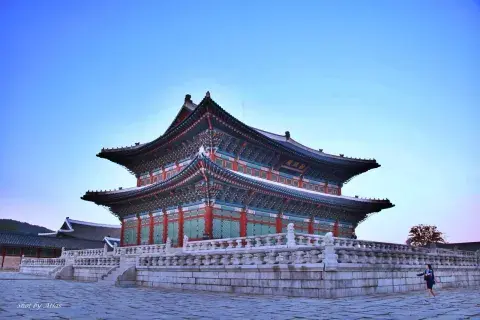
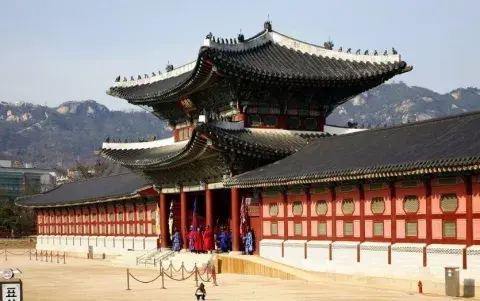
Built in 1395, Gyeongbokgung Palace is also commonly referred to as the “Northern Palace” because it is the furthest north when compared to the neighboring palaces of Changdeokgung (Eastern Palace) and Gyeongheegung (Western Palace).

Gyeongbokgung Palace is arguably the most beautiful and...

Built in 1395, Gyeongbokgung Palace is also commonly referred to as the “Northern Palace” because it is the furthest north when compared to the neighboring palaces of Changdeokgung (Eastern Palace) and Gyeongheegung (Western Palace).

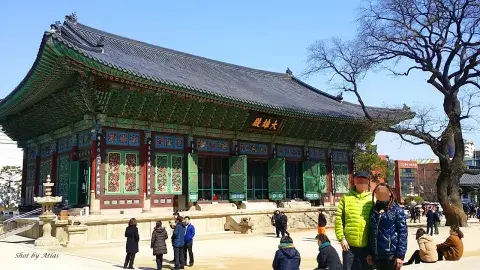
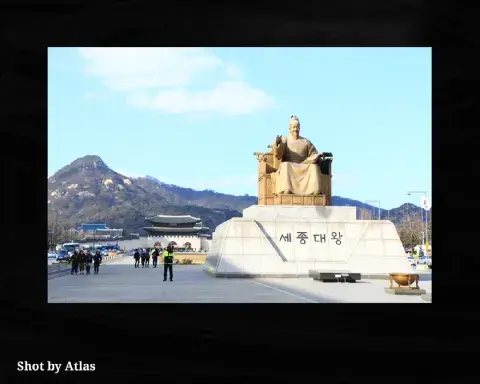
Gyeongbokgung Palace is arguably the most beautiful and remains the grandest of all five palaces.

Remarkably, the most representative edifices of the Joseon Dynasty, Gyeonghoe-ru Pavilion and Hyangwonjeong Pond are still relatively in tact. Woldae and the sculptures of Geunjeongjeon (The Royal Audience Chamber) represent past sculpture of contemporary art.

The National Palace Museum of Korea is located south of Heungnyemun Gate, and the National Folk Museum is located east within Hyangwonjeong.


Current Status 
Historic Site No.117 


The named Gyeongbokgung means the "Palace Greatly Blessed by Heaven."


An effort to fully restore Gyeongbokgung Palace to its former glory has been ongoing since 1990. The colonial Government-General building was removed, and Heungryemun Gate was restored to its original state. The royal quarters and the East Palace for the crown prince were also restored to their original state.


Dress Code: 

  • No slippers 
  • No sleeveless 
  • No ripped pants 
  • No too short pants 
  • Please refrain from using Selfie Stick (even though it is not illegal we are trying to curb soon, as July 1, 2015) 
  • No drone and the like 
  • No abnormals 


Notice: 

  • Close on Tuesdays. 

DMZ (DeMilitarized Zone)

DMZ is a buffer zone between two Koreas. It was established to prevent a clash of arms. 

DMZ is an area looks like a belt from East to West. It covers 2 kilometers from the MDL to the South Korea and 2 kilometers from the MDL to the North Korea. So it is located in t...

DMZ is a buffer zone between two Koreas. It was established to prevent a clash of arms. 

DMZ is an area looks like a belt from East to West. It covers 2 kilometers from the MDL to the South Korea and 2 kilometers from the MDL to the North Korea. So it is located in the middle of the Korean peninsula.

Actually some area is narrow than 2 kilometers because of the shape of a river or mountain which was the front line during the Korean War.

  •  The Value of DMZ nowadays
  •  Perspective of Peace: the last relics of Cold War. Now it is very peaceful.
  •  Perspective of Ecology: the eco-system of DMZ is an area symbolizing the nature’s recovery ability (self-cleaning ability) – destroyed during Korean War and recovered after the Korean War
  •  Perspective of Future: DMZ is emerging as the land of opportunity for unification (it can be a model of world-wide eco-tourism and peace tourism) 

DMZ Tour sample destinations: it is vary 

  • Imjingak park 
  • Check Point (Civilian Control Line) 
  • the 3rd Tunnel 
  • Dora Observatory 
  • Dorasan station 
  • Tongilchon (Unification village)  


Photo regulations (as of July 1, 2015) 

  • No picture inside the 3rd Tunnel and inside buildings 
  • No pictures of Soldiers or military facilities 
  • No pictures at the Check Point in CCL(=Civilian Control Line) 
  • and the guide says "No" 


MUST bring: Passport (ALL of you)  


Related Destinations: 

  • Incheon Landing Memorial Hall in Incheon
  • Weolmido
  • Freedom Park with the general MacArther


Notice: DMZ can be canceled with notice, because of security, conflict, military operation, to isolate military from virus, etc.