Duan Qiao (Broken Bridge)
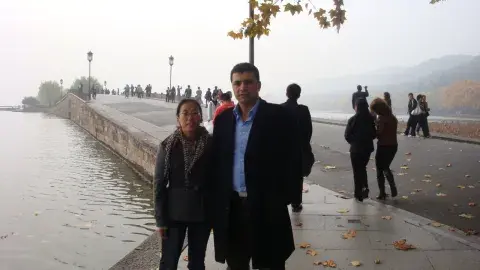
The Broken Bridge is located at the Bai Causeway, and it is the place where Lady Snakewhite and Scholor Xu Xian met each other after them spearated by misunderstood, said of Chinese folk story "The Legend of Lady Snakewhite".
Bai Causeway was built by the most is th...
The Broken Bridge is located at the Bai Causeway, and it is the place where Lady Snakewhite and Scholor Xu Xian met each other after them spearated by misunderstood, said of Chinese folk story "The Legend of Lady Snakewhite".
Bai Causeway was built by the most is the most famous poet when he was the governor of Hangzhou. It is the most time-honored causeway at the West Lake, people named this ancient causeway as Bai (or Lord Bai ) Causeway in memory of him.
Local bus routes: Y9,Y2,K7.
Hu's Villa
Hu Xueyan's (1823-1885) Villa is situated on the Yuanbao Street, a narrow alley nearby the Hefang Street, a famous old commercial street of Hangzhou. It's a typical southeast-China-style complex with houses and gardens of distinct Anhui architecture features. Hu's Villa was built in 1...
Hu Xueyan's (1823-1885) Villa is situated on the Yuanbao Street, a narrow alley nearby the Hefang Street, a famous old commercial street of Hangzhou. It's a typical southeast-China-style complex with houses and gardens of distinct Anhui architecture features. Hu's Villa was built in 1875 at the zenith of his prosperity and was officially open to public since 2001 after the renovation.
The villa has roughly three sections: The middle section is for reception and consultations; the eastern section is for pleasure and relaxation; and the western section is for living. In the villa, gardens, pavilions, terraces, bridges, houses, rockeries, ponds and corridors are ingeniously designed and harmoniously landscaped. Some parts of the villa have western elements as Mr. Hu lived in a time when China was opened up to outside world for trade and cultural exchange.
Hu Xueyan was born in Anhui Province, started off as a counterjumper in a money shop in Hangzhou and eventually passed away in poverty and sorrow. Following the success of his business in running money shops and pawns, he expanded the field to salt, medicine, silk, tea, cloth and arms trade, etc. It's said that in the prime time his overall wealth was half as much as the national treasury of Qing government. Although he cracked up in latter years of his life as he fell victim of political game, Hu Xueyan, who also assumed high position in government as a result of his tremendous impact in business, has been widely recognized as the stereotype of "Red-Top Merchant" (high-ranking government officials wore hat with red top in Qing Dynasty when going to imperial court), a title people use to refer to merchants who are influential in politics as well.
What else noteworthy is the Huqing Yutang Traditional Chinese Medicine Store founded by Hu Xueyan also. It's located on the Hefang Street, some ten minutes walk from the Hu's Villa. A drop-in-on to it would add more content if you intend to visit Hu's Villa.

Orchid Pavilion (Lan Ting Pavilion)
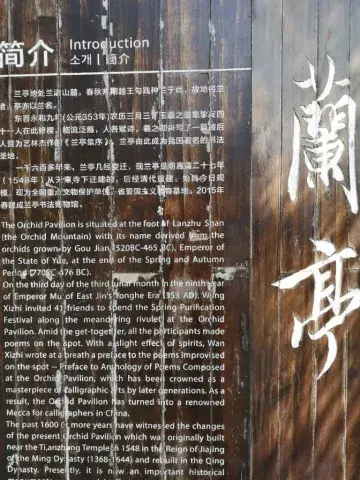
The Orchid Pavilion, set in pleasing natural scenery with bamboo woods and winding streams, is situated 9 miles southwest of Shaoxing city, Zhejiang Province. A stele with inscription by Emperor Kangxi (reigned 1662-1723) is housed in the pavilion. Outside the pavilion a picturesque little lake e...
The Orchid Pavilion, set in pleasing natural scenery with bamboo woods and winding streams, is situated 9 miles southwest of Shaoxing city, Zhejiang Province. A stele with inscription by Emperor Kangxi (reigned 1662-1723) is housed in the pavilion. Outside the pavilion a picturesque little lake extends some 30yd. In the center of this lake is a stone tablet with two ideograms which, roughly translated, mean “goose pond”. They are attributed to Wang Xizhi, the most accomplished calligraphy master, who in the year 335 of the Eastern Jin Dynasty wrote the famous “Preface to the Orchid Pavilion Poetry Collection”.
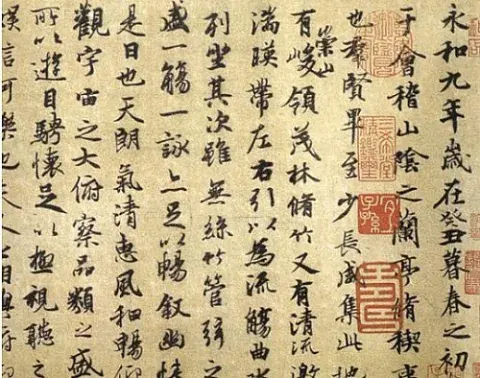
"Preface to the Orchid Pavilion Poetry Collection” is the most famous work of calligraphy by Wang Xizhi. Written in running-cursive script, it is the most well-known and wild-copied piece ever. It describes a gathering of 42 literati at the Orchid Pavilion during the Spring Purification Festival, the third day of the third lunar month, to compose poems and enjoy the wine. The gentlemen had engaged in a drinking contest: wine cups were floated down a small winding creek as the men sat along its banks; whenever a cup stopped, the man closest to the cup was required to empty it and write a poem. In the end, twenty-six of the participants composed thirty-seven poems.
The preface consists of 324 Chinese characters in 28 lines. The character zhi (之) appears 20 times, but no two look the same. It is also a celebrated work of literature, flowing rhythmically and giving rise to several Chinese idioms. It is a piece of improvisation, as can be seen from the revisions in the text. Its original work was greatly treasured by Emperor Taizong of Tang Dynasty, but unfortunately got lost later in history. What people could see now are the copies made by calligraphers after Tang Dynasty.
At the foot of Lanzhu Mountain, 14km southwest of Shaoxing City

The Orchid Pavillion
The Orchid Pavilion is 13 kilometers away from the city center. During the Chunqiu dynasty, the king of Yue planted orchids here and later a pavillion was constructed here during the Han dynasty. Thus, there is a pretty simple explanation for the name of this popular tourist attraction today. The...
The Orchid Pavilion is 13 kilometers away from the city center. During the Chunqiu dynasty, the king of Yue planted orchids here and later a pavillion was constructed here during the Han dynasty. Thus, there is a pretty simple explanation for the name of this popular tourist attraction today. The Orchid Pavilion is Shaoxing’s most famous landmark. Visitors have been making the journey to see the Orchid Pavillion for more than 1600 years. In 353 A.D., the noted calligrapher Wang Xizhi wrote some of his celebrated calligraphy here. Since then, the Orchid Pavilion has been known as a home of Calligraphy.
The main sights in the Orchid Pavilion are: the Goose Pool Stele, the Orchid Pavilion Stele, the Orchid Pavilion River, and the Calligraphy Museum. The Goose Pool Stele was created by the calligrapher Wang Xizhi and his son Wang Xianzhi. Wang Xizhi’s favourite animal was the goose, and the goose theme is prevalent throughout the Orchid Pavilion. The Orchid Pavilion is not only one of the four famous pavilions in China, but is also a famed garden.

The East Lake
Along with the West Lake in Hangzhou and the South Lake in Jiaxing, Shaoxing’s East Lake make up the three most famous lakes in Zhejiang Province. The East Lake is smaller than its counterparts, but it is regarded as a magical lake by...
Along with the West Lake in Hangzhou and the South Lake in Jiaxing, Shaoxing’s East Lake make up the three most famous lakes in Zhejiang Province. The East Lake is smaller than its counterparts, but it is regarded as a magical lake by the Chinese. The combination of cliffs, grottos, and stone bridges is the reason why the East Lake deserves its magical reputation. Taking a boat ride on the East Lake, you can discover its natural beauty from a variety of viewpoints. You can also take the boat into the caves, and you will be simply awed by the scenery. From the mountain top beside East Lake, you can enjoy another unbeatable view of the "Oriental Venice".
Local bus routes No. 1, 107, 117, 137, 157, 207.