
Dapeng Ancient City

Dapeng Ancient City is an old fortress-town overlooking Daya Bay on Dapeng Peninsula in the east of Shenzhen. The fortress was first established in 1394 and developed into a large town during the Ming and Qing dynasties. The remains of this walled town cover an area of 10,000 square meters....
Dapeng Ancient City is an old fortress-town overlooking Daya Bay on Dapeng Peninsula in the east of Shenzhen. The fortress was first established in 1394 and developed into a large town during the Ming and Qing dynasties. The remains of this walled town cover an area of 10,000 square meters.
 
 
The best way to see the city is to enter from the South Gate and move in an anti-clockwise direction, taking in Dongmen Street and Zheng Street. Between the South Gate and the East Gate, the Yiwen Building houses a small exhibition of documents and artefacts recording the city’s history. Dapeng Ancient City is designated as a “patriotism education site” and  its important role in the Opium Wars and, after the cessation of Hong Kong, as a frontier garrison is emphasized.
 
Opposite the Yiwen Building is a residence of a former admiral. The house, which has inner-courtyards, bedrooms, a kitchen and an ancestral worship hall, is an excellent example of how the upper echelons of pre-Liberation Chinese society lived.
 
A visit to Dapeng Ancient City is well worth the one-hour trip from Luohu. The emptiness gives Dapeng a greater sense of history than Nantou Ancient City. It is a great place to see the layout and architecture of an ancient Chinese city, without the interferences of a modern one.


Dapeng Ancient City is in Longang District just outside the Special Economic Zone. Bus nos. 360 and 364 take about one hour from Luohu District to Dapeng Town (passing the Meisha Beach Parks on the way). From there it is a ten-minute ride on bus 818.
 

Chiwan Tianhou Palace Temple

Chiwan Tianhou Palace Temple 赤湾天后宫庙
7am –5:30pm
No.9 Chiwan 6th Rd. Nanshan Dist. 南山区赤湾六路9号
(0755) 26851350
Admission: RMB15
 
Chiwan Tianhou Palace Temple is dedicated to the worship of Tianhou -- or Matsu, as t...
Chiwan Tianhou Palace Temple 赤湾天后宫庙
7am –5:30pm
No.9 Chiwan 6th Rd. Nanshan Dist. 南山区赤湾六路9号
(0755) 26851350
Admission: RMB15
 
Chiwan Tianhou Palace Temple is dedicated to the worship of Tianhou -- or Matsu, as the coastal people of South Asia more commonly know her. Matsu is the Chinese goddess of the sea. She protects fishermen and others whose lives are dependent on the capriciousness of the ocean. She is worshipped in Fujian, Taiwan, Guangdong, Hong Kong, and Macau as well as in the Chinese communities of South East Asia.
 
 
The Chiwan Tianhou Palace Temple sits at the foot of Xiaonan Hill facing the sea (and surrounded by ship-container yards) in the western part of Shenzhen. There has been a temple here since the late Southern Song dynasty (AD1127-1279), which developed and expanded over the course of the Ming and Qing dynasties.
 
 
At the front of the temple complex a large statue of Matsu stands between Moon Pond and Sun Pond, facing a Drum Tower, a Bell Tower and the entrance to the inner courtyard. Just inside the courtyard and behind a small shrine to earth deities, stands the “Celestial Tree.” Those experiencing difficulties or challenges ease their worried minds by writing petitions on red cards and tying them to its branches. Inside the main building an impressive standing statue of Matsu is flanked by large conical stands comprised of numerous small lights. Businesses and households purchase these lights in the hope that they will shine good fortune on them.
 
 
Chiwan Tianhou Palace Temple is a popular place of worship and attracts visitors from home and abroad. The two weeks leading up to Matsu’s birthday, which falls on the 23rd day of the 3rd month in the Chinese Lunar Calendar, is a busy period for the temple and an ideal time for visitors to witness a centuries-old, Chinese tradition in action.


Chiwan Tianhou Palace Temple is a RMB15 cab ride from Seaworld in Shekou. It can also be reached by bus nos. 226 and 433.

Meisha Beach Parks

The tourist brochure for the Meisha Beach Parks needlessly states that this area “is a good land where people lived, procreated and done diving into the sea” since ancient times. You might not want to live or procreate here but it is not a bad spot to feel some sand between your toe...
The tourist brochure for the Meisha Beach Parks needlessly states that this area “is a good land where people lived, procreated and done diving into the sea” since ancient times. You might not want to live or procreate here but it is not a bad spot to feel some sand between your toes and gaze at fishing boats at work.
 
Da Meisha and Xiao Meisha are the two beaches that make up this coastal scenic area. Both of them have been shaped into parks, with restaurants and shops serving day-trippers from the city centre. There is an aquarium zoo, jet skiing, boating, bungee jumping, and other resort-type activities. Da Meisha is a public area, while Xiao Meisha has a RMB20 entry fee. The only real difference is that the ticket price ensures no hassle from beggars.
 
At one end of Da Meisha there is a rocky little cove next to a public garden called Lunar Square (Moonlight Square would be a better translation). This is a popular spot for wedding photos and there seems to be a few wedding parties there almost everyday. It’ s quite a spectacle to behold as photographers have the newly-wed couples precariously perch themselves on rocks while frantic bridesmaids try to keep wedding gowns out of the surf. There is a bar and “western food” restaurant next to Lunar Square. The food is sub-standard but the beer garden is a nice setting for a drink.
 
Xiao Meisha --  the smaller of the two -- tends to be a bit less crowded but has more restaurants and shops near it. It also offers the bizzare spectacle of local tourists all wearing identical 1950s-style swimsuits, which are rented out nearby.
 
While the Meisha Beach Parks are too built-up and busy to inspire castaway fantasies, they are decent places to have some seaside fun and are easy to get to from the city.

Lotus Hill Park

Lotus Hill Park -- also referred to as Lianhua Mountain Park and Lianhuashan Park --  is an oasis of open green spaces, winding scenic paths, leaf-sheltered picnic spots and heady floral fragrances, bang-smack in the heart of the city’s new business district. The park has a lake and ...
Lotus Hill Park -- also referred to as Lianhua Mountain Park and Lianhuashan Park --  is an oasis of open green spaces, winding scenic paths, leaf-sheltered picnic spots and heady floral fragrances, bang-smack in the heart of the city’s new business district. The park has a lake and two hills as well as 166 hectares of grass, plants, flowers and trees.
 
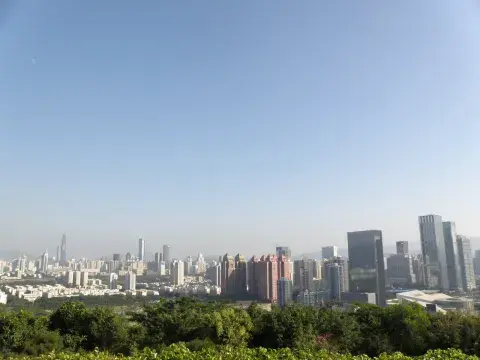
The focal point of the park is Mountain-Top Square. This large viewing area is at the top of the southern hill and commands excellent vistas of Shenzhen. There is a large statue of a confident Deng Xiaoping striding forward and looking benevolently over the city whose creation he inspired. This statue was erected on the Chinese National Day in 2000, which is recorded in an inscription on the base in the handwriting of Deng’s successor Jiang Zemin.
 
The Urban Planning Show is housed in a small building and records the history of the park in the form of a photograph exhibition. In one of the shots, Deng’s statue appears to be smirking down on a large group of Miss World contestants. The exhibit also includes a scale model of Shenzhen.
 
Lotus Hill Park is one of the best public parks in China; it allows a real sense of escape from the city. The best time to visit is in the late afternoon and early evening when the views of Shenzhen are bathed in a soft light and the park becomes illuminated by the glow of lanterns.
 
Suggested Route
Enter the park at the southeast entrance and follow the path to Kite-Flying Square. From here proceed uphill to Mountain-Top Square. Follow the main road (from behind Deng’s statue) passing the Urban Planning Show until a junction appears. Take the path on the right up the northern hill to a viewing pavilion. Follow the path downhill to the next junction and turn left in the direction of the lake. This path is interrupted by the main road but can be picked up again on the other side. This will eventually lead to the southern edge of the lake and alongside Palm Meadow. There is a teahouse here in a traditional style building set amongst bamboo trees. After passing the teahouse you will arrive back at Kite-Flying Square.
 
At a leisurely pace this route will easily fill up three hours. The park’s features are well signposted and there are large maps at key areas.
 
The easiest way to get to Lotus Hill Park is by metro. Exit B2 at Shao Nian Gong station, on Line 4 will bring you across the road from the park’s south-eastern gate. Bus nos. 25, 60, 235 and 236 stop at its main entrance.