Meixi Royal Stone Archways
Zhuhai is a cradle for people of excellence. She possesses a number of celebrities during the modern history of China period . Chenfang is the one who was born and grew up in Meixi village Zhuhai .
Zhuhai is a cradle for people of excellence. She possesses a number of celebrities during the modern history of China period . Chenfang is the one who was born and grew up in Meixi village Zhuhai .
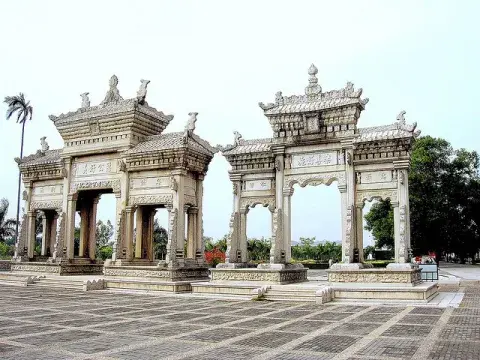
Once mentioning Meixi village,we can't ignore the memory archway here .The Meixi Royal Stone Archways is located at Mei Xi Village in Qianshan town, Zhuhai City. It occupies 126,000 square meters. Its main sceneries are the first Chinese consulate in Hawaii at the end of the Qing dynasty, the oversea Chinese millionaire Mr. Cheng Fang's hometown, Cheng family's history, Chinese stone archways exhibition, Zhuhai famous people's waxwork, art gallery and articles, and more. It puts famous people, folk-custom and cultural relic protection together. It is an ideal place for relaxation and very popular for sightseeing.
Now, there are three stone archways left, which were built in 1886 and 1891. They were built by Guangxu Emperor in honor of Cheng Fang and his families. The stone archways are built from granite. It combines the architectural art of the west and east and it has many wonderful engravings. It is regarded as a major artistic treasure of Zhuhai. So highly regarded by the Zhuhai government is this building that it was pointed as the 'Special protection item of old architecture' by Guangdong provincial government in 1989.
The Meixi Royal Stone Archways area has a very beautiful garden scenery, and its service facilities are excellent. It is not far from the city, and making your way there and back is easy. It is a good place for you to visit.
P.S.More about Chenfang
Born in Meixi Village, Qianshan Town, Zhuhai, Chen Fang led quite a legendary life。 He traveled far across the sea to Honolulu, Hawaii at a young age and later became the first millionaire there.
Chen Fang was known in business circles as the “Business Giant”. He married a local princess of mixed blood named Julia, who gave birth to 12 daughters & 4 sons. Due to the fact that his children had mixed blood from China, Great Britain & Hawaii, Chen Fang built a luxurious villa on the island combining the art styles from these three countries. From the end of the 19th to the beginning of the 20th century, this villa has been a must for tourists visiting Honolulu. In 1881, Chen Fang was appointed by the Qing Government as China’s first Consul General to Hawaii,ln 1890,Chen Fang sold off his property and returned to his motherland where he built another villa similar to the one in Honolulu.
bus,especially tour bus in Zhuhai city ,it's free
taxi or private car
Nantou Ancient City
Located in the far west of Shenzhen, close to the east bank of the mouth of the Pearl River, is the ancient city of Nantou (a.k.a. Xin’an city). Nantou is one of the earliest urban areas in what is now Shenzhen and was a busy commercial port in the Ming Dynasty. Excavations in this area h...
Located in the far west of Shenzhen, close to the east bank of the mouth of the Pearl River, is the ancient city of Nantou (a.k.a. Xin’an city). Nantou is one of the earliest urban areas in what is now Shenzhen and was a busy commercial port in the Ming Dynasty. Excavations in this area have revealed evidence of civilization as far back as the Shang Dynasty (1700 –1100BC), contradicting the traditional believe that until relatively recent times Guangdong was a forlorn wilderness to which errant officials were exiled.
Nantou is still home to thousands of residents today. They mostly live in modern apartment blocks within the city’s ancient walls. Between the functional white-tiled blocks, architectural gems from bygone days, such as the Dongguan Clubhouse, Sir Xinguo’s Shrine and the Baode Shrine, are preserved. Conspicuous for its European style, the Foundling Hospital is a reminder of foreign influences in this part of China. Today, it functions as a church for Nantou’s Catholics.
A museum, located near the South Gate provides an excellent insight into the city’s past with dozens of excavated artefacts on show. Unfortunately, the captions have not yet been translated into English. The RMB20 entrance charge includes a bilingual map of Nantou.
If you prefer to experience history with a sense of continuity, Nantou Ancient City is a treat. This is a lived-in, historical area, as opposed to a museum-type showpiece. Life goes on, somewhat changed, somewhat the same, in its narrow alleys: Farmers sell vegetables in the arches of its gates, as they have been doing for centuries; The heaps of fresh incense ash in its ancient shrines indicate that these deities are still being worshiped; Children play in streets pungent with the smell of the same foods their ancestors cooked and ate; and, open doorways provide flashing glimpses of meals being prepared, intense mahjong games and other scenes of family life. The contrast with the wide soulless roads and department stores outside its gates is dramatic.
For a similar but quieter experience check out Dapeng Ancient City.
Nantou’s South Gate can be entered from Shennan Boulevard, the far western end of Shennan Road, close to its intersection with Nanxin Road. Bus nos. 201, 301, 305, 310 and 355 go in this direction.
Alternatively, Nantou can be entered from Zhongshan Park from its south side.

Zhongshan Park
Zhongshan Park is dedicated to one of Guangdong’s most celebrated sons, Dr. Sun Yat-sen, who is represented in a large sculpture at the park’s main entrance. In Hero-Gathering Lawn, several local historical heroes from ancient and modern times are honoured with sculptures by renowned ...
Zhongshan Park is dedicated to one of Guangdong’s most celebrated sons, Dr. Sun Yat-sen, who is represented in a large sculpture at the park’s main entrance. In Hero-Gathering Lawn, several local historical heroes from ancient and modern times are honoured with sculptures by renowned artists. Driving home the revolutionary spirit of the park, a monument to martyrs of the liberation struggle stands among trees in the south side.
Although Zhongshan Park is not as pretty or as tidy as Lotus Hill Park, its proximity to Nantou Ancient City -- Nantou can be entered from the park’s southern edge -- makes it worth a peek. A stroll on the lawns by Zhongshan Park’s lake will be a pleasant conclusion to exploring the crowded lanes of Nantou.
Zhongshan Park’s main gate can be entered from Shennan Boulevard, the far western end of Shennan Road, near Nanshan Bus Station. Alternatively, the park can be entered from the north side of Nantou Ancient City.