




The "Mother Yellow River" Sculpture
It's in the Xihu Park on Binhe Road.
The "Mother Yellow River" Sculpture is a sign of Lanzhou.In China we call Yellow River and Long river "The mother rivers",you can see how important thes...
It's in the Xihu Park on Binhe Road.
The "Mother Yellow River" Sculpture is a sign of Lanzhou.In China we call Yellow River and Long river "The mother rivers",you can see how important these 2 rivers to Chinese people.

Silk Road
The Silk Road is a historically important international trade route between China and the Mediterranean. Because silk comprised a large proportion of trade along this road, in 1877, it was named 'the Silk Road' by Ferdinand von Richthofen, an eminent German geographer....
The Silk Road is a historically important international trade route between China and the Mediterranean. Because silk comprised a large proportion of trade along this road, in 1877, it was named 'the Silk Road' by Ferdinand von Richthofen, an eminent German geographer.
Culture: The road is not only an ancient international trade route, but also a splendid cultural bridge liking the cultures of China, India, Persia, Arabia, Greek and Rome. The Four Great Inventions of China and religions of the West were introduced into their counterparts.
History: From the time Zhang Qian opened up the world-famous Silk Road during the Han Dynasty, until the collapse of the Yuan Dynasty, it enjoyed a history of about 1,600 years.
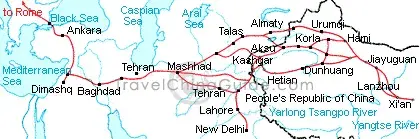
Route: This ancient road begins at Chang'an (now Xian), then by way of the Hexi Corridor, and it reaches Dunhuang, where it divides into three, the Southern Route, Central Route and Northern Route. The three routes spread all over the Xinjiang Uygur Autonomous Region, and then they extend as far as Pakistan, India and even Rome.
Other roads: In fact, besides the Silk Road in the northwest of China, there are another two trade roads in the southwest of China and by sea, which also contributed greatly to the development of the world. They are called the "Southern Silk Road" and the "Silk Road on the Sea".
Scenery along the Road: The scenery and sights along the Silk Road are spectacular and intriguing. There are well-known Mogao Caves (Mogao Grottoes) in Dunhuang, the bustling Sunday Bazaar in Kashgar and exotic customs in Xinjiang Uygur Autonomous Region and more …
Silk Road Adventure: There are all kinds of tour plans for traveling the world-famous road. TravelChinaGuide provides many tour lines for visitors to experience the adventures of this ancient trade road.
Tips: It is necessary for tourists be aware of some travel essentials when they are on the road, such as weather, food, drink, accommodation, transportation and customs of minorities. Here provides detailed information about them.