Shawan Ancient Town

Shawan Ancient Town is situated in the center of Panyu District in the south of Guangzhou. Originally built in the Southern Song Dynasty (1127 - 1279), it has a history of over 800 years. Characterized by the architectural style of south China, the history and culture of the Ming and Qing Dynasti...

Shawan Ancient Town is situated in the center of Panyu District in the south of Guangzhou. Originally built in the Southern Song Dynasty (1127 - 1279), it has a history of over 800 years. Characterized by the architectural style of south China, the history and culture of the Ming and Qing Dynasties (1368-1911) and the Republic of China (1912-1949), Shawan Ancient Town is a typical southern town surrounded by water. Relying on its beautiful view and rich cultural heritages, it has developed into an attractive tourist destination. Covering an area of 0.6 square miles (153 hectares), the town consists of the east village, west village and north village.

Shawan Ancient Town looks very primitive and elegant. Rows of houses, old streets and long alleys show the features of the ancient style. The most common attractions you can see here are ancestral halls, the number of which has reached 100. Some intangible cultural heritages, such as Cantonese folk music, the lion dance, and Piaose (a kind of folk art integrating play, magic, acrobatics, music and dance), are well preserved. Visitors can not only have an insight into the lives of the local people, but also experience the special folk culture.

Recommended Touring Route
Daxiangyong Road - Qingshui Well - Renrang Gongju (Administrative Bureau) - Yanqing Hall (Memorial Hall of He Binglin) - Chebei Street - Gaoyao Alley - Youqi Hall - Chichang Hall - Huiyan Alley (Former Residence of He Shaoxia) - Guanyin Hall - Dunhouli - Ancient Wall - Yuxu Palace - Liugeng Hall - West Square - Dama Alley - Agriculture Life Museum - Wenfeng Tower - Study Room - Zhennan Ancestral Hall - Sanren Hall - West Anning Street

Nansha Tin Hau Palace (Nansha Mazu Temple)

Facing the Lingdingyang (Lingding Ocean), the mouth of the Pearl River, Nansha Tin Hau Palace is a mazu temple on the southeastern slope of the Dajiao Mountain in Guangzhou City and covers about 100 hectares (247.1 acres). The architecture combines both the style of the Forbidden City in Beijing ...

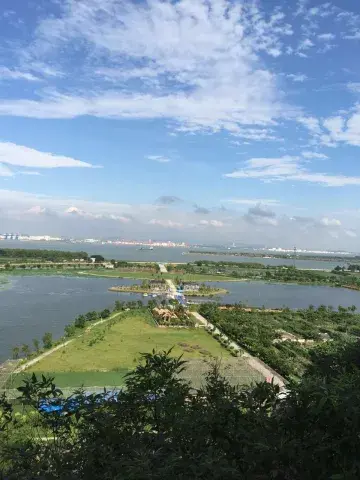
Facing the Lingdingyang (Lingding Ocean), the mouth of the Pearl River, Nansha Tin Hau Palace is a mazu temple on the southeastern slope of the Dajiao Mountain in Guangzhou City and covers about 100 hectares (247.1 acres). The architecture combines both the style of the Forbidden City in Beijing and the sublimity of Dr. Sun Yat-sen's Mausoleum in Nanjing. It is the largest palace compound of its category in the world. It is reputed as the 'First Tin Hau Palace under Heaven' and the biggest Mazu Temple in southeastern Asia.

It was built to worship the Goddess of sea, also called Mazu (or Tianhou in Chinese, literally meaning Heavenly Empress) by the people, whose real name is Linmo (960-987). There are many touching stories about her helping people in shipwrecks, so she was thought to be the incarnation of the goddess of sea and was paid homage by over 100 million believers in more than twenty countries.

This palace was first built in the Ming Dynasty, then was renovated during the reign of Emperor Qianlong (1737-1795) in the Qing Dynasty (1644-1911), but was later ruined. The one we see now was rebuilt in 1994 and completed in 1996.

When you arrive there, you will first reach the Tin Hau Square which covers an area of 1.5 hectares (about 3.7 acres). At the center of the square stands a huge statue of the Goddess. The statue faces the Lingdingyang and is about 14.5 meters (about 47.6 feet) high, made of 365 pieces of granite. It symbolizes that mazu could bless fishermen and bring favorable weather for the whole year.

Behind the square is the memorial archway, on which the name of the palace is written over the top, and some inscriptions written on both sides. Once you have gone through it, you will come to the main gate where honored the statues of two legendary immortals, Clairvoyance (thousand-mile eye) and clairaudience (wind-accompanying ear).

Walking up the flagged path after entering the gate, you will come to the Hall of Blessing where a statue of the heavenly empress is honored. She is guarded by four Dragon Kings (the Gods of the sea) holding up a jade tablet and standing at each side. Then comes the Main Hall, the center of the whole palace. In the hall, two statues of the Goddess are honored in a shrine. One is 3.8 meters (about 12.5 feet) high, plated and carved from the fragrant sandalwood. The other is known as 'soft-body' statue, whose hand and foot joints are movable. The entire Main Hall is filled with a sense of benevolence and majesty, rectitude and holiness. Behind it is the Resting Hall, the living room of the Goddess, where a sitting sculpture of the goddess is displayed together with some simple instruments of her daily life.

At the very back of the palace is the Nanling Tower, an 8-storey building. It rises to a height of 45 meters (about 148 feet) and is the highest point of the whole palace. There is an unwritten folklore spread widely among Chinese people that the code of a God is singular, while that of a Goddess is plural. Because of that, the number of all stories, steps and tiles there is plural.

In addition, there are seven forts together called Dajiao Mountain Forts in the palace, which have been listed as national priority cultural relic protection sites in 1982. Additionally, the Free Life Pond is also worth a visit, where tourists could set free small creatures. Every year, this place attracts a lot of visitors by its charming scenic beauty and classical buildings. It definitely deserves a visit on your trip to Guangzhou.

Huaisheng Mosque (Remember the Sage Mosque)

The Huaisheng Mosque in Guangzhou, also named the Light Tower Mosque or the Lighthouse Mosque, is located at No. 56, Guangta Road. With an area of 3,547 square yards (2,966 square meters), it is the oldest mosque existing in China, confirming its remarkable position among the four oldest mosques ...

The Huaisheng Mosque in Guangzhou, also named the Light Tower Mosque or the Lighthouse Mosque, is located at No. 56, Guangta Road. With an area of 3,547 square yards (2,966 square meters), it is the oldest mosque existing in China, confirming its remarkable position among the four oldest mosques in the coastal areas, with the other three being Quanzhou Kylin Mosque, Yangzhou Crane Mosque, and Hangzhou Phoenix Mosque. Huaisheng Mosque was first built in 627, during the Tang Dynasty (618-907), when Islam was introduced to China for the first time. It was invested and constructed by some Arabs and named as Huaisheng Mosque, meaning ‘remembering the sage’, in honor of Islamic prophet Muhammad.

Generally speaking, Huaisheng Mosque maintains its original Arab architecture style. Walking into a narrow entrance, a screen wall can be seen, which prevents visitors from seeing the inner courtyard. But passing through the screen wall, the quaint buildings come into view.

Moon Tower
Walking through three doors, tourists come to the Moon Tower, which is a square gate tower with a red sandstone base built in the Ming Dynasty (1368 - 1644) and a double-eave roof renovated in the Qing Dynasty (1644 - 1911). The tower is used to observe the moon to decide the time for the Fast and Ramadan.

Prayer Hall
Going forward, a larger courtyard appears. At the two sides of it, Covered Corridor can be seen, where some Islamic texts are posted. Right in front of the courtyard locates the Prayer Hall, which is the center of Huaisheng Mosque. When worshiping, followers face the direction of Mecca. The color and decoration in the hall is based on the west Asian style. Non- Muslims are not allowed to enter into the Prayer Hall, but just appreciate the architecture from the outside.

Lighthouse
The most outstanding building inside the mosque is the Lighthouse (minaret). It cannot be sure that when the tower was built, but it is believed to be the oldest existing Islamic architecture in China. Lying at the southwest of the mosque, the round Light Tower with a pointed tip is about 118 feet (36 meters) tall. It is from the tower that the mosque itself gets another name - Light Tower Mosque. The tower features the typical characteristics of Arab architecture style with pointed tip on the top. A muezzin would climb up to the tower to call out to followers at prayer times. It is said that the minaret was used as a beacon to lead directions for ships passing through the river. Besides, sailors often climb up to the tower to observe the weather conditions.

Huaisheng Mosque also houses other scenic spots, such as the Exhibition Hall, the Ancient Well and flourishing trees. Walking in the mosque, tourists can see many historical relics and tablets with inscriptions, too.

Guangdong Provincial Museum

The International Museum Day (May 18) of 2010 is the opening day of the new Guangdong Provincial Museum. It is situated in Zhujiang New Town and can be easily accessed by subway. This is a culture and art square in the new downtown area. The new museum is in the neighborhood of Guangzhou Opera Ho...

The International Museum Day (May 18) of 2010 is the opening day of the new Guangdong Provincial Museum. It is situated in Zhujiang New Town and can be easily accessed by subway. This is a culture and art square in the new downtown area. The new museum is in the neighborhood of Guangzhou Opera House and the city's Library. Its south side faces the Pearl River. It is a large modern square building, like a 'treasure box of moonlight', which is the name of museum building favored by local people.

Being built in 1959 and located at 215 Wenming Lu, the museum is a round-topped three-storied building with a hall in the center which is surrounded by corridors. The big yard of the museum was originally the Gongyuan (the imperial examination centre) of Guangdong in the Qing Dynasty  (1644—1911). Inside the yard, there are several national cultural heritage sites, such as the Site of the First National Congress of the Chinese Nationalist Party (including the Revolution Square), the Red Mansion, the Astronomical Observatory of Zhongshan University and the Lu Xun Memorial Hall.

A new display building with modern facilities was constructed at the end of 1992. This new building covers an area of 13,200 square meters (3.26 acres) and the exhibition hall is about 6000 square meters (1.48 acres). It has thirteen exhibition halls, two procedures rooms and an academic lecture hall. The Provincial Museum's new display hall considers historic folk, art and nature as its three main exhibition aspects. As one of the three landmarks of cultural facilities in Guangzhou, it plays a very important role in strengthening the international culture communication and developing the city into a modern international metropolis.