Drink Tsingtao in Qingdao
If you’ve spent any time at all in China or have a taste for foreign beers, you’ve probably heard of Tsingtao. While it’s not the most popular beer in China (that honour goes to Snow), it’s definitely China’s most famous malty export.
If you’re wanting to take your love affair with Tsingtao...
If you’ve spent any time at all in China or have a taste for foreign beers, you’ve probably heard of Tsingtao. While it’s not the most popular beer in China (that honour goes to Snow), it’s definitely China’s most famous malty export.
If you’re wanting to take your love affair with Tsingtao to a new level, you can pay a visit to the German-inspired beach town of Qingdao. Home to both the Tsingtao Brewery & Museum and the Qingdao International Beer Festival, it’s a place for a beer lover’s pilgrimage.
Beyond the suds, Qingdao is a picturesque city of beaches, clifftop art installations, German architecture, and good food.
If you need our guide/assistant/sourcing/interpreter, welcome to contact us.:)
We can custom your trip and guide you.
Please click my photo and add my contact. Let's talk details.
Thanks for reading.
Jessica In China (86-13570345653)
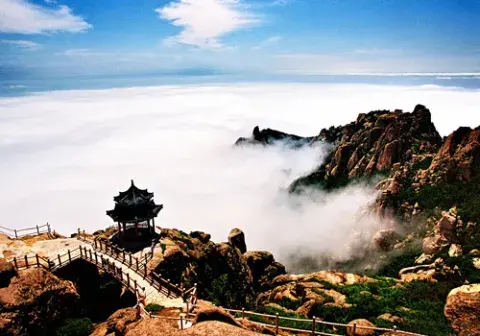
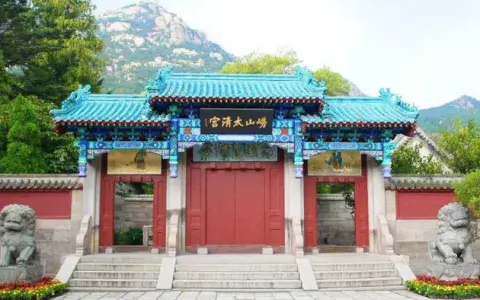
Zhanshan Temple, Qingdao
Zhanshan Temple (English: Zhan Shan Temple; pinyin: Zhànshān Sì; German: Dschanschan Tempel) is a Buddhist temple in Qingdao, Shandong, China. It is located on the southern side of Zhanshan (literally 'clear' or 'deep mountain'), Facing the sea
The monastery was built in 1945 and is ...
Zhanshan Temple (English: Zhan Shan Temple; pinyin: Zhànshān Sì; German: Dschanschan Tempel) is a Buddhist temple in Qingdao, Shandong, China. It is located on the southern side of Zhanshan (literally 'clear' or 'deep mountain'), Facing the sea
The monastery was built in 1945 and is an active, functional Buddhist sanctuary. Apart from the Stupa and the Olympic Mascot Bell Tower, located on the right-hand side of the grounds, the remaining buildings are situated in a square format. To the right Of the entry portal is one of the several Buddhist scripture shops. Here, incense sticks and other Buddhist supplies are available for purchase. Adjacent the scripture shop is a Bell Tower (zhonglou; bell tower) with the first of many statues of Buddha. Right of the entry is the Drum Tower (gulou)
Returning to the central path, directly ahead of the Heavenly King Hall (tianwang dian; king of the temple). The large Buddha, which is the focal point of this shrine, is flanked by four large statues, one depicting a pipa player. Directly behind Heavenly King of the largest Hall of Sakyamuni, which honors the founder of Buddhism, the son of a king of the Sakya clan of the Kshatriya (ie, warriors). His given name was Siddhartha, his family name, Gautama. The Epithet "Sakyamuni" means "sage of the Sakyas." In this magnificent hall, a large, central Buddha is flanked by two smaller statues, each attended by eight priests. This hall is an active place of prayer equipped with cushions for kneeling, candles For lighting incense, and other Buddhist prayer supplies.
Behind the Hall of Sakyamuni is the Hall of Three Saints (san sheng dian; three sanctuaries). In the center of the hall are three large, gilded statues, each about twelve feet in height.
Continuing along the central path, the next building is the Preaching Hall (shengtang; church), where, behind a long, gilded Altar, a gilded, bejeweled statue of Buddha stretches out almost twenty feet in length
Opposite the Hall of the Recumbent Buddha is the Shandong Zhanshan Buddhist College (Shandong Zhanshan Fo xue yuan). To the right of the Hall of the Recumbent Buddha is the headquarters of the Qingdao Buddhist Association, Tiantai sect, (Qingdao) The following is from the top of this bell tower is panoramic; however, there is an additional fee of () 10 yuan to see that view.
The 8 April of the lunar calendar is tradimate as the birthday of the Buddha. On that day, thousands of Buddhists flock to the monastery grounds to attend religious events.
In 2004 June, the renovation remains in progress.
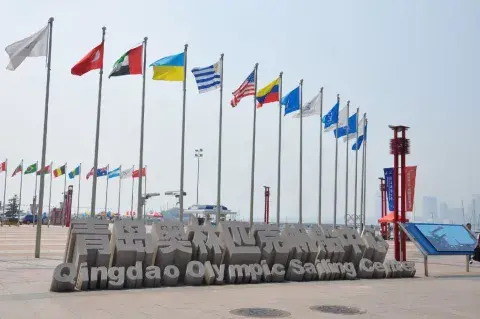
Qingdao International Sailing Centre
The Qingdao International Sailing Centre is a sailing marina located on the former site of the Beihai Shipyard by Qingdao's Fushan Bay at Shandong Province in China. It was constructed for the 2008 Summer Olympics. It hosted the Olympic and Paralympic Sailing competitions. Wind conditions v...
The Qingdao International Sailing Centre is a sailing marina located on the former site of the Beihai Shipyard by Qingdao's Fushan Bay at Shandong Province in China. It was constructed for the 2008 Summer Olympics. It hosted the Olympic and Paralympic Sailing competitions. Wind conditions vary greatly from very light winds to +15knots. During the Olympic competitions, fog was also an occasional factor.