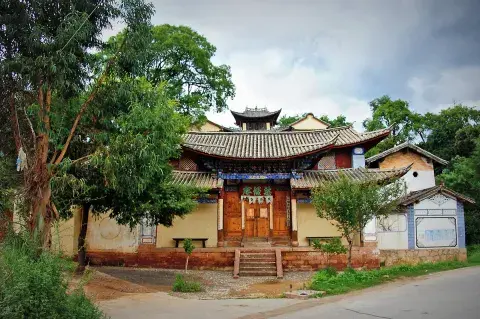
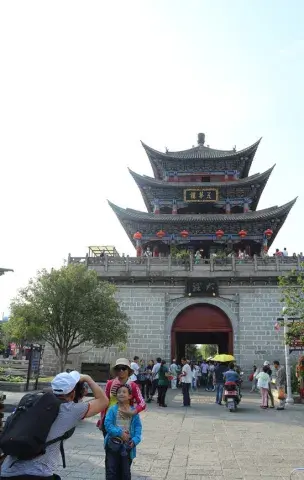
Three Pagodas of Chongsheng Temple
The Three Pagodas of Chongsheng Temple (崇圣寺三塔) are an ensemble of three independent pagoda towers arranged on the corners of an equilateral triangle, near the town of Dali, Yunnan province, China, dating from the time of the Kingdom of Nanzhao and Kingdom of Dali in the 9th and 10th centuries....
The Three Pagodas of Chongsheng Temple (崇圣寺三塔) are an ensemble of three independent pagoda towers arranged on the corners of an equilateral triangle, near the town of Dali, Yunnan province, China, dating from the time of the Kingdom of Nanzhao and Kingdom of Dali in the 9th and 10th centuries. The Three Pagodas are located about 1.5 km (0.93 mi) north of scenic Dali, Yunnan province. They are at the east foot of the tenth peak of the massive Cangshan Mountains and face the west shore of the Erhai Lake of ancient Dali. The Three Pagodas are made of brick and covered with white mud. As its name implies, the Three Pagodas comprise three independent pagodas forming a symmetric triangle. The elegant, balanced and stately style is unique in China’s ancient Buddhist architectures, which makes it a must-see in the tour of Dali. The Three Pagodas, visible from miles away, has been a landmark of Dali City and selected as a national treasure meriting preservation in China.
If you need our guide/assistant/sourcing/interpreter, welcome to contact us.:)
We can custom your trip and guide you.
Please click my photo and add my contact. Let's talk details.
Thanks for reading.
Jessica In China (86-13570345653)
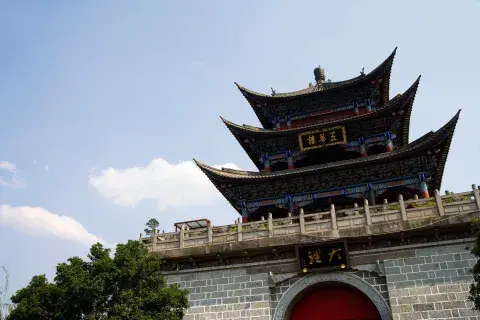
The Ancient City Of Dali
Dali Ancient Town is about 13km away from Xiaguan in Dali City and is one of Dali's Three Ancients-ancient city, ancient pagoda and ancient steles. History of Dali can be dates back to 1382 during the Ming Dynasty and it has been listed among the top historic cities of China.
...Dali Ancient Town is about 13km away from Xiaguan in Dali City and is one of Dali's Three Ancients-ancient city, ancient pagoda and ancient steles. History of Dali can be dates back to 1382 during the Ming Dynasty and it has been listed among the top historic cities of China.
Unlike any other Chinese town, the traditional Bai ethnic folk houses give the town distinctive feel. The town's layout was uniform, with five main streets from south to north and eight main streets from east to west, while marketplaces were neatly arranged within the town, which has remained unchanged to this date. Besides the Bai houses, the houses with gray-green roof tiles, peculiar workshops, temples, schools and churches with antique flavor are scattered. Traditional marble artworks, like pencil vases, striped screen, and a variety of woven handicrafts of fine straw are laid chockablock on both sides of the street to be appreciated and purchased. Its grand city wall, traditional Bai houses and marvelous scenery have been attracted many visitors.
Dali is also famous for the many types of marble it produces, which are used primarily in construction and for decorative objects. In fact, Dali is so famous for the stone that the name of marble in Chinese is literally Dali Stone.
Dali's newly finished administrative district that houses the newly opened Dali International Convention Center is in Longshan District. The Dali government's urban planning keeps its old and new districts separate, so those coming here for the first time often feel they have entered a time tunnel.
The new city is known as Xiaguan and is south of the old city. The old city was built during Ming Dynasty emperor Hongwu's reign (1368–1398). Owing to the distance between them, the old city is still peaceful and quiet.
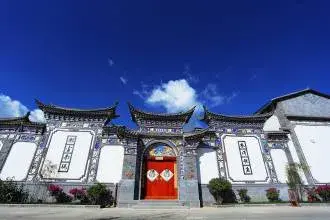
House Of Bai Minority.
Bai minority are much in evidence at Xizhou, 18 km north of Dali Ancient Town. Green mountains, winding creeks and fertile land make here a lyrical and carefree life.
Bai minority are much in evidence at Xizhou, 18 km north of Dali Ancient Town. Green mountains, winding creeks and fertile land make here a lyrical and carefree life.
The history of Xizhou can be dated back to the Sui Dynasty (581-618 AD). At that time, it was called the city of Dali. It was later conquered by General Shi Wansui, so it also enjoys the name of Shicheng (Shi City).
People nowadays regard Xizhou as a town that is famous for the Bai minority culture. The old houses and streets are well preserved, through which visitors may still find some traces of past glory.
At the entrance to Xizhou, a magnificent structure catches the attention of visitors. It is a two-storey building made of wood and brick. The second floor is an attic of horizontal inscribed board. The first floor is a corridor, leading people into the history.
Not far away is a banyan tree with flourishing leaves and branches. Perched on the tree is a large flock of egrets. They lead a comfortable and luxurious life without disturbance. People may have their doubts about whether the banyan tree and egrets are sacred things worshipped by the locals from generation to generation. All the same, such a seamless and harmonious relationship between human beings and nature really is a great attraction.
Walking along the slate road, sauntering though the winding alleys, visitors can have a good look at the delicate and intricate designs on the walls.
The houses of local residents are characterized by a traditional Chinese rectangular courtyard with a screen wall facing the gate. On the screen wall there are usually four Chinese characters, reading 'Qingbai Shijia' (innocent family) or 'Ziqi Donglai' (Auspicious air comes from the East). Around them are landscape paintings and decorations with profusion of colors. The doors and windows are full of grills with auspicious paintings.
In Xizhou, visitors also have the opportunity to appreciate the genuine tea ceremony of the Bai minority. Sandao Tea is a must-drink. It consists of bitter tea, sweet tea and aftertaste tea, indicating the whole life of the people.
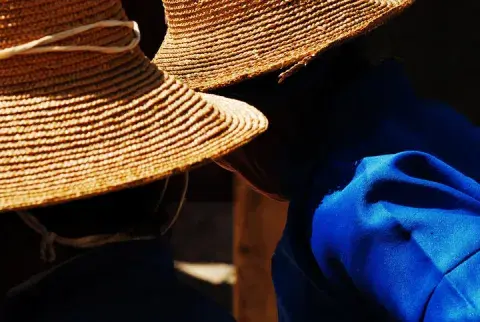
Dali Straw Hats
Straw hats are made of wheat straw in plait patterns,by going through bleaching treatment,sewing together into hats ans then fitting out with pink coloured ribbons,The Dali strawhats have more than 170 patterns and desins,The best ones are those which require the finest whaet straw with best...
Straw hats are made of wheat straw in plait patterns,by going through bleaching treatment,sewing together into hats ans then fitting out with pink coloured ribbons,The Dali strawhats have more than 170 patterns and desins,The best ones are those which require the finest whaet straw with best techniques,straw hats are the favourites of young boys and girlsamong young people while they are courting or getting married.
Like marble articles,straw hats are another kind of the most important handicrafts of Dali,In recent years,more and patterns have been designed and more hats produced.it is not only favoured by the minority people at home,but also welcomed by people abroad.It has good markets in America,Australia,the Philippines,Japan and Hongkong.
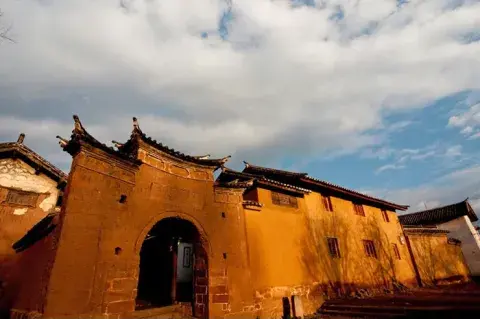
Shaxi old town -- a Gem hid on the mountain
Shaxi old town is located in the valley between Lijiang and Dali, It's a beautiful Gem hid on the mountain. It is known as the last best preserved old town on the ancient Tea & horse road.
The old town equipped with all necessary functions:...
Shaxi old town is located in the valley between Lijiang and Dali, It's a beautiful Gem hid on the mountain. It is known as the last best preserved old town on the ancient Tea & horse road.
The old town equipped with all necessary functions:
1. Old square market for tea and salt business
2. Old theater for entertainment (Still used even nowadays)
3. Hotel for horse man and caravan
4.Shops in both side in the alley
Suggestion:
1. Suggest travellers to stay at shaxi for one night, So you will have enough time to enjoy the cozy time at the old town. meanwhile Dont's miss a visit to the famous shibaoshan mountain, there are many nice rute of hiking and Many old temple and buddism grotto hiden on the mountain.
2.Remember to bring a good camara with you, there are many photography opportunities around Shaxi.
3. There are nice cafe and resturants near the square markets, Enjoy your time at shaxi old town.
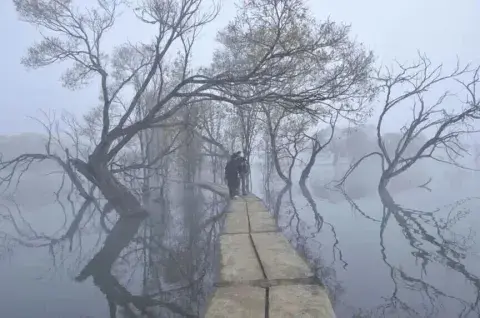
Yellow Dragon Pool
Yellow Dragon Pool
...Yellow Dragon Pool
Yellow Dragon Pool is located in Heqing,Dali,where is 1 hour far from Lijiang,in ancient times,in order to have good Fengshui,the Bai minority built many dragon pool,but the Yellow Dragon Pool is very famous,especially in Autumn,the nice view attracts many visitors coming!
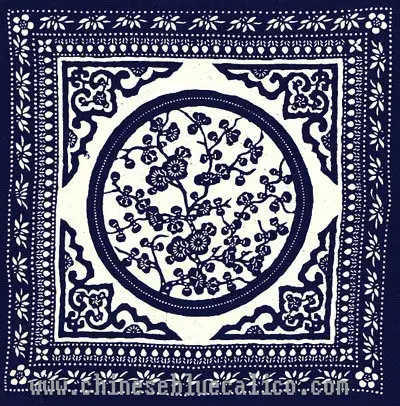
Tie-dyed Cloth In Dali
Tie-dyed Cloth
...Tie-dyed Cloth
It is also a traditional product of the Bais in Zhoucheng Village.The process of making this kind of cloth is like this:First,the villagers fold and tie white cloth by hand in the patterns of the Eight Diagrams(bagua),butterflies,the Three pagodas with their reflections and plum flowers,ets.and hen dye the piedes of cloth for more than 10 times in indigo-blue water(both imported indigo-blue and local made indigo-blue are used),and finally,hang them up in the open air to dry and untie the nods and spread them out,Now,you'll see the patterns of white and blue prints on the cloth.The characteristic of the tie-dyed cloth is simple in style but the colour sustains,window ans door curtains,table cloth,wall hangings,souvenir bags and handkerchiefs,which are applauded warmly in both domestic and foreign markets.

Shaxi Ancient Town
Shaxi—an old Horse and Tea Trade Route outpost that was more or less unknown to tourists years before backpackers fleeing the tourist boomtowns of Dali and Lijiang stumbled across it—is now the beneficiary of big-time development funds and the attentions of a Swiss-led team of...
Shaxi—an old Horse and Tea Trade Route outpost that was more or less unknown to tourists years before backpackers fleeing the tourist boomtowns of Dali and Lijiang stumbled across it—is now the beneficiary of big-time development funds and the attentions of a Swiss-led team of historical restoration specialists. The result: Shaxi is gaining in popularity, but the hordes that flock to Dali and Lijiang have yet to descend—no doubt in large measure because of the lack of five-star resorts and all of the trappings of a destination ready to accommodate busloads of tourists looking for tidily packaged "authentic" experiences of local ethnic minority culture. Instead, a handful of lovingly restored old structures house small-scale guesthouses—the most intriguing being the old town opera house, complete with courtyard stage.
Shaxi is, then, emblematic of the conundrum at the heart of tourism: It's the place we feel bad about writing about because it's on the verge of widespread discovery, but it's our job to write about it, and, well, we feel obliged to say that you should go sooner than later in order to experience it at its best... before the roads are improved, the resorts are built, and the tourist buses start dumping their payloads.
The town sits at the end of a wide, beautiful valley lined with Bai minority homes and tiny tucked-away villages. The heart of the town is a beautiful marketplace, Sideng Market, which features an authentic classic Chinese theater and one of the most peaceful temples in the region, Xingjiao Temple. Officially Buddhist, Xinjiao Temple is actually more syncretic, incorporating icons and symbols representing all major Asian faiths. This is a phenomenon that is very special to this part of Yunnan, where many different traders and travelers have passed over the centuries, bringing their beliefs with them and fostering a deep tolerance for difference among the local residents.
You can see this philosophy on grand display at the nearby Shi Bao Shan temple complex. Set in a rolling valley at the far end of Shaxi, Shi Bao Shan is a scattering of spiritual sites, shrines and temples that has served as a place of worship and spirited, spiritual discussion for centuries. The buildings are in good shape and the complex is large enough to easily take up an entire day. Notable sites include statues of Indian sages along the climb up to the temple complex and a Yoni Shrine, a cleft in the cliffside that bears a striking resemblence to the holiest of holies and enjoys a constant flow of cool mountain water.
Also back in the hills is the village of Maping Guan (Mǎpíng Guān, 马坪关), an extraordinary holdover from the old Horse and Trade period. This staunchly Bai village boasts a Confucian Temple, a shrine to the Guanyin Buddha as well as a traditional theater. This cultural trifecta used to be a standard requirement for any self-respecting Chinese village, but now places that hold on the old ways like Maping Guan are rare indeed.
History
Horse and Tea Trade Route caravans heading north from the tea plantations of Jinghong and Pu'er (Pǔ'ěr Shì, 普洱市 ) or south from the highlands western Sichuan found themselves entering the Shaxi Valley just before dark. The outpost that emerged at the crossroads was a vital link and a welcome resting spot for traders of all sorts of goods. Salt and silver were produced locally—in Misha and nearby He Qing—while tea and horses came from abroad.
Sideng Market in the center of Shaxi Town became famous throughout the valleys and mountains of southwestern China as traders from a dazzling array of cultures gathered there, chasing wealth. Naxi from Lijiang brought timber, Muslim Hui and Tibetans brought furs and horses, the local Bai made salt and dealt in silver, Han brought jade, tea and silk, Hani from southern Yunnan brought tea and cloth.
There were Burmese traders and Indian monks. It was a beautiful situation, and it lasted for centuries, from the late Tang Dynasty (618-907 AD) to the very end of the Qing Dynasty (1614-1911). (Check our tidy summary of China's dynasties for the historical framework.)
Today, the market features a fully restored theater stage in the old traditional style that stands opposite a very unique temple that combines cultural elements from throughout China, Tibet, India and Southeast Asia, reflecting Shaxi's fascinating past as a trade crossroads.
After the heyday of the Horse and Tea Trade Route, stagnation hit the once-flourishing town, stagnation that was only relieved by the oncoming People's Liberation Army, which was more interested in destroying anti-Revolutionary elements then reviving an old trading town.
Over the first 50 years of the PRC's existence, Shaxi descended into backwardness, obscurity and poverty, while much of the local population left for work in the bigger cities. This trend was reversed in 2001 when the World Monument Fund listed Shaxi, Sideng Market and many of the old wooden temples, theaters and homes of the region as "endangered."
Soon after a 1.3 million U.S. dollar project was launched in collaboration between the Swiss Federal Institute of Technology Zürich (ETH) and the People's Government of Jianchuan County, part of which went into developing Shaxi.
Now the valley and the town rely almost solely on tourism for income, and, so far, it has proven a success: much of the area's old heritage is still alive in some form or another, and the tourists keep pouring in.
Climate
Shaxi is at a high elevation and is set in a forested valley near Dali in central Yunnan. The summers are sunny with a bit of rain, autumn is divine, winter is cold and crisp but not uncomfotably so and spring is wet and very, very green. There really is no bad time to go to Shaxi.