Beijing Capital International Airport
Beijing Capital International Airport or "Capital Airport" for short, is located in Shunyi District, Beijing.It is the busiest international airport in China. Beijing Capital International Airport is an important gateway for foreign exchanges.
Capital Airport was built in 1958. For more tha...
Beijing Capital International Airport or "Capital Airport" for short, is located in Shunyi District, Beijing.It is the busiest international airport in China. Beijing Capital International Airport is an important gateway for foreign exchanges.
Capital Airport was built in 1958. For more than 50 years of operation, the annual passenger throughput of Beijing Capital International Airport increased from 1.03 million in 1978 to 86.128 million in 2014, ranking No.1 in Asia and No. 2 in the world.
On September 4, 2015, Beijing Capital Airport ranked the 10th in the top 100 airports in the world by Skytrax, a certification authority of the international civil aviation authority. The selection covers more than 240 airports around the world. According to waiting experience, waiting time, cleanliness and shopping experience, the final result is generated by questionnaires and polls of 110 million travelers worldwide.
December 14, 2016, Capital Airport annual passenger throughput officially exceeded 90 million people mark.

Guangzhou Party Tram
The BEST way to travel along the river in Guangzhou. The party tram wisks you along offering great views. Almost every stop has something worth stoppping for and it makes a great, and easy, day out. The stops are:
Guangzhou Tower – climb the tallest structure ...
The BEST way to travel along the river in Guangzhou. The party tram wisks you along offering great views. Almost every stop has something worth stoppping for and it makes a great, and easy, day out. The stops are:
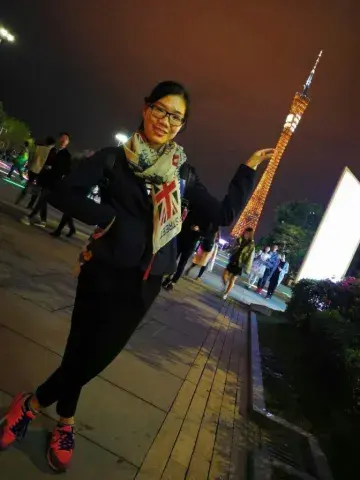
Guangzhou Tower – climb the tallest structure in the city for some amazing views, it is a very expensive ticket up to the top so not for those on a budget.
Guangzhou Tower East – my suggestion is to walk between these two stops (only a 10 min walk) at night to enjoy the very impressive lights on the other side of the river.
Liede Bridge South – Walk over this bridge for some great views, and, on the other side, a recently restored ancient town (and great coffee shops)
Party Pier – stop off for bars and restaurants – and the local beer museum
Nanchang - not a lot here at the moment aside from nice river views
Convention Centre East – a walk around a pretty park...feed some ducks or ride a bike
Convention Centre Middle -
Convention Centre West – stop off for lunch at the impressive Shangri-la hotel
Pazhou Bridge South – a short walk to the next stop will taken you past the newly restored Pazhou Pagoda and through some new, and beautiful, gardens
Pazhou Pagoda – a view of the pagoda can be had here
Wangshangwei – visit the Guangzhou metro museum, new shopping malls and more here.
Take the metro to Wanshangwei or Canton Tower

Kaifeng Fu (Yamen of Ancient Kaifeng)
Physically suffered a long course of history and natural disasters, the past of Kaifeng Fu (the Yamen of Ancient Kaifeng) has become a legend with the bricks and tiles of the old houses and streets. In replacement of the decrepit houses is the restored Kaifeng Fu with more magnificence.
T...
Physically suffered a long course of history and natural disasters, the past of Kaifeng Fu (the Yamen of Ancient Kaifeng) has become a legend with the bricks and tiles of the old houses and streets. In replacement of the decrepit houses is the restored Kaifeng Fu with more magnificence.
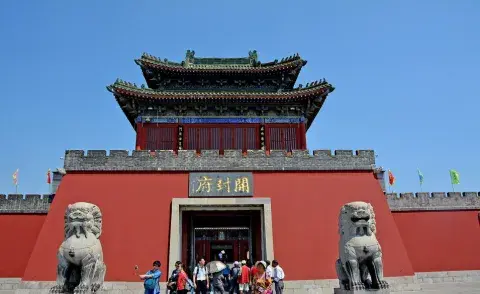
The restored Kaifeng Fu sits at the north shore of the lake, facing south, occupying about 60 acres of land. Besides a main gate in the middle, there are two side gates, one on either side. The main gate opens twice a day during the Lord Bao welcoming performance and some important occasions. Tourists usually enter through the side gates. There are two stone lions guarding the main gate, and above the gate is a tower with a huge clock and a large drum. It was used in the past to announce the change of hour, but is now for tourists to beat the drum for fun. On top of lintel, three characters are written, spelling 'Kaifeng Fu', which is the original of the great calligrapher Cai Xiang of the Song Dynasty. There are about 50 pavilions and winding corridors that are divided into nice themed cultural areas, such as 'office alley cultural area', 'punishment and imprisonment cultural area', and 'Bao Gong legend cultural area', among others.
The Kaifeng Fu project was huge. The outer wall is a city wall with crenels; there are battlements and a tower over the gate forming a square alley city, which baffles most of the visitors. According to the experts, this construction had a lot to do with the turmoil the country suffered at that time. Wars were frequent, and, therefore, all important towns had outer cities, inner cities and alley cities; and so was the construction of Kaifeng Fu. When the Song Dynasty (960 - 1279) arose, Emperor Zhao Kuangyin ordered the tearing down of all citadels except Kaifeng Fu because the man in charge was Zhao Guangyi, the Emperor's younger brother.
The citadels remained, but people still need to be very careful with any structures suggestive of military aggression living at the foot of 'the son of heaven' (the Emperor). From Zhao Guangyi onward, no one dared to place a single soldier in the citadel; there were only clocks, drums, entertainment facilities, and some technological and cultural facilities. Therefore, this city wall gained a unique name: 'cultural city wall'.
However, Kaifeng Fu was supposed to be like a court. Its purpose was to judge by law. Why were there so many appendant buildings? It was another misunderstanding. A government office alley had more functions than just being a court. It was a comprehensive administrative organization, taking charge of the civil administration, judicature, public security, labor pay, education, examination, religion, and so forth. It was probably Lord Bao being too famous a judge that made people think of Kaifeng Fu as only a court.
The restoration of Kaifeng Fu is obviously not just for nostalgia, it is more for the present, which is to develop the tourism industry of the city. For that matter, there are activities for tourists, just like any other touristic location; so that when you learn about history, you can relax and enjoy.
Entrance Fee: CNY 50 for adults; CNY 25 for kids
(kids under 1.4 m are free of charge)
Opening Hours: 07:00 - 19:00
Transportation:
A. Take Bus No. 1, 4, 5, 9, 16 or 20 in the city and get off at Kaifeng Fu;
B. It cost less than CNY 10 to take a taxi there;
C. Visitors can also take a tricycle to Kaifeng Fu, which is also a very interesting trip.
Lai Chi Wo village
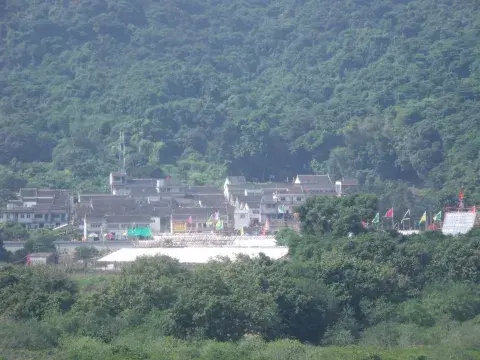
The village of Lai Chi Wo is one of those hidden gems deep in the countryside, located on the shore of Double Haven. There is no road acces to the village, the only way to get there is on foot (two hours to the nearest road), or by boat.
The village dates back some 400 years, and used to ...
The village of Lai Chi Wo is one of those hidden gems deep in the countryside, located on the shore of Double Haven. There is no road acces to the village, the only way to get there is on foot (two hours to the nearest road), or by boat.
The village dates back some 400 years, and used to be one of the more prosperous Hakka villages in the New Territories. At its peak, about 1,000 people lived there. Nowadays just a handful of mainly elderly residents remain, as most of the younger people have left for jobs in the city, mostly moving to Tai Po and Fanling.
Today the village still keeps a lot of its charm. Many of its houses are well kept, and the wall around the village has recently been renovated. It has a lush Fung Shui woods behind the village.

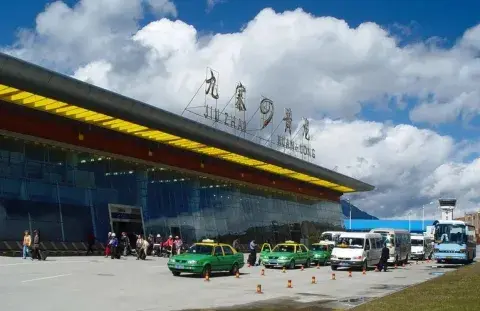
JiuzhaigouHuanglong Airport
Jiuzhaigou-Huanglong airport is short for Jiuhuang Airport. It was first time used in 28th Sep. 2003. because it is located in Chuangzhusi Town, it is also called Chuangzhusi Airport.
Aititude: 3448 above the sea level
Airport code: IATA— JZH;ICAO —Z...
Jiuzhaigou-Huanglong airport is short for Jiuhuang Airport. It was first time used in 28th Sep. 2003. because it is located in Chuangzhusi Town, it is also called Chuangzhusi Airport.
Aititude: 3448 above the sea level
Airport code: IATA— JZH;ICAO —ZUJZ
12 km away from Chuangzhusi Town, about 20 minutes drive.
90 km away from Jiuzhaigou 1.5-2 hours drive.
52 km away from Huanglong . about 1 hour drive
45 minutes from Chengdu-Jiuzhaigou-Huanglong Airport.
the mountain peak was cut to make this airport.