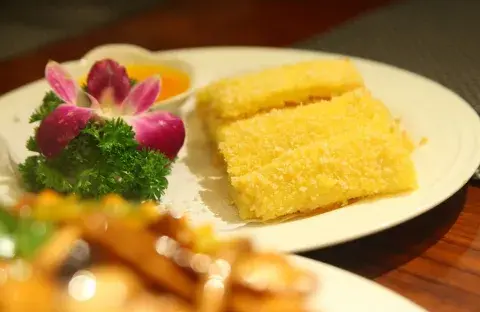
Tong Sheng Xiang-Mutton Pao Mo

Tong Sheng Xiang is one of the more well-known places for getting Yangrou Pao Mo in Xi’an.

It is located next to the Drum Tower, in the park at the center of Xi’an city, next to Defachang dumpling restaurant.

Other Location:

No. 9 Jinhua Lu (金花路甲子9号)
+86 (0)29 83219285

Link: An introduction to Yangrou Pao Mo (羊肉泡馍)

Lao She Teahouse

Lao She is one of Beijing’s most famous teahouses, and has been visited by a number of well-known politicians. Photos hanging in the entrance corridor depict many of these dignitaries enjoying a visit to Lao She. An evening at the tea house involves a Chinese dinner followed by ...
Lao She is one of Beijing’s most famous teahouses, and has been visited by a number of well-known politicians. Photos hanging in the entrance corridor depict many of these dignitaries enjoying a visit to Lao She. An evening at the tea house involves a Chinese dinner followed by traditional Chinese entertainment that includes a series of acts, such as Peking Opera, acrobatics, dancing, and a comedy show. All of the entertainment is in Chinese and although there is a screen overhead with English translations, much of the performance will be unfathomable to the non-Chinese speaker. Nonetheless it is still very enjoyable for those seeking an introduction to traditional Chinese entertainment. Lao she is also a good place to take family or friends who may be visiting you in Beijing.
 
A highlight is the tea pouring acrobatics of the waiters. The waiters masterfully pour tea from a very long spouted tea pot into a small tea cup, which is always greeted by much applause. Amazingly fresh tea is served throughout dinner and the performance. There is also a tea and curio shop in the teahouse.
 
Making a reservation in advance is a must, especially on weekends.

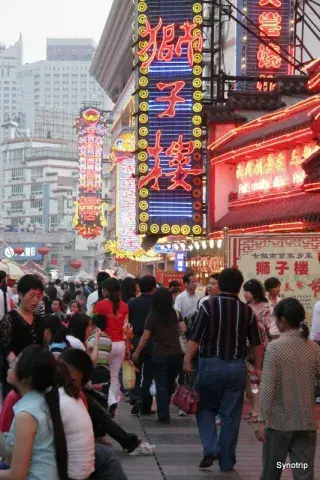
Lions Bridge - Food Street

Even when compared with many other bustling, restaurant-laden streets in Nanjing, this little pedestrian area appears to fit the most great restaurants in one place. There are a wide variety of restaurants here including full service Chinese, Japanese, Korean, and Western style res...

Even when compared with many other bustling, restaurant-laden streets in Nanjing, this little pedestrian area appears to fit the most great restaurants in one place. There are a wide variety of restaurants here including full service Chinese, Japanese, Korean, and Western style restaurants. And last, but not least, there are naturally a tonne of xiaochi (snacks).

What can you find on Lions Bridge?

- Treats - Try some bubble tea, ice and fruit (baobing), or candied fruit on a stick.

- Meatier snacks - Try the soup dumpling place or the locally popular Xinjiang meat on a stick joint.

- Xinjiang Food - For cheap Xinjiang noodles, take a walk down one of the smaller alleys.

- Pizza - For some interesting Chinese style pizza, consider the roast duck pizza at Aloha.

- Sichuan Food - Give King’s Town a try.

- Huaiyang Chinese Food - Try Nanjing Da Paidang for a tasty selection of Nanjing-influenced Chinese food.

- Korean Food - There are several Korean restaurants on Lion’s Bridge as well as another popular locale on the seventh floor of Suning (苏宁) department store just across Hunan Road.

- Thai - The Thai restaurant is very popular among the foreign crowd in Nanjing.

- Indian - Punjabi is another favourite with foreigners.

- Boring Fast Food - Of course, there are some homogenous competitors encroaching in. If you want to try something totally uninteresting go to KFC or Pizza Hut or even walk down towards the western end of Hunan Road to the McDonalds.

entrance to Lion’s Bridge (shizi qiao) on Hunan Road
The Hunan Road entrance to Lion’s Bridge.

How To Get There

Lion’s Bridge is located between Hunan Road and Hubei Road.  To reach Lion’s Bridge via subway, get off at the Xuanwu Men station and walk west down Hunan Road for about 5 minutes.  Cabs are typically parked at both ends of Lion’s Bridge.
Nanjing Food Court (Nanjing Da Paidang)

I was impressed by the distinctive local features of this restaurant.  As you approach the entrance, two elderly male hosts wearing white mandarin jackets, white round dicers, and towels on their right shoulder enthusiastically direct you inside. Upon entering...

I was impressed by the distinctive local features of this restaurant.  As you approach the entrance, two elderly male hosts wearing white mandarin jackets, white round dicers, and towels on their right shoulder enthusiastically direct you inside. Upon entering, you will be surprised by the expansive hall and its old-fashioned, yet tasteful decoration. The first floor is more of a dining hall with tables that seat 4 to 12 guests. The second floor alternatively offers small, private rooms.  The rooms are more comfortable and offer a better viewing angle of the first floor through the wooden windows, but you have to pay spend a minimum of 200 yuan (including alcohol and beverage) in order to obtain a room.

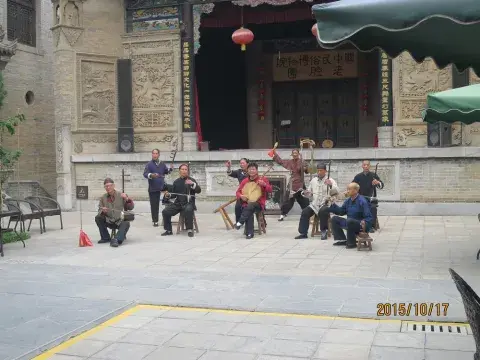
The cuisine served at the ’food court’ is traditional Huaiyang Chinese dishes.  To me, the flavor here simply makes my mouth water. The first time I dined at the food court, two guests and I ate for 190 yuan. The second time 7 of us compiled a bill of more than 500 yuan, so the average expense works out to about 60-70 yuan per person. One last detail well worth a mention is the inclusion of a daily Suzhou Pingtan performance (storytelling and ballad singing in Suzhou dialect), which begins at 7 o’clock. Credit cards are accepted here as well.

How to Get There: Check the Lion’s Bridge article.

Other Locations
Deji Plaza (德基广场)
Usually open until 10:00pm
+86 (0)25 8472 2777

No. 96 Caochangmen Dajie (草场门大街96号)
Usually open until 10:00pm
+86 (0) 25 8621 8777

Cantonese food, Guangdong cuisine

Cantonese or Yue cuisine originates from Guangdong Province (SE China around Hong Kong), and it is the most widely served style of Chinese cuisine in the world. This is because most of the Chinese who immigrated and set up restaurants overseas were from Guangdong. Though what's served abroad ...

Cantonese or Yue cuisine originates from Guangdong Province (SE China around Hong Kong), and it is the most widely served style of Chinese cuisine in the world. This is because most of the Chinese who immigrated and set up restaurants overseas were from Guangdong. Though what's served abroad now has departed from authentic Yue cuisine.

What distinguishes Cantonese food is lightly cooked fresh vegetables and meat, and sweet sauces.

A wide variety of foodstuffs are used to make Cantonese dishes. Therefore, it surprises foreigners sometimes. The saying "They eat everything with four legs except tables and everything that flies except airplanes" is an exaggeration. But dishes might contain snakes, cats, dogs and sea life not familiar to most foreigners. Keep that in mind when you are ordering something off the menu with strange Cantonese names.

An authentic Cantonese chef's goal is to preserve the food's original flavor. Unlike other Chinese styles of cooking such as Sichuan style where the cook buries the food in a lot of spices and oil, a Cantonese chef aims to bring out or highlight the original flavor of the vegetable, meat, or fruit. So little spice or sugar is used generally.

The result: The result of this cooking technique is to produce food that might seem bland or insipid to foreigners who are used to the overseas style of Chinese food where a lot more sugar and spice is used. It takes some time to appreciate the mild and distinct flavors of the meat, vegetables and fruit.

If you want to try authentic Cantonese Cuisine, our tours can take you to authentic local restaurants. Our Guangzhou tours combine must-see attractions in Guangzhou with meals in carefully selected restaurants.