Chinese Bronze Ware
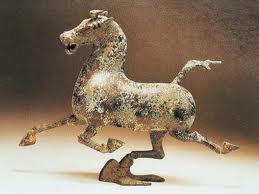
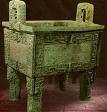
Epitomizing China’s ancient civilization and rich cultural heritage, bronze artifacts have been treasured items ever since the time of the Shang and Zhou aristocrats for whom they were made.
Ritual bronzes served as ceremonial offerings to ancestors, as banquet utensils, and occasionally as formal gifts. Members of China’s nobility possessed sets of bronzes, the sizes and types of which conveyed the social status of their owners.
Bronze Age artisans mastered complex casting techniques and produced vessels with rich decoration. In the period from the fifth to the third century BC, China’s Iron Age began, but the metal industry was still dominated by bronze casting.
Many bronzes have been found in the border areas of China. Characterized by distinctive shapes and local styles these bronzes exhibit the artistic achievements of minority peoples living in the border areas, and they also supply valuable evidence of cultural exchanges among the different nationalities of ancient China.
Initial stage: Xia (21st – 16th century BC)
Around the 21st century BC, China entered the Bronze Age. The earliest Chinese bronze culture so far known is the Erlitou culture of the late Xia dynasty. Bronze containers, musical instruments, weapons, tools, and personal ornaments, as well as foundry remains, have been found at the Erlitou site in western Henan province.
Ritual bronzes of the period were thin-walled and cast by a clay piece-mold technique that was already mature. Their forms began to show decided character. The animal-mask motif appeared at this stage, as did the use of turquoise inlay.
Formative stage: early and middle Shang (16th – 13th century BC)
During the early and middle Shang dynasty, bronze casting evolved further. Rituals that mainly involved wine vessels became important, and bronze weapons increased in variety. The animal-mask motif decorated many bronzes, executed with bold, deeply-cut linear elements and becoming ever more complex. The mold-making process became sophisticated, and an ingenious technique was developed for casting a complicated shape in a sequence of separate pours of metal. Many bronzes dating from this time have been unearthed along the middle reaches of the Yellow and Yangtze rivers.
Mature stage: late Shang – early Western Zhou (13th – 11th century BC)
The late Shang and early Western Zhou dynasties witnessed the zenith of Chinese bronze casting. During this period the sets of bronzes used in ritual (originally mainly wine vessel) changed. Although at first the early Western Zhou people followed the Shang ritual system, they gradually developed ceremonies in which food containers played an important role.
Using techniques that produced both high and low relief, artisans designed bronzes entirely covered with elegant patterns. They also further refined the mysterious animal-mask motif. Inscriptions first appeared on late Shang bronzes. The inscriptions on Western Zhou bronzes are often lengthy.
The stage of renewal: middle Spring and Autumn Warring States (late 7th century – 221 BBC)
The Chinese bronze tradition enjoyed a second flowering beginning in the middle Spring and Autumn period. As the bronze industries in the feudal states matured, regional styles with unique characteristics arose. Bronzes cast in the northern states of Jin and Qin, the eastern states of Qi and Lu, and the southern state of Chu reflect a mutually beneficial exchange of ideas and materials, and their bronze arts achieved great splendor.
While the ritual functions of the bronze vessels gradually diminished, their use as daily utensils increased, with the result that new and delicate vessel types appeared. Decorative dragon patterns became minute and intricate, and scenes of daily life were used for the first time as bronze decoration. The lost-wax technique and the use of impressed molds enabled artists to obtain rich inlay decoration of unsurpassed delicacy and intricacy.
Bronze Arts of the Chinese Border Areas Minorities
During the Eastern Zhou, Qin, and Han dynasties bronze casting flourished among the minority peoples inhabiting the border areas of China. The Yue minorities in the south, the Ba-Shu in the west, the Yi in the southwest, and the Xiongnu in the north all developed their own bronze-casting industries. Their bronzes were deeply influenced by the Shang and Zhou traditions of the Central Plains, but they also showed unique features and styles. Exchanges between the border areas and the Central Plains inspired lively and inventive works of bronze art.
Casting Techniques
Mining, smelting, and casting reached high levels of technology in ancient China. The proportions of copper, tin, and lead in bronze, the first invented alloy became perfected as time passed. Stone, clay, and metal molds were used, with clay piece-molds being highly developed. Great expertise was required in the choice and combination of materials, the making of models and molds, the carving of inscriptions and decoration. The main casting techniques were one piece casting, casting in several pours, and stack-casting. Bimetallic casting showed the skilled use of different alloy formulas. Magnificent surface decoration for bronzes resulted from inlaying and gilding techniques. Lost-wax casting was an important advance in foundry technique. The transparent “mirror of the Western Han with its unique optical properties, might be described as a last afterglow of China’s extraordinary Bronze Age.