Guangzhou Chens' Ancestral Temple
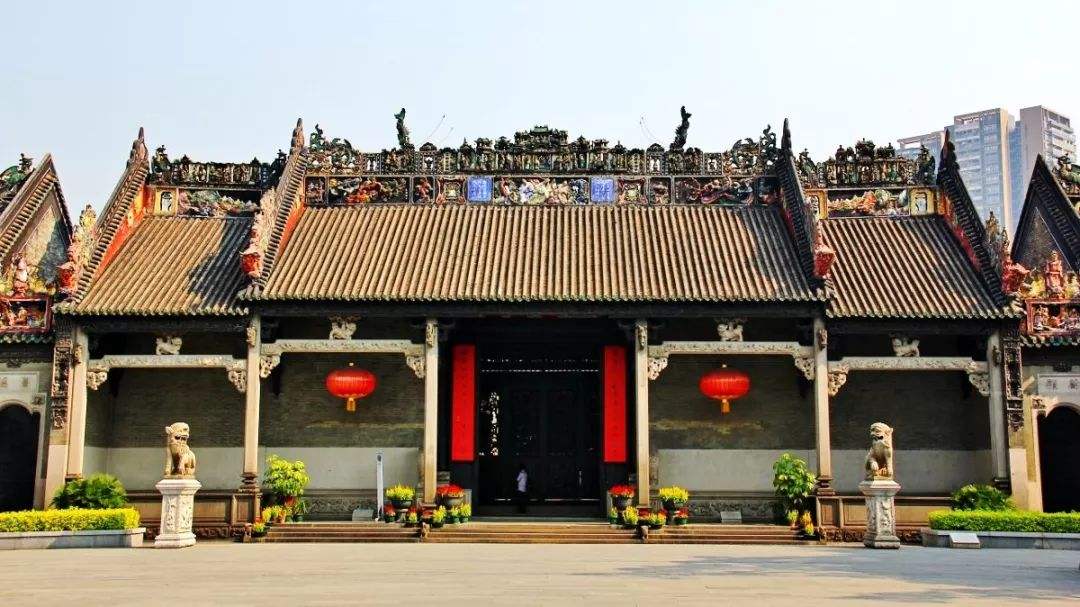
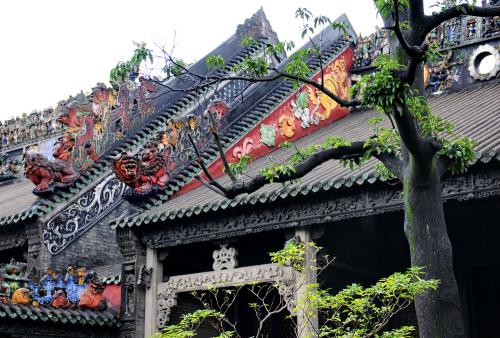
Chens' Ancestral Temple- also known as Academy of the Chen Clan, was built with money pooled by all those surnamed Chen residing in the 72 counties of Guangdong. A typical example of classical Lingnan architecture, the temple is marked for its elaborate and ingenious ornamentations. Today the temple is the site of Guangdong Museum of Folk Arts and Crafts.
Occupying an area of 15,000 square meters (about 17,940 square yards), the Ancestral Temple of Chen Family is a fine piece of architecture of Cantonese style, composed of six courtyards, nine main halls, and nineteen buildings. It is considered as one of the four main cultural attractions in Guangdong Province in China with the three others being - the Ancestors' Temple in Foshan City, the former Residence of Sun Yat-sen in Zhongshan City and the Opium War Memorial Hall in Dongguan City.
The Ancestral Temple of Chen Family, given another name called Chen Clan Academy later, was built between 1890 and 1894 during the reign of Emperor Guangxu of the Qing Dynasty (1644 - 1911). The temple was funded by Chen's families in 72 counties of Guangdong province as well as some oversea members of Family Chen. The original function of this construction was to pay tribute to Chens' ancestors, later, it was used as an academy, where the descendants of Chen family lodged at and prepared for the imperial examination. It is now the Guangdong Folk Art Museum. Walking in the temple, you will see a lot of folk artworks and handicrafts, including enameling, embroidery, porcelain, lacquer work and paper cutting, all with a long history. What fascinates most is the traditional Chinese watercolor. As the artist flicks his wrist for several times, a scene of China's past takes shapes.
What makes Ancestral Temple of Chen Family distinctive is the extensive application of the various techniques just like wood carvings, stone carvings, brick carvings, clay sculpture, ash sculpture, brass and iron foundry, grotto and other forms of art. The sculptural technique expresses simplicity and ruggedness, precision and exquisiteness, each setting off the other.
The Ancestral Temple of Chen Family abounds with the finely made brick carvings, which represent the highest level of Cantonese brick carvings in the Qing Dynasty. The selection of the quality of the blue bricks is very essential for the brick carvings. Subsequently, the bricks are carved one by one according to the designed pattern. Finally, they are embedded in the wall for the ornamental purpose. Brick carving is a form of art that adorns the wall in a plain and elegant way.