Chengdu, an Ancient and Modern City (I)
The Origin of Chengdu City
On the Chengdu Plains the ancient city remains of the Bao Dun culture, being traced back over 4,500 years, is considered as the origin of Chengdu city. 3,000 years ago, in the era of the San Xing, Jin Sha and Shi Er Qiao Ruins, a largest and earliest ancient city emerged on the inner Chengdu Plains. From then on, the city never changed its location for 3,000 years and more. During the early Warring States Period Chengdu’s urban district turned to be the settlement of the Kai Ming Dynasty. Down to the late Warring States Period, King Hui Wen of the Qin State conquered Shu in 316 B.C. Afterwards Chengdu turned to be the seat of the local government of Shu prefecture, and at the same time Chengdu County had been established.
Evolution of Administrative Systems
For a span of over 2,000 years from the Qin Dynasty to the Qing Dynasty, Chengdu remained as the seat of administrative divisions by the names of xian (county), jun ( prefecture), zhou (The name of jun had been replaced by zhou or fu during the Sui and Tang dynasties.), fu, lu (The regional size of each lu is almost the same as the one of a province), dao (In the Qing Dynasty, the dao had more administrative power than the prefecture “zhou,” but it was still held under control by the province.) and sheng (province). At intervals Chengdu turned to be the capital of separatist regimes that included Cheng Han, Shu Han, Da Cheng, Former Shu, Later Shu, and Da Xi. During the period of the Republic of China, Chengdu was still a provincial seat. In 1922, the Municipal Administration Office was established. In 1928, Chengdu Municipal Government was founded, and the city itself was under the jurisdiction of the provincial government. After the foundation of the People's Republic of China, the Western Sichuan Administration Office was established, and Chengdu became its seat. In 1952, when the provincial system was brought back, Chengdu turned to be the capital of Sichuan, and it remains in the same position ever since.
Chengdu’s Previous Names
The Origin of Its Name
The name of cheng du has remained unchanged for almost 2,500 years. Below are some explanations for the origin of it's name.
1. According to Around the World, an ancient Chinese geographic book published in the Song Dynasty, cheng du originated in the saying “it took a year to assemble and live in a compact community; the second year to become a county center; the third year to turn into a metropolis.” Literally it means, “Becoming a capital.” This is a most popular saying about its origin.
2. According to some modern scholars, there is another explanation to the origin. Cheng du came from the dialect of a Shu nationality. Cheng is a term of a nationality, while du refers to the place where the Cheng nationality lived.
3. In addition, modern scholars believe that Chengdu gains its name after chao ju. The character “cheng” is the image of chao ju, which refers to a mode of human beings’ inhabitation in remote ancient times; the character “du” is the place where people gather together; cheng du is a seat where the chao ju clan resided. In short, Chengdu’s historical characteristics are quite uncommon in the world, with its location and its name that have remained unchanged for 3,000 years and for 2,500 years respectively.
Name-Carved Cultural Relics
The carving or typecasting of the Chinese characters “Chengdu” on cultural relics appeared as early as the Spring and Autumn Period and the Warring States Period. In Qing Chuan and Yin Jin counties archeologists unearthed lacquerwares, which had marked brands or seals in the shape of “成”(cheng), “成屮”(cheng 屮) and “成亭”(cheng ting). These characters suggested the places where the products were manufactured. Also the surface of a copper lance, unearthed in Yin Jin County, has Chinese characters “Chengdu.” In Qing Chuan County a copper dagger-axe was unearthed. It was produced by Shu Dong Gong Weapon Workshop in 277 BC, and “Chengdu,” the carved characters were on its surface.
The Elegant Names of Chengdu
During the period from the Qin to the Han dynasties Shu brocade was well-known all over the country. The brocade fabrics became very bright after these were rinsed in a river. Accordingly the river was called “Brocade-Rinsing River or “Brocade River” for short. In the Han Dynasty Jin Guan (brocade administration office) was set up near a city bridge for the purpose of taking charge of brocade workshops. Therefore, Chengdu was called “Jin Guan City” or “Jin City (brocade city)” for short.
The climate in Chengdu is suitable for the growth of flowers and trees. The hibiscus is the variety that local people love, and its flowers appear all over the city when the hibiscus blossoms. Du Fu, a poet of the Tang Dynasty, said in one of his lost poems, “I ponder upon my bygone trips as if I were in dreams / Beyond the City of Hibiscus, water remains around and boundless.” Evidently even in the Tang Dynasty Chengdu did obtain a good name called Rong Cheng, the City of Hibiscus. Later, Meng Chang, the king of the Later Shu, had people plant hibiscus all over the city. By then, the good name really matched its reality.
Other Names of Chengdu
In 311B.C. the city wall around Chengdu officially began its construction. According to The Biography of Shu Kings and Emperors, in those days city walls often collapsed after its construction was completed. One day a big tortoise unexpectedly arrived. He circled around the city until he reached the southeast corner where he died of fatigue. So people restarted the city-wall construction along the route the big turtle passed by, and the newly built wall was a success. From then on Chengdu picked up another name “the City Where the Tortoise Reincarnates” or “the City of Tortoises” in its abbreviated form.
The Old Urban Districts of Chengdu
The Big City and the Mini City
The Mini City was the urban area emerged in the earliest period in Chengdu. It was called Shao because of its small size and early founding. The city was also the earliest market place or business section. The Big City was another section that came out after the Mini City. So it was called “Da” or “big.” In 311 B.C. Zhang Yi began building walls around Chengdu, which started to have a type of regular walls and street layout, similar to the urban planning and design of Xian Yang, capital of State of Qin. In terms of its initial function, the urban area fell into two parts, the west part being the Mini City business section and the east one being the Big City official administrative and residential area. The two cities co-existed until the Ming Dynasty. Afterwards another pattern of three-city co-existence emerged and it remained through the Ming to the Qing dynasties. The pattern of the two-city and then three-city co-existence remains a great characteristic of the city layout in Chengdu.
Two Rivers Surround The City
During the late Warring States Period, around 256 B.C, Li Bing, the governor of Shu Prefecture, constructed the Due Jiang Yan Irrigation System, which led the water of the Ming Jiang River down to the Chengdu Plains. This system includes two main inlet Canals, one being the Pi Jiang River and the other the Liu Jiang River. According to The History of Huayang State, the Pi Jiang River and the Liu Jiang River flowed through separate cannels, moved along the city’s southwest corner and then continued their flow eastwards, side by side until they reached Chengdu. At that time the two rivers were named “Chengdu Twin Rivers,” and this canal system existed more than one thousand years. In the late Tang Dynasty, the Nan Zhao Kingdom often invaded Chengdu, frequently leaving the local residents disturbed. In 876 Gao Pin, the newly appointed western Sichuan military commander, built another city called Luo City. His purpose was to consolidate the city defense. Originally the Pi Jiang River Canal extended towards the south of Chengdu. However, due to the new city’ construction, its river course was changed. Instead the river was diverged to flow around the north and the east of the city before it converged at He Jiang Ting Pavilion with the Liu Jiang River that flowed around the south of the city. As a result, the rivers flowed around Luo City, forming a river course pattern of “two rivers surrounding the city,” which still exist today.
The Zi Cheng City, the Luo Cheng City and the Yang Ma Cheng City
The Zi Cheng City (son city) was another name of the Big City in the Sui and Tang dynasties. The Luo Cheng City was the result of the expansion of the Zi Cheng City in the late Tang Dynasty when Gao Pin changed the water courses of the two rivers. The character luo refers to “hold with a net,” and therefore any city with a pair of walls is usually called “Luo Cheng City.” Meng Zhixiang of the Late Shu State again expanded the area lying beyond Luo Cheng City and constructed a larger and wider city wall. The third newly city was named Yang Ma Cheng City (sheep and horse city). However, the new wall construction project started so hurriedly that the quality assurance failed. Consequently the newly built wall soon collapsed and disappeared
The Imperial City
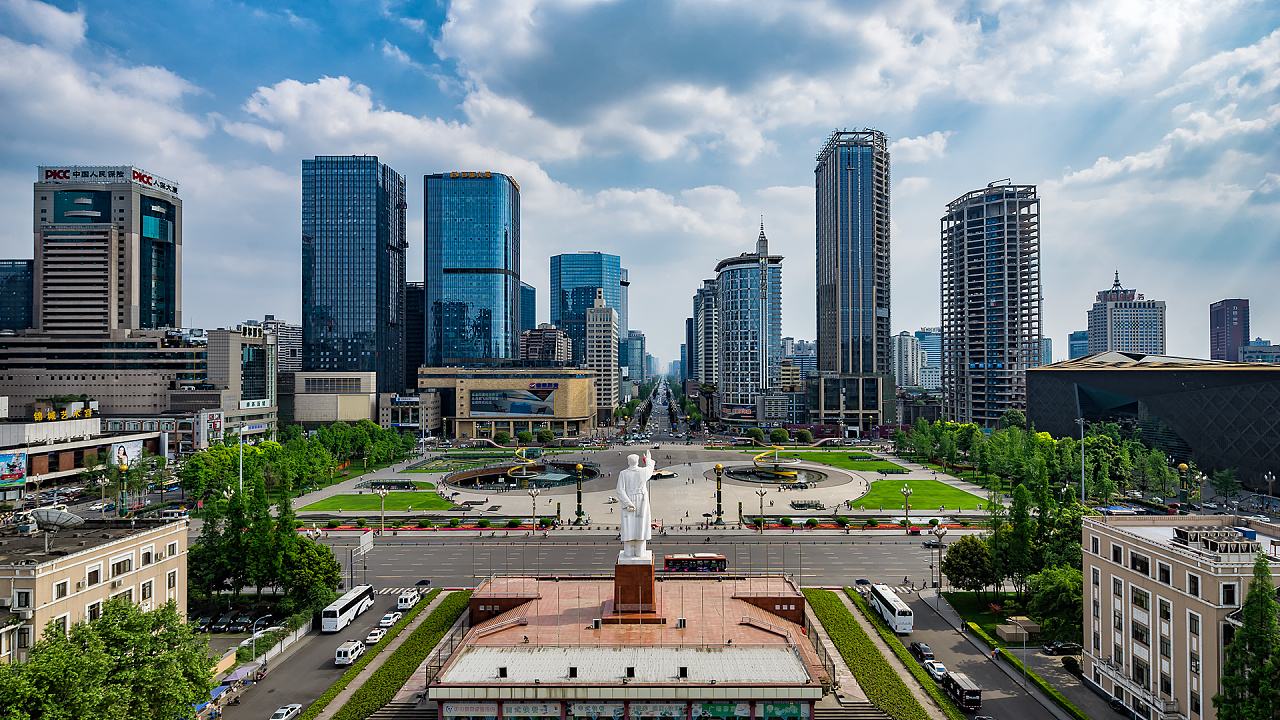
In 1390, Emperor Zhu Yuanzhang assigned his thirteenth son Zhu Chuan to the Shu King’s post. Afterwards Zhu Chuan came to Chengdu and lived here. The Shu King’s residence that began to be built as early as 5 years ago was completed at the moment when Zhu Chuan arrived. The construction appeared mighty and had a grand exterior. Therefore, common people named it Imperial City. Its brick wall around the residence was 5 m. in height; its perimeter was 4,500 m. in length; the wall itself was called Screen Wall. The site of the present-day Tian Fu Square and Hou Zi Gate area used to be the center of the Shu King’s Residence that year.
Good reputations of Chengdu in ancient and modern times
No Daily Life Worries
The Book of the Earlier Han Dynasty · Geography Chronicles evaluates the Shu prefecture as it records the prefecture’s facts and events. It says, “People eat rice and fish. There is no crop failure year and no daily life worries.” The irrigation system ensures the Chengdu Plains to keep away floods and droughts so that people neither have the taste of famine-year hunger nor worries in their daily life.