Old Villa-Style Houses and culture in Dongshan,Guangzhou,China.
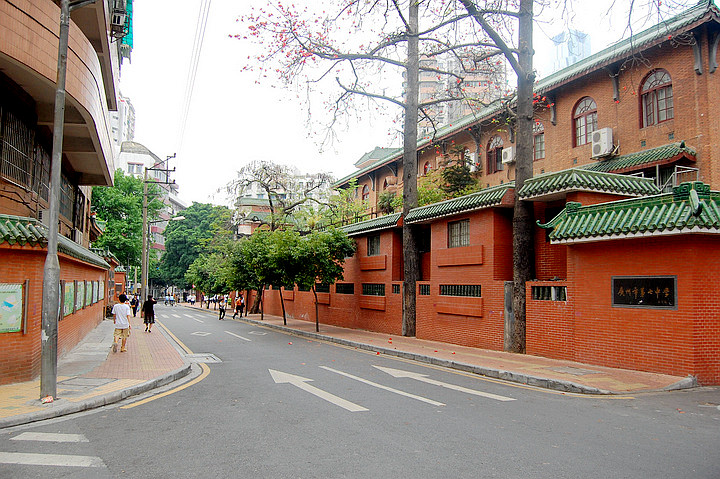
Generally ‘Dongshan (东山)’ is defined more as a geographic concept than an administrative region. Locals usually think of the area east to Dadao Lu (达道路), west to Dongshankou Metro Station, south to Xinhepu Lu (新河浦路) and north to Nonglin Dong Lu (农林东路).
Lying just west of Guangzhou’s new downtown is Dongshan, one of a handful of little neighborhoods in the city to retain its traditional look and even some of its old character. Though it is not the first area sought after by visitors or by locals, on many accounts it deserves to be, as it has some of the nicest walks you’ll discover in Guangzhou. Here you’ll find streets lined with a blend of European and Chinese architecture, houses with gorgeous facades, a long canal lined with trees and flowers, small quiet housing communities, and of course the main walking street of Dongshan Da Jie, which is where most of the restaurants and colorful Chinese shops can be found. Even a short stay in Guangzhou would miss out on a unique piece of its history, and a very relaxing stroll, if it did not include this little-developed, historical downtown neighborhood.
Dongshan, which means Eastern Hills, actually has quite a bit of history as a part of Guangzhou. It was a small, poor eastern suburb during the Ming dynasty, until an influential court official built Dongshan Temple here. With the temple came more people, and with more people came more homes and shops. Dongshan started to become more than a shanty town. Dongshan Temple, though it no longer exists, is still known to the public through the names of many of the neighborhood streets. Names such as Miao Xian Zhi Jie, which literally means “temple front straight street” once indicated to visitors that it was the street immediately in front of the temple.
Dongshan received further attention after the turn of the 20th century through the settlement of Westerners here. Preachers built churches, schools and orphanages, and wealthy Westerners made their homes here, providing the neighborhood with everything from balconies to stained glass and Greco-roman pillars. This heavily European style of building became commonly called Dongshang Yang Fang, a self-explanatory name which simply means Dongshan Foreign Style. The name has a very broad meaning; some of the buildings may seem closer to the Western style of Shamian, and others to the very blended style of Xiguan, while yet still others seem unique, probably built to suit the tastes of the owners.
Eventually, as Dongshan expanded and its finances grew, the neighborhood became well-known as a home to wealthy Chinese. The popular term Dongshan Dashao was used for the local wealthy young men. This brief period of history starting in the 1920s is recorded in part by many legendary romances between the stylish young men from Dongshan and the rich young women from Xiguan. It was believed that pairs from the two neighborhoods were the perfect match.