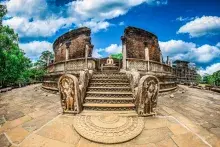
Travel to Sri Lanka
Traveling down the mountain slopes one comes to Ratnapura - the City of Gems - known from ancient times and mentioned in the tales of the Sheherazade or Arabian Nights. It was to Ratnapura in Sri Lanka that Sinbad came to obtain sapphires, rubies, cat's eyes and other gems of priceless value. It was from Sri Lanka and Ratnapura that King Solomon obtained the gems and other gifts such as peacocks and elephants to woo the Queen of Sheba. Ratnapura and its surrounds still abound in gems, much sought after by the world. Tradition has it, that the gems that are found in the riverbeds around Ratnapura, are in fact the crystallized tears of Adam & Eve as they wept after being banished from the real Eden to this other Eden.Always a few hours driving distance away is the wildlife of Sri Lanka, given sanctuary in many national parks, and strict nature reserves. Here one can see the elephant and leopard roam in freedom, as do the sloth bear, the spotted deer and Sambhur. There are peacocks aplenty displaying the vibrant colours of their tails to attract mates, as well as many species of parrot, stork, swift, the Brahiminy Kite, the Fishing Eagle, the colourful Kingfishers and Woodpeckers, and the unique tailor birds and weavers to name only a few. The inviting warm tropical climate of Sri Lanka also brings in a large number of winged visitors from as far away as Siberia to escape the cold of the winter, the most colourful of these being the Siberian Flamingo. There are also plenty of tern and wild duck that come here during the winter adding to the island's own 150 plus species of indigenous birds.By far the biggest attraction of Sri Lanka is its people. The Sinhalese, Tamils and Muslims are all friendly by nature and the country has an unsullied record of hospitality over the centuries. It is a land of smiles and a warm welcome, observed by Anton Chekov, Bernard Shaw and Sir Arthur C. Clarke who has made Sri Lanka his home, and the inspiration for at least two of his books. It is known as a land of tolerance that has been tempered over the years by the teachings of the Buddha. Its overall Buddhist culture, with a lasting blend of Hindu influence has been the source of an ancient civilization, with masterpieces of sculpture, construction, and irrigation that have lasted to this day in the several ancient and medieval cities that bear testimony to Sri Lanka's historic splendour. The huge irrigation tanks that dammed rivers and also harnessed the rain from the 1st Century BC are known as marvels of a unique hydraulic civilization and still provide the water for the rice field of today. At the beginning of a new millennium, Sri Lanka that has known much of history, still beckons as a land of splendour far beyond the limits of a tropical isle.Geography
Sri Lanka is an island situated at the southern tip of india in the Indian Ocean. From North to South - 432 km From East to West - 224 km Total area - 65, 525 sq. kmPopulation
The majority of Sri Lankans are Singhalese and Buddhists, but the total population is a mixture of Tamil, Moor, Burgher (people of european descent). Sinhala, Tamil and English are the national languages. English is spoken throughout the island.Time
Sri Lanka is +5 ½ Greenwich Mean Time.Climate
The south-west monsoon brings rain to the western, southern and central regions from May to July, while the north-eastern monsoon occurs in the north and east in December and January. The weather is finest in the coastal regions and hill country of the south-west from October to March. The temperature in the lowlands averages 27 degrees Celsius. However, temperatures fall rapidly with altitude. In Kandy the temperature on average is around 20 degrees Celsius and in Nuwara Eliya it is often below 15 degrees Celsius.Clothing
Lightweight clothing is recommended. It is a good idea to be conservatively dressed on the streets and shorts are not permitted in places of worship. Footwear off in temples. A light sweater is recommended in the hill country. Bring rain proofs, avoid synthetics.Telephones
Card operated telephone booths and cyber cafes can be found in most towns. Cards can be obtained at the nearest grocery shop or kiosk. Mobile telephone rentals are also freely available.Health
It is safer not to drink water from the tap though water in major towns are treated. Boiled water, bottled water and water and ice at reputed hotels are safe. Government run hospitals and a number of private hospitals are available in the event of an emergency. Most hospitals are well equipped with medical specialists on call at any time of day. Reputed hotels have a Doctor on call.Electricity
210-240 volts, 50Hz, Alternating Current / Plug sockets take round pins.Currency
The currency in Sri Lanka is the Rupee. The value fluctuates with world market rates. All commercial banks are authorized to exchange money and so are most tourist class hotels. American Express, Master Card and Visa Card are also widely accepted.Visas
Nationals of most countries may obtain visas on arrival, at the airport. It is best to check with your nearest Sri Lankan diplomatic mission or consulate. The visa that is issued at the point of entry is only valid for 30 days. Extensions can be obtained, if required, from the Department of Immigration & Emigration in Colombo.Shopping
Sri Lanka offers good bargains in ceramics, garments, leather goods, gems etc.Communications
The general post office is situated in the city of Colombo. Other towns have central post offices. Privately run agency post offices, cyber cafes, communication centers also function throughout most of the country.
User reviews
Leave a review
Add Review