Guangdong Province Attractions


Guangdong Province Articles
Bright Filial Piety Temple
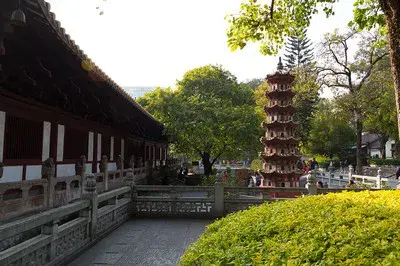
Situated at the north end of Guangxiao Road, Bright Filial Piety Temple (Guangxiaosi) is among the grandest and most influential temples in China with a history dating back more than 1,700 years....
Situated at the north end of Guangxiao Road, Bright Filial Piety Temple (Guangxiaosi) is among the grandest and most influential temples in China with a history dating back more than 1,700 years. In fact, it is said that 'The Bright Filial Piety Temple existed before the birth of Guangzhou City'. In 1961, it was designated by the State Council as a Key National Cultural Preservation Site.
Initially built during the Western Han Dynasty (207 BC - 24 AD) as a private house, it was used as a lecture hall before being dedicated completely to the function of a Zen Buddhist Temple during the Southern Song Dynasty (1127 - 1279). The many noted monks and sutra-translators who have resided there have contributed greatly to the spread of Buddhist culture. The pride of the temple is Hui Neng, the famous sixth master of Zen Buddhism, who had his hair cut and was initiated into monkhood there.
The architecture of the temple and cultural relics provide insight into the history of Chinese Buddhism, culture, and architecture as well as the local history of Guangdong Province. The main complex consists of Mahavira Hall, Sixth Ancestor Hall (Liuzudian), Samgharama Hall, Heavenly King Hall (Tianwangdian), the East and West Iron Towers, and the Mahakaruna Dharani Sutra Pillar.
The Mahavira Hall was built in 401 during the Eastern Jin Dynasty (317 - 420) with additions made during succeeding dynasties. Today it is 35.36 meters (116 feet) long by 24.8 meters (81.36 feet) wide by 13.6 meters (44.62 meters) high. Situated on a high platform, the stately building, which is considered the most magnificent in South China, is guarded by the Bell Tower and the Drum Tower. Inside are three fine statues of Buddha. Travelers to other parts of South China will note that many other temples in the area have imitated the architectural style of Mahavira Hall.
The Sixth Ancestor Hall, located behind Samgharama Hall, was established during the Northern Song Dynasty (960 - 1127) in honor of Master Hui Neng, a larger-than-life statue of whom is found inside. Behind this hall grows a bodhi tree, which symbolizes the Buddhist ideal of wisdom. In 676, the abbot of the temple buried Hui Neng's cut hair under the tree. Today the seven-story (7.8 meters [25 feet]) octagonal Yifa Pagoda stands as a memorial to him. Each level houses eight shrines.
The East and West Iron Towers are the oldest iron towers in China. The West Iron Tower, the older of the two, was erected in 963; the East Tower was built four years later in 967. The four upper floors of the West Tower failed to survive the collapse of the house. The East Tower, which remains intact, is seven stories tall. About 1,000 shrines, each housing a small, exquisite statue of Buddha, are carved into the exterior of the tower. It is said that at the time of its completion, the exterior of the tower was gilded.
In addition to these structures, other beautiful buildings and relics can be seen on the Temple grounds. The Heavenly King Hall boasts the 380-year old Helin Stele, which was inscribed during the Ming Dynasty (1368 - 1644).The Spring of Washing Bowl was dug in 527 to provide clear spring water in which Bodhidhamma, the initiator of Chinese Zen Buddhism, could wash his bowl. And the unique mushroom-shaped dharani pillar, which was made of bluestone in 826, is engraved on all eight sides with the words of the Mahakaruna Dharani Sutra.
Baomo Garden
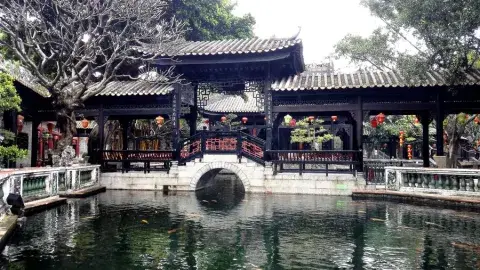
Baomo Garden is located in Zini Village, Panyu District of Guangzhou. More than just a garden, it covers an area of about 100,000 square meters (about 25 acres) and is a complex of encompassing culture, south China traditional architecture and south China garden arts.
...Baomo Garden is located in Zini Village, Panyu District of Guangzhou. More than just a garden, it covers an area of about 100,000 square meters (about 25 acres) and is a complex of encompassing culture, south China traditional architecture and south China garden arts.
History
Baomo Garden was built in the late Qing Dynasty as an extension of the Temple of Lord Bao located to the east of the Garden. The Temple itself was built during the reign of Emperor Jiaqing of Qing Dynasty (1644 - 1911 AD), to praise Lord Bao Zheng of the Song Dynasty (960 - 1279 AD) and his qualities of incorruptibility and justice. The original garden was destroyed in the 1950s. Reconstruction work began in 1955 and lasted for eight years. Large and elegant, the rebuilt garden is a good example of south China gardens.
Major Attractions
Baomo Garden can be divided into many scenic areas and sites. At its front gate is a grand and exquisite white stone archway. Inside the garden, pottery sculptures, porcelain sculptures, brick sculptures, stone carvings, and wood carvings can be seen everywhere. The most amazing piece is the porcelain inverse relief “Qingming Festival by the Riverside”, which has been added to the Guinness Book of World Records. Another example of this type of work is the huge brick carving, Wall of Flowers and Birds. The bronze statue of Confucius is exhibited in the Treasure Pavilion on Litchi Island for visitors to worship.
In addition to the above mentioned attractions and art works, there are many other famous scenic spots inside the garden.
Zhiben Hall was originally Lord Bao’s Hall. In its lobby, hangs a Chinese painting of a Lotus, symbolizing the upright and holy spirits of Lord Bao. Behind the hall, there is a granite plaque inscribed with the characters of “Baomo Garden”, which is the only relic of the garden.
In the lobby of Baomo Hall is a portrait of Lord Bao, painted by the famous Chinese painter, Han Yunlang. The two elms in front of the hall are nearly 100 years old. As they are tall and vigorous, and standing right in front of Lord Bao’s portrait like guards, people call them “General Trees”. On the roof bridge is a group of pottery sculptures telling the story of Lord Bao throwing ink stone into the river.
Longtu Hall is built in a traditional south China architecture style. It boasts delicate and elegant brick carvings, wood carvings, and clay sculptures, etc. Upon entering, visitors see a giant rosewood screen, 3.5 meters by 4.5 meters (about 11.5 feet by 14.8 feet). This screen took 16 artists about 18 months to complete. In front of it is the statue of Lord Bao that portrays his commitment to standing on principles.
Zhao Tailai Collection Hall is built in the late Qing Dynasty temple style of the Pearl River Delta. Mr. Zhao is the permanent honorary director of Baomo Garden. His donations to this garden, including bronze Kwan-yin, horse, burner, and 41 large Tibet Thangkas are housed here.
Qianxiang Corridor, about 1,000 meters (3,281 feet) long, winds up and down following the terrain and layout of the surrounding architecture. It not only provides protection from the rain and sun, but also is a nice place for sightseeing and resting.
The garden has a lot of wonderful water features. Litchi Scenery Bay, Qingping Lake, Baomo Lake and a 1000-meter-long river are interconnected. They are glassy like mirrors and run all the time. Over 30 bridges cross these waters for visitors’ convenience. The most famous is the Purple Ribbon Bridge over Qingping Lake. It is a traditional 9-arch stone bridge carved with famous Chinese stories like “The Romance of the Three Kingdoms (220 - 280 AD)” and “The Romance of the Sui (581 - 618 AD) and Tang Dynasties (618 - 907 AD)”. Another attractive water scene over Qingping Lake is Zidong Boat. The two-storey boat is 21 meters (69 feet) long, 6.8 meters (22 feet) wide and 8.7 meters (29 feet) high, constructed of reinforced concrete and decorated with teak. The wood carvings and wood furniture on the boat are very beautiful. On its first storey, visitors can drink tea and enjoy Cantonese music and operas.
Another great thing about Baomo Garden is its plants and flowers, which make the garden beautiful all year round. The best places to enjoy these plants include Rose Yard, Lotus Pond, Orchid Garden, and Purple Bamboo Woods.

White Cloud Mountain (Baiyun Mountain)
From ancient times, White Cloud Mountain has been one of the most famous spots of natural beauty in Guangzhou, and it's still known as the First Spectacular Scene of the city....
From ancient times, White Cloud Mountain has been one of the most famous spots of natural beauty in Guangzhou, and it's still known as the First Spectacular Scene of the city. Every time the sun shines after the rain, and through late spring, a wreath of airy clouds circles the mountains. This is how White Cloud Mountain has won its name, and its reputation as a marvelous spectacle of nature. The fierce differentiation of rocks, and the different ways in which erosion has affected them, has caused it a crisscross network of gullies. So its relative height is now about 100 meters (109 yards). The quiet and secluded environment of the valley has made it a haven of peace from the big city.
People always describe the natural beauty of Guangzhou as being composed of white cloud and pearl sea, the white cloud referring to the mountain, located about 17 kilometers (10 miles) north of the city. The total area of White Cloud Mountain is about 28 square kilometers (10 square miles), consisting of 30 peaks. Moxing Ridge (Star-Scraping Ridge), known as 'the first peak under the southern sky', is about 382 meters (417 yards) high. You can stand on the summit and look over the whole city and the beautiful Pearl River, the most famous river in Guangzhou.
This area is an ideal place for people to relax. It has six areas that are popular with visitors, Bright Pearl Building Park, the San tailing Summit Park, the Bird Spring Valley Park (Mingchun Valley), the Santailing Park, the Luhu Park and the Fei'eling Park. Yuntai Garden, a bright pearl in the crown of White Cloud Mountain, is located in Santailing Park. Yuntai Garden is an enormous garden filled with all kinds of blooms and trees, which make Guangzhou, City of Flowers, worthy of the name. The Sculpture Park is located in Fei'eling, and covers an area of 46 hectares (113 acres). It was built according to the fashion of the times, which was to use modern languages in sculpture. You will also find the biggest natural birdcage in China, perfect for enjoying all kinds of birds; Bird Spring Valley Park. Here you can stroll idly by the river and mountains, and mingle with the birds. Luhu Park is famous for Jinye Pond. The lake is so clear that the beautiful sights surrounding the lake are perfectly reflected in the water, like a brilliantly drawn picture.
Due to the recent rapid development of the city, the mountain is mostly surrounded by urban developments. A major beauty spot in a modern city with a population of 8,000,000 is really a most unusual occurrence. It is fairly known as a return to nature from the big city.
Top Guangdong Province Tours
$150 Per Day
Guangzhou
Day 1 Arrive in Guangzhou
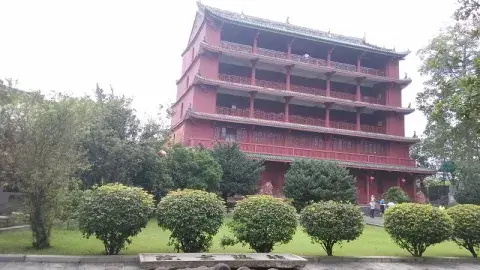
Arrive in Guangzhou in the morning, you will be met and transferred to hotel, then visit Sun Yat-sen Memorial Hall. The Memorial Hall is a very famous historical scenic spot. It is in memory of Sun Yat-sen, the great revolutionary forerunner. After that proceed to visit the Ancestral Temple of the Chen Family. It is a unique site for offering up sacrifices to worship ancestors of 72 Chen families in Guangdong. This ancestral temple is also the largest, best preserved and best decorated ancient architecture existing in Guangdong province.
...Read moreDay 1 Arrive in Guangzhou
Arrive in Guangzhou in the morning, you will be met and transferred to hotel, then visit Sun Yat-sen Memorial Hall. The Memorial Hall is a very famous historical scenic spot. It is in memory of Sun Yat-sen, the great revolutionary forerunner. After that proceed to visit the Ancestral Temple of the Chen Family. It is a unique site for offering up sacrifices to worship ancestors of 72 Chen families in Guangdong. This ancestral temple is also the largest, best preserved and best decorated ancient architecture existing in Guangdong province.
Day 2 Guanzhou Tour
After breakfast, you will go to Yuexiu Park first, the largest and the most famous park in downtown Guangzhou. There are three artificial lakes and seven hills of Yuexiu Mountain. Then you will visit Temple of Six Banyan Trees, which is one of the four best Buddhist temples in Guangzhou and located on the Liurong Road (meaning the Six Banyan Trees Road). The Nanyue King Tomb Museum is a must-see Guangzhou attraction, which dates back to 2,000 years ago, is the earliest large scale painted stone chamber tomb ever found south of the Five Ridges. Buried with the tomb owner in a jade shroud are a gold seal and a lot of exquisite jade adornments. It has become a world famous museum. After the day tour you will be transferred to airport for your next destination.
$150 Per Day
Discovery of Martial Art City-One Day Sight Seeing Trip To Ancestor’s Temple And Bruce Lee Ancestor House In Foshan
Chinese new year, the most important festival for chinese. Many staff will have 7 days vacation, which can make good use of these day to travel and have relax. Most customers from Synotrip contact me whether to be their tour guide and interpreter during the new year .I was born in Guangzhou ,my hometown is Guangzhou, I know the culture of Guangzhou and Guangdong the best, that's why so many clients choose me to their interpreter.
...Read moreChinese new year, the most important festival for chinese. Many staff will have 7 days vacation, which can make good use of these day to travel and have relax. Most customers from Synotrip contact me whether to be their tour guide and interpreter during the new year .I was born in Guangzhou ,my hometown is Guangzhou, I know the culture of Guangzhou and Guangdong the best, that's why so many clients choose me to their interpreter.
One of clients contact me from Synotrip, now we become friends. He is obsess with chinese martial art and Bruce Lee, so he decide to come to China to follow the step of martial idol.
He ask me to plan a “discovery of martial art” trip for him. No doubt that Foshan, which is renowned for its martial art form, is the best place to him. In fact, the city of Foshan can be called the birth place and home town of this particular martial art form. The notable celebrity are Ip Man, Bruce Lee, and Wang Fei Hong who is a legendary martial art master and doctor and seldom foreigner know him.
We plan to visit Ip Man memory hall in Ancestral Temple first, after that, go to Bruce Lee ancestor house. Actually, we can go Ancestral Temple by metro from Guangzhou. There is a Guangfo line connected Guangzhou and Foshan, which it is more convenience for the people of two city. But considering the distance from Guangzhou East to Foshan, tight schedule, and the place of Bruce Lee ancestor house is a remote village hard to get there by public transportation, we decided to rent a car for traveling.
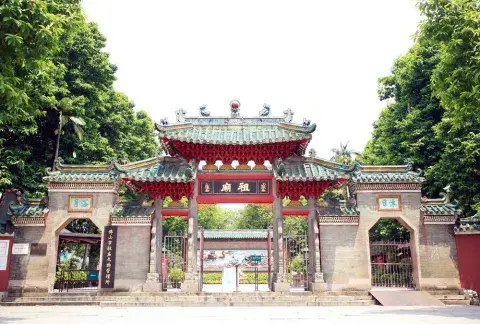
My friend arrived at about 9:30 am at Guangzhou East station,and after picking him up we headed to Ancestral Temple. The Foshan Ancestral Temple is commonly called Zumiao. It is a Daoist temple, museum, and exhibition center. The architecture, decor and articles on view in Foshan Ancestral Temple are remarkably refined, and are part of the unique historical heritage of Foshan.
Because my friend is a martial art fans, so we directly to the Ip Man memory hall.Ip man, a man dedicated to a Wing Chun, is a famous Chinese martial art master, had been a master of Bruce Lee. Bruce Lee learn Wing Chun and develop it in his Jeet Kune Do. In the museum, you can see a likeness of Ip Man, martial arts training equipment, and a plaque with information about him.
There is another memory hall for famous legendary martial artist and doctor named Wang Fei Hong. In this place,we also see a chinese traditional customs performance ---lion dance.
We are so deep addicted to enjoying the time in the Ip Man hall and lion dance without noticing that it comes to the afternoon. We need to head to next place - Bruce Lee Ancestor House, which it take one hour to arrive from temple.
Bruce Lee who is considered by many as the most influential martial artist of the 20th century, and an important cultural icon. He used Wing Chun, as his base, learned from the influences of other martial arts, and later created his own martial art philosophy — Jeet Kune Do.
The Bruce Lee Ancestral House located in Jun'an Town is another site for Bruce Lee fans to visit.Built by his grandfather, Lee came back to the house once and lived in the house for only a few days. Even though we only just saw the furniture and the introduction of him and his family, we still felt exciting stand a place which Bruce had been lived.
We spent a great day to feel the martial art culture and gorgeous historical building in Foshan. My friend is pretty good impressed and said that he must would share this experience to his martial art friend when he go back to UK.

$100 Per Day
Guangzhou and Foshan tour guide
Hello, there, this is Albert who based in Guangzhou. I am a native and have been a tour guide and interpreter for more than 4 years, if you come to China , I deficinately can help you,the itinerary maybe like this:
Day 1,Guangzhou Baiyun mountain in the morning, after lunch go to Shangxiajiu street for shopping or visit the Muslim temple or other temples, around 6pm to dinner, after dinner go to the night cruise nearby Canton tower,which has the amazing view you will ever see.
Hello, there, this is Albert who based in Guangzhou. I am a native and have been a tour guide and interpreter for more than 4 years, if you come to China , I deficinately can help you,the itinerary maybe like this:
Day 1,Guangzhou Baiyun mountain in the morning, after lunch go to Shangxiajiu street for shopping or visit the Muslim temple or other temples, around 6pm to dinner, after dinner go to the night cruise nearby Canton tower,which has the amazing view you will ever see.
Day 2 can choose go to region where far away from downtown or nearby city center, we can discuss in day one, Nansha district of GZ there are sunflower garden, goddess temple, and etc…Sunflower garden is famous throughout the entire Guangdong province,people are willing bare the long distance journey to experience the amazing floewr garden.
Wine, beer or specialty sampling we can try. After 6 pm ,we can go to some bar to try the local beers or cocktails, if you have interest. At midnight we even can enjoy the China nightclubs where hasve many chinese young pretties,and I am sure you will love it.
Day 3 we can go to the nearby cities,like Foshan,Dongguang,Zhonfshan.Zhuhai.most factories are situated in Dongguan city,therefore if you want to source some products,there will be a good place for you;likewise, Foshan is famous by its furniture manufactories.during the trip perhaps you can see some tables or beds which are your type. In my perspective,we go to other cities, the transportation should br TAXI or train. TAXi is convenient but a little bit expensive and you need to pay the toll as well.
Day 4, If you want to see the southern China sea, you can go to Zhuhai or back to GZ,or even go to Hongkong.If not ,continued to discover this beautiful area full of passion-driven winegrowers.
Visit the traditional local farm land and the cellars, where hundreds of wooden barrels are lined up. During this visit, you will improve your regarding of chinese farmers.
A stroll into the past: Enjoy a nice walk in Foshan and discover this City of Art and History, In the company of your local expert, visit the charming heart of the city with its historical half-timbered houses and private mansions. explore one of the underground caves that was dug from the 10th-12th century, in order to extract the famous stone used to build all the monuments of the region. Before saying goodbye, share an aperitif made of local products
7.00 pm: Back to the hotel in Tours.
Day3, if you choose to Foshan, the schedule is like this :
After hotel pickup, your driver and English-speaking guide will take you by private, air-conditioned vehicle to Foshan City. Located just 50 minutes from Guangzhou in Guangdong province, Foshan is a city famous for its long cultural history. Founded during the Jin Dynasty, Foshan was a well-populated village inhabited by fishermen and farmers as early as the Qin and Han dynasties. By the Tang (618-907 AD) and Song (960-1279 AD) dynasties, Foshan was already an important trade port in Southern China – renowned for its handicrafts, commerce and culture. First, visit the Foshan Ancestral Temple (Foshan Zu Miao), built in 1078-1085 for sacrificial offerings to the Northern Xuantian Heavenly Emperor, a revered Daoist deity. Reconstructed in 1372 after the original building was destroyed, the formerly named Zumiao Temple was Foshan’s first temple. As you tour the Ancestral Temple, admire the locally produced decorations, furnishings and ceramics for which Foshan is known. Your guide will enlighten you about the temple’s use, before the Qing Dynasty, as a meeting place to conduct official business. Your guide will take you to a local restaurant to enjoy a lunch of traditional Chinese specialties. Then, head to Shiwan village to visit the Nanfeng Ancient Furnace, a kiln built in the early 16th century and still used for firing ceramics today. Named for the cool summer winds that blew at the back of the furnace through the banyan trees growing there, Nanfeng is a fine example of a ‘dragon kiln,’ as its roof resembles the scales of a dragon’s back. Learn from your guide about the flame, which has burned continuously for 500 years – ever since the Tang Dynasty! Watch a demonstration by a skilled artisan and try your hand at the pottery wheel. With a 5,000-year-long history of ceramic making that reached its peak in the Ming and Qing dynasties, Shiwan’s ceramic tiles are considered some of the best in the world. Wander through the Shiwan Art Ceramics Market with your guide and see animal sculptures and human figurines for which the kiln became famous during the Qing Dynasty of the 1600s. Browse the stalls to see different replicas of modern and ancient designs. Your day trip concludes with private transport back to your hotel in Guangzhou.
Last but not the least,
Tailor-made trip of course can be offered,you can tell me what is your favourite place and food and etc...
I could give you some suggestions about hotel conditions, locations, services, whether the staff speak English when you choose a hotel.
- I can pick you up at the Airport or Train Station so you wont feel nervous if this is your first time to Guangzhou and dont know much about Chinese language.
- If you need to book train/flight tickets i might can help you too.
- I could be your shopping assistant or assistant of living in Guangzhou, such as Guangzhou local food, supermarket, open markets, electrical appliances, where to go for nightlifes, theaters or so. Looking forward to meeting you.