Guangdong Province Attractions

Yuyin Garden

Yuyin Garden (Yuyin Shanfang or literally Yuyin Mountain House) is located on North Street, South Village Town, Panyu District in Guangzhou, 11 miles (17 kilometers) from the city center. Built in 1864, it was originally the private garden of Wu Bin, a successful candidate in the imperial examina...

Yuyin Garden (Yuyin Shanfang or literally Yuyin Mountain House) is located on North Street, South Village Town, Panyu District in Guangzhou, 11 miles (17 kilometers) from the city center. Built in 1864, it was originally the private garden of Wu Bin, a successful candidate in the imperial examinations during the Qing Dynasty (1644 - 1911). Covering an area of 1,911 square yards (1,598 square meters), it boasts little and dainty features and a very well-organized layout. It is one of the four famous gardens in Guangdong Province and a level 4A scenic spot.

Small as it is, it is complete with everything: pavilions, bridges, lotus pool, rock hills and beautiful flowers. Bas reliefs and decorations on the buildings are all made by experienced craftsmen. A few minutes’ walk after entering the main gate, you will see the entrance to the inner garden with a Chinese couplet on it describing the lovely scenery – ‘flowers spread all around the small yard like red raindrops; trees shade every corner like green clouds’.

There is an arch bridge named ‘Huan Hong Kua Lv’ (Red Flowers with Green Trees) in the middle of the garden. When shadows of moon, arch bridge and people appear together in the lotus pool below, the scenery is called ‘Hong Qiao Ying Yue’.

The West Part of the Garden
Separated by the arch bridge, the western part of the garden is centered by a rectangular lotus pond made by stone. North to the lotus pond is the main hall named Shenliu Hall (Willow Hall), while to the south is the Linchi Pavilion (Waterside Pavilion). Shenliu Hall, as the main building of the whole garden, was used to receive guests. Well-decorated by a number of gems, such as a 32 piece mahogany fan painting and fine wood carvings, etc, it is of typical architectural style of Guangdong Province. In the front there is an old tree on both sides. When flowers are in full bloom, they seem like red raindrops which are very attractive. The Linchi Pavilion was a study of the host in the past. The host liked bamboo very much, but the garden is small. Finally, the owner came up with a good idea: planting bamboo between walls to conserve land and control the overspreading of bamboo as well. Thus it can also protect the garden from any dust coming from outside.

The East Part of the Garden
The octagonal pool, being special for its shape is in the middle of the east part. Situated in the pool is an octagonal pavilion named ‘Ling Long Shui Xie’. It used to be a place for writing poems and drinking wines. There are windows in each of the eight directions, so it is the best place for visitors to view the scenery. All eight angles of the roof are decorated by different carved ornamentations. To the southeast of the pavilion are rockeries along the walls of the garden; to the northeast are two small pavilions and to the north is ‘Wo Piao Lu’, a place for resting. Around the pool, there are many old trees such as chimonanthus tree and metasequoia glyptostroboides.

Yu Garden
Yu Garden, also known as Ladies’ Building is located to the south of Yuyin Garden. It was built by Wu Zhongyu, the fourth-generation grandson of Wu Bin in 1922. Now, it is a part of the Yuyin Garden. It was a place for ladies to play the Zheng and paint, etc. The first floor is a boat hall; the second floor is a glass floor from which you can overlook the whole scenery of the Yuyin Garden.

Near the Yuyin Garden, there is the ancestral shrine of the Wu’s family to in memory of the ancestors.

Shawan Ancient Town

Shawan Ancient Town is situated in the center of Panyu District in the south of Guangzhou. Originally built in the Southern Song Dynasty (1127 - 1279), it has a history of over 800 years. Characterized by the architectural style of south China, the history and culture of the Ming and Qing Dynasti...

Shawan Ancient Town is situated in the center of Panyu District in the south of Guangzhou. Originally built in the Southern Song Dynasty (1127 - 1279), it has a history of over 800 years. Characterized by the architectural style of south China, the history and culture of the Ming and Qing Dynasties (1368-1911) and the Republic of China (1912-1949), Shawan Ancient Town is a typical southern town surrounded by water. Relying on its beautiful view and rich cultural heritages, it has developed into an attractive tourist destination. Covering an area of 0.6 square miles (153 hectares), the town consists of the east village, west village and north village.

Shawan Ancient Town looks very primitive and elegant. Rows of houses, old streets and long alleys show the features of the ancient style. The most common attractions you can see here are ancestral halls, the number of which has reached 100. Some intangible cultural heritages, such as Cantonese folk music, the lion dance, and Piaose (a kind of folk art integrating play, magic, acrobatics, music and dance), are well preserved. Visitors can not only have an insight into the lives of the local people, but also experience the special folk culture.

Recommended Touring Route
Daxiangyong Road - Qingshui Well - Renrang Gongju (Administrative Bureau) - Yanqing Hall (Memorial Hall of He Binglin) - Chebei Street - Gaoyao Alley - Youqi Hall - Chichang Hall - Huiyan Alley (Former Residence of He Shaoxia) - Guanyin Hall - Dunhouli - Ancient Wall - Yuxu Palace - Liugeng Hall - West Square - Dama Alley - Agriculture Life Museum - Wenfeng Tower - Study Room - Zhennan Ancestral Hall - Sanren Hall - West Anning Street

Nansha Tin Hau Palace (Nansha Mazu Temple)

Facing the Lingdingyang (Lingding Ocean), the mouth of the Pearl River, Nansha Tin Hau Palace is a mazu temple on the southeastern slope of the Dajiao Mountain in Guangzhou City and covers about 100 hectares (247.1 acres). The architecture combines both the style of the Forbidden City in Beijing ...

Facing the Lingdingyang (Lingding Ocean), the mouth of the Pearl River, Nansha Tin Hau Palace is a mazu temple on the southeastern slope of the Dajiao Mountain in Guangzhou City and covers about 100 hectares (247.1 acres). The architecture combines both the style of the Forbidden City in Beijing and the sublimity of Dr. Sun Yat-sen's Mausoleum in Nanjing. It is the largest palace compound of its category in the world. It is reputed as the 'First Tin Hau Palace under Heaven' and the biggest Mazu Temple in southeastern Asia.

It was built to worship the Goddess of sea, also called Mazu (or Tianhou in Chinese, literally meaning Heavenly Empress) by the people, whose real name is Linmo (960-987). There are many touching stories about her helping people in shipwrecks, so she was thought to be the incarnation of the goddess of sea and was paid homage by over 100 million believers in more than twenty countries.

This palace was first built in the Ming Dynasty, then was renovated during the reign of Emperor Qianlong (1737-1795) in the Qing Dynasty (1644-1911), but was later ruined. The one we see now was rebuilt in 1994 and completed in 1996.

When you arrive there, you will first reach the Tin Hau Square which covers an area of 1.5 hectares (about 3.7 acres). At the center of the square stands a huge statue of the Goddess. The statue faces the Lingdingyang and is about 14.5 meters (about 47.6 feet) high, made of 365 pieces of granite. It symbolizes that mazu could bless fishermen and bring favorable weather for the whole year.

Behind the square is the memorial archway, on which the name of the palace is written over the top, and some inscriptions written on both sides. Once you have gone through it, you will come to the main gate where honored the statues of two legendary immortals, Clairvoyance (thousand-mile eye) and clairaudience (wind-accompanying ear).

Walking up the flagged path after entering the gate, you will come to the Hall of Blessing where a statue of the heavenly empress is honored. She is guarded by four Dragon Kings (the Gods of the sea) holding up a jade tablet and standing at each side. Then comes the Main Hall, the center of the whole palace. In the hall, two statues of the Goddess are honored in a shrine. One is 3.8 meters (about 12.5 feet) high, plated and carved from the fragrant sandalwood. The other is known as 'soft-body' statue, whose hand and foot joints are movable. The entire Main Hall is filled with a sense of benevolence and majesty, rectitude and holiness. Behind it is the Resting Hall, the living room of the Goddess, where a sitting sculpture of the goddess is displayed together with some simple instruments of her daily life.

At the very back of the palace is the Nanling Tower, an 8-storey building. It rises to a height of 45 meters (about 148 feet) and is the highest point of the whole palace. There is an unwritten folklore spread widely among Chinese people that the code of a God is singular, while that of a Goddess is plural. Because of that, the number of all stories, steps and tiles there is plural.

In addition, there are seven forts together called Dajiao Mountain Forts in the palace, which have been listed as national priority cultural relic protection sites in 1982. Additionally, the Free Life Pond is also worth a visit, where tourists could set free small creatures. Every year, this place attracts a lot of visitors by its charming scenic beauty and classical buildings. It definitely deserves a visit on your trip to Guangzhou.

Huaisheng Mosque (Remember the Sage Mosque)

The Huaisheng Mosque in Guangzhou, also named the Light Tower Mosque or the Lighthouse Mosque, is located at No. 56, Guangta Road. With an area of 3,547 square yards (2,966 square meters), it is the oldest mosque existing in China, confirming its remarkable position among the four oldest mosques ...

The Huaisheng Mosque in Guangzhou, also named the Light Tower Mosque or the Lighthouse Mosque, is located at No. 56, Guangta Road. With an area of 3,547 square yards (2,966 square meters), it is the oldest mosque existing in China, confirming its remarkable position among the four oldest mosques in the coastal areas, with the other three being Quanzhou Kylin Mosque, Yangzhou Crane Mosque, and Hangzhou Phoenix Mosque. Huaisheng Mosque was first built in 627, during the Tang Dynasty (618-907), when Islam was introduced to China for the first time. It was invested and constructed by some Arabs and named as Huaisheng Mosque, meaning ‘remembering the sage’, in honor of Islamic prophet Muhammad.

Generally speaking, Huaisheng Mosque maintains its original Arab architecture style. Walking into a narrow entrance, a screen wall can be seen, which prevents visitors from seeing the inner courtyard. But passing through the screen wall, the quaint buildings come into view.

Moon Tower
Walking through three doors, tourists come to the Moon Tower, which is a square gate tower with a red sandstone base built in the Ming Dynasty (1368 - 1644) and a double-eave roof renovated in the Qing Dynasty (1644 - 1911). The tower is used to observe the moon to decide the time for the Fast and Ramadan.

Prayer Hall
Going forward, a larger courtyard appears. At the two sides of it, Covered Corridor can be seen, where some Islamic texts are posted. Right in front of the courtyard locates the Prayer Hall, which is the center of Huaisheng Mosque. When worshiping, followers face the direction of Mecca. The color and decoration in the hall is based on the west Asian style. Non- Muslims are not allowed to enter into the Prayer Hall, but just appreciate the architecture from the outside.

Lighthouse
The most outstanding building inside the mosque is the Lighthouse (minaret). It cannot be sure that when the tower was built, but it is believed to be the oldest existing Islamic architecture in China. Lying at the southwest of the mosque, the round Light Tower with a pointed tip is about 118 feet (36 meters) tall. It is from the tower that the mosque itself gets another name - Light Tower Mosque. The tower features the typical characteristics of Arab architecture style with pointed tip on the top. A muezzin would climb up to the tower to call out to followers at prayer times. It is said that the minaret was used as a beacon to lead directions for ships passing through the river. Besides, sailors often climb up to the tower to observe the weather conditions.

Huaisheng Mosque also houses other scenic spots, such as the Exhibition Hall, the Ancient Well and flourishing trees. Walking in the mosque, tourists can see many historical relics and tablets with inscriptions, too.

Guangdong Provincial Museum

The International Museum Day (May 18) of 2010 is the opening day of the new Guangdong Provincial Museum. It is situated in Zhujiang New Town and can be easily accessed by subway. This is a culture and art square in the new downtown area. The new museum is in the neighborhood of Guangzhou Opera Ho...

The International Museum Day (May 18) of 2010 is the opening day of the new Guangdong Provincial Museum. It is situated in Zhujiang New Town and can be easily accessed by subway. This is a culture and art square in the new downtown area. The new museum is in the neighborhood of Guangzhou Opera House and the city's Library. Its south side faces the Pearl River. It is a large modern square building, like a 'treasure box of moonlight', which is the name of museum building favored by local people.

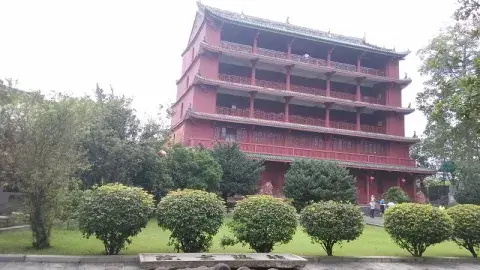
Being built in 1959 and located at 215 Wenming Lu, the museum is a round-topped three-storied building with a hall in the center which is surrounded by corridors. The big yard of the museum was originally the Gongyuan (the imperial examination centre) of Guangdong in the Qing Dynasty  (1644—1911). Inside the yard, there are several national cultural heritage sites, such as the Site of the First National Congress of the Chinese Nationalist Party (including the Revolution Square), the Red Mansion, the Astronomical Observatory of Zhongshan University and the Lu Xun Memorial Hall.

A new display building with modern facilities was constructed at the end of 1992. This new building covers an area of 13,200 square meters (3.26 acres) and the exhibition hall is about 6000 square meters (1.48 acres). It has thirteen exhibition halls, two procedures rooms and an academic lecture hall. The Provincial Museum's new display hall considers historic folk, art and nature as its three main exhibition aspects. As one of the three landmarks of cultural facilities in Guangzhou, it plays a very important role in strengthening the international culture communication and developing the city into a modern international metropolis.

Guangdong Province Articles

Top Guangdong Province Tours

$150 Per Day

Guangzhou

Day 1 Arrive in Guangzhou

Arrive in Guangzhou in the morning, you will be met and transferred to hotel, then visit Sun Yat-sen Memorial Hall. The Memorial Hall is a very famous historical scenic spot. It is in memory of Sun Yat-sen, the great revolutionary forerunner. After that proceed to visit the Ancestral Temple of the Chen Family. It is a unique site for offering up sacrifices to worship ancestors of 72 Chen families in Guangdong. This ancestral temple is also the largest, best preserved and best decorated ancient architecture existing in Guangdong province.

Day 2 Guanzhou Tour 

After breakfast, you will go to Yuexiu Park first, the largest and the most famous park in downtown Guangzhou. There are three artificial lakes and seven hills of Yuexiu Mountain. Then you will visit Temple of Six Banyan Trees, which is one of the four best Buddhist temples in Guangzhou and located on the Liurong Road (meaning the Six Banyan Trees Road). The Nanyue King Tomb Museum is a must-see Guangzhou attraction, which dates back to 2,000 years ago, is the earliest large scale painted stone chamber tomb ever found south of the Five Ridges. Buried with the tomb owner in a jade shroud are a gold seal and a lot of exquisite jade adornments. It has become a world famous museum. After the day tour you will be transferred to airport for your next destination.

$150 Per Day

Discovery of Martial Art City-One Day Sight Seeing Trip To Ancestor’s Temple And Bruce Lee Ancestor House In Foshan

Chinese new year, the most important festival for chinese. Many staff will have 7 days vacation, which can make good use of these day to travel and have relax. Most customers from Synotrip contact me whether to be their tour guide and interpreter during the new year .I was born in Guangzhou ,my hometown is Guangzhou, I know the culture of Guangzhou and Guangdong the best, that's why so many clients choose me to their interpreter.

One of clients contact me from Synotrip, now we become friends. He is obsess with chinese martial art and Bruce Lee, so he decide to come to China to follow the step of martial idol. 

He ask me to plan a “discovery of martial art” trip for him. No doubt that Foshan, which is renowned for its martial art form, is the best place to him. In fact, the city of Foshan can be called the birth place and home town of this particular martial art form. The notable celebrity are Ip Man, Bruce Lee, and Wang Fei Hong who is a legendary martial art master and doctor and seldom foreigner know him.

We plan to visit Ip Man memory hall in Ancestral Temple first, after that, go to Bruce Lee ancestor house. Actually, we can go Ancestral Temple by metro from Guangzhou. There is a Guangfo line connected Guangzhou and Foshan, which it is more convenience for the people of two city. But considering the distance from Guangzhou East to Foshan, tight schedule, and the place of Bruce Lee ancestor house is a remote village hard to get there by public transportation, we decided to rent a car for traveling.

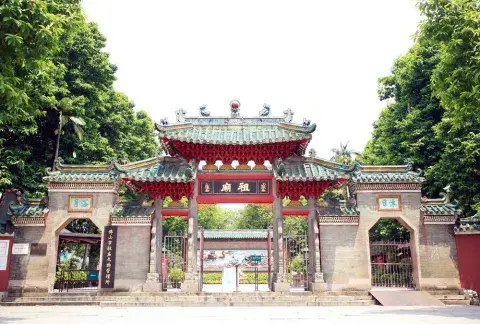
My friend arrived at about 9:30 am at Guangzhou East station,and after picking him up we headed to Ancestral Temple. The Foshan Ancestral Temple is commonly called Zumiao. It is a Daoist temple, museum, and exhibition center. The architecture, decor and articles on view in Foshan Ancestral Temple are remarkably refined, and are part of the unique historical heritage of Foshan. 

Because my friend is a martial art fans, so we directly to the Ip Man memory hall.Ip man, a man dedicated to a Wing Chun, is a famous Chinese martial art master, had been a master of Bruce Lee. Bruce Lee learn Wing Chun and develop it in his Jeet Kune Do. In the museum, you can see a likeness of Ip Man, martial arts training equipment, and a plaque with information about him.

There is another memory hall for famous legendary martial artist and doctor named Wang Fei Hong. In this place,we also see a chinese traditional customs performance ---lion dance.

We are so deep addicted to enjoying the time in the Ip Man hall and lion dance without noticing that it comes to the afternoon. We need to head to next place - Bruce Lee Ancestor House, which it take one hour to arrive from temple.

Bruce Lee who is considered by many as the most influential martial artist of the 20th century, and an important cultural icon. He used Wing Chun, as his base, learned from the influences of other martial arts, and later created his own martial art philosophy — Jeet Kune Do.

The Bruce Lee Ancestral House located in Jun'an Town is another site for Bruce Lee fans to visit.Built by his grandfather, Lee came back to the house once and lived in the house for only a few days. Even though we only just saw the furniture and the introduction of him and his family, we still felt exciting stand a place which Bruce had been lived.

We spent a great day to feel the martial art culture and gorgeous historical building in Foshan. My friend is pretty good impressed and said that he must would share this experience to his martial art friend when he go back to UK.

 

$100 Per Day

One Day tour for furniture and building materials wholesale markets in Guangzhou and Foshan


Foshan is the manufacture basement for Furniture, Building Material and Lighting. Has professional wholesale market for different products, all market are not far away from each other, if you wanna have a roughly idea about the market before you go into detail purchase, one day tour can be helpful to you.

Our company provide you professional one day tour service in Foshan.

Here is the suggested one day tour plan.

1, 9:00am
Pick you up in your hotel at 8:30am with a private car.
Market open at 9:00am, we can arrive the market  about 10:00am, depending on where is your hotel.

2, 10:00am
Arrive Lecong Furniture market street.
Lecong furniture market is a road which is over 5,000km, with over 30 furniture wholesale building, with different level, for example Luvor is high end building with most variety of choice and design. You can find home furniture (morden, classicla, new classical, American coutry style, French style etc.), office furniture, hotel furniture, sanitary ware, lighting, home decoration items inside.
We can start from Luvor.


3,  11:30am
Arrive Kitchen/waredrobe and Lighting market.
Kitchen and lighting market is on the same road of furniture street. 3 minutes by car from the Furniture market. It's two building, one building with three floor for kitchen, one building with three floor for lighting, it's the biggest professional market for kitchen/waredrobe and lighting.


4, 1:00pm
Lunch.
There is a food street behind of the kitchen/waredrobe and lighting market. With variety style of food, western style, China style (Local cantoness food, spicy food etc.)
Average cost is 8USD - 20USD per person.

5, 2pm
IFEM
IFEM is the biggest complex building for furniture, building material and lighting in Foshan also in China, but still new not so busy untill now. (2015.10)
Around 10 minutes from the food street.


6, 3pm
Zhie ye ceramic wholesale market.
This market is middium to low level market for ceramic tiles and sanitary ware. Just behind IFEM.

7,4pm
China ceramic city
China ceramic city is the midium to high level ceramic tiles and sanitary ware wholesale market, including almost all of the famous international brand also China brand.
It's around 5 minutes from zhiye ceramic wholesale market.

8, 5pm
Huayi building decoration material wholesale market.
Huayi building decoration material wholesale market including all materials related to building decoration, like window, door, wooden floor, sanitary ware, kitchen, waredrobe, lighting, ceiling, wall paper etc.


9, 6:00pm
Finish one day tour, send you back hotel or other relevant place accorording to your requirement.

Charge:
150 USD per day for the one day tour guide+Driver, 9hours per day.
No other extra cost.