Datong Attractions

Datong Garden Hotel

otel Description
The Garden Hotel is owned by the owner of two famous restaurants - Kun Lun and Hong Ya Restaurant. It is a four star tourist and business hotel. The hotel is located within walking distance to the Bell Tower, Nine Dragon Wall as well as within easy distance of business an...

otel Description
The Garden Hotel is owned by the owner of two famous restaurants - Kun Lun and Hong Ya Restaurant. It is a four star tourist and business hotel. The hotel is located within walking distance to the Bell Tower, Nine Dragon Wall as well as within easy distance of business and shopping district.
Comprising of 108 rooms including Garden Suite, Executive Suite, Deluxe King, Deluxe Twin, Superior Twin, Superior King; all are tastefully decorated and well equipped with elegant and comfortable Ming-Qing Dynasties pear wood furniture. All rooms are provided with a full array of modern amenities including high speed broadband internet, international satellite and movie channels, IDD/DDD telephone, private safe, fully stock minibar, coffee and tea making facility and mineral water supply. Non-smoking rooms are also available.
Garden Hotel has a unique landscape called Garden Atrium located at second floor. It features garden within the hotel and best place for afternoon tea and relaxation place. The best way to view Garden Atrium is by two bubble lifts.

Restaurant: Chinese restaurant,western restaurant.

Recreation: Game room, sauna, beauty salon.
Mosque

Islam probably first reached China in the mid-7th century. The Yuan Dynasty (1271-1368) witnessed the zenith of prosperity of Islam. Datong Mosque is located in the heart of old Datong City. It is one of the most well known Mosques in Shanxi Province. According to a stone stele in the Mosque, thi...

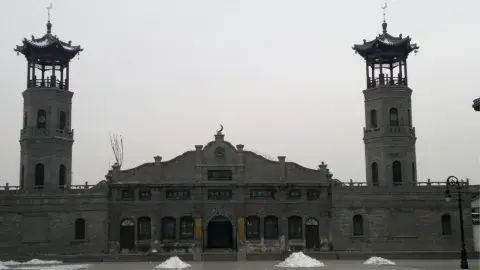
Islam probably first reached China in the mid-7th century. The Yuan Dynasty (1271-1368) witnessed the zenith of prosperity of Islam. Datong Mosque is located in the heart of old Datong City. It is one of the most well known Mosques in Shanxi Province. According to a stone stele in the Mosque, this ancient mosque was first build in the Yongle Period of the Ming Dynasty (1368-1644). It was built in the early period shortly after the introduction of Islam to China. Facing to the west, the mosque has three courtyards with main buildings located on the central axis, namely entrance gate of the temple, second gate of the temple, Pavilion for Introspection, Best Scholar Bridge, Praying Hall, stone carving screen and back door. The layout of the temple is rectangular in shape covering an area of around 20 Mu (13,333 square meters). In 1981, the mosque was put on the list of cultural relics under the protection of the city government. In 2008, an overall project of Preservation and Rejuvenation of Historical and Cultural City undertaken by Datong local government started. As one of part of this overall city construction project, Datong Mosque was restored to its magnificent original appearance.

Eastern city wall Belt Park

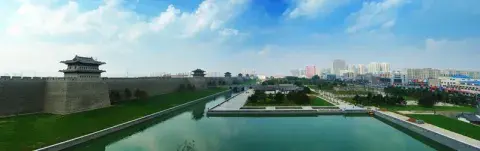
A collection of fine sculptural art from different dynasties can be found in Datong. The golden time for ancient Datong was the Northern Wei Dynasty when Datong was taken as the capital city for nearly one hundred years and in the Liao Dynasty when the city was taken as the second capital city fo...

A collection of fine sculptural art from different dynasties can be found in Datong. The golden time for ancient Datong was the Northern Wei Dynasty when Datong was taken as the capital city for nearly one hundred years and in the Liao Dynasty when the city was taken as the second capital city for nearly two hundreds years. The sculpture art demonstrated in Yungang Grottoes, Huayan Temple and Shanhua Temple opened a new era in the sculpture history of China. As the home of nearly 100,000 pieces of ancient sculpture, Datong is reputed as ‘Sculpture Capital City of China’. As a model of the combination of sculpture and city planning the Eastern City Wall Belt Park is constituted with the city moat, a sink-style courtyard, green belt, sculpture squares etc. which creates a magnificent view together with eastern city wall. The Eastern City Wall Belt Park is 2 kilometers long and 210 meters wide covering an area of 450,000 square meters. There are altogether six sculpture squares with an area of 2,500 square meters each one with six individual sculptures as its theme. These give every visitor a taste of the human environment and the profound history of the city.

Yanmenguan Pass of Great Wall

Yanmenguan Pass of Great Wall is located in the Gouzhu Mountain ranges, within the Hengshan Mountain range, 12 miles to the north of Dai County, in Shanxi Province. Along with Ningwuguan Pass and Pianguan Pass, Yanmenguan Pass is one of three important passes through the inner line of the Great W...

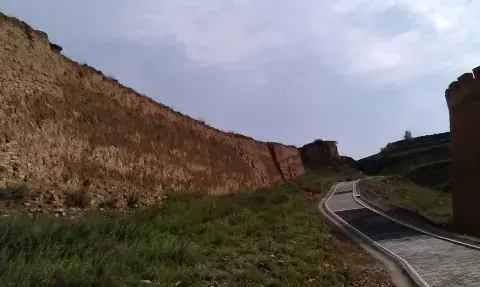
Yanmenguan Pass of Great Wall is located in the Gouzhu Mountain ranges, within the Hengshan Mountain range, 12 miles to the north of Dai County, in Shanxi Province. Along with Ningwuguan Pass and Pianguan Pass, Yanmenguan Pass is one of three important passes through the inner line of the Great Wall in the Shanxi section. It is also known by other names, namely Yanmensai and Xilongguan. Located at a place of strategic importance and difficult to get through, it was regarded as the principal one of the nine passes under heaven in ancient times. Many famous historical battles have been fought in the area.

Yan means 'wild goose' in English, and was so-named because wild geese are seen flying around the pass every year. Early in the Spring and Autumn Period (770 BC - 476 BC), King Wuling of Zhao established Yanmen County in this region. The Tang Dynasty (618 - 907) built a pass called Xiting Pass by Yanmen Mountain, west of the present l ocation. In the year 1374 during the Ming Dynasty (1368 - 1644),

Yanmenguan Pass Gatethe pass was rebuilt and moved to today's location.

This Great Wall pass is 0.6 miles wide. There are three gates: the small north gate, west gate and east gate.  The small north gate is inscribed with the three characters, 'Yan Men Guan'; the west gate is labelled 'Di Li', meaning the favorable geographical location; the east gate is labelled 'Tian Xian', translated as the unbreakable stronghold. Adjacent to the pass, lies Jingbian Temple.

The Yanmenguan Pass of Great Wall is being well preserved at present. It is a precious ancient military relic, attracting more and more people who visit here to recall past times.


How to get there :

By Car: exit from 'Xinguangwu’ Exit/ Entrance of Dayun Freeway and then travel southward about 7-8 kilometers to ge there;

By Bus: take a bus running from Daixian County to Datong, get off at Yanmenguan and then walk about 2 kilometers to get there;
By Taxi: about CNY 100 from Daixian County to get there by taxi.

Datong Articles

Top Datong Tours

$999 Per Day

7 Days Shanxi Highlights tour

Day 01 Arrival in Datong (no meal)
Arrival in Datong by train or bus in the evening, be picked up and transferred to the hotel.
Day 02 Datong (B, L)
Visit the UNESCO World Cultural Heritage site – Yungang Grottoes. Then proceed to ancient Huayan Temple of Liao and Jin Dynasty and Nine Dragon Screen.
Day 03 Datong – Mount Wutai (B, L)
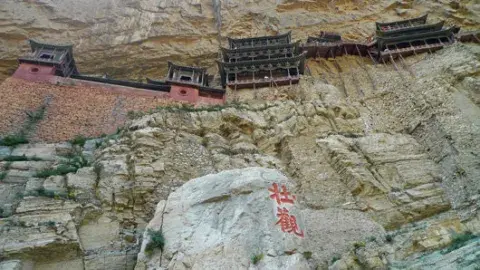
Drive to visit Hanging Temple, Wooden Pagoda at Ying County, which is the oldest existent fully wooden pagoda still standing in China, first built in 1056. Overnight at Wutaishan city.
Day 04 Mount Wutai – Taiyuan (B, L)
Half day tour to Mount Wutai, one of the four holy mountains for Buddhists in China, you will tour the Xiantong Temple, Pusading Temple and Tayuan Temple. After lunch, drive 4 hours to Taiyuan, the capital city of Shanxi Province.
Day 05 Taiyuan - Pingyao (B, L)
After breakfast, transfer to visit Jinci Temple, which was founded about 1,400 years ago, boasting a diverse collection of more than 100 sculptures, buildings, terraces, and bridges. Then proceed to Pingyao, you will visit Qiao Family Compound and Double Forest Temple before checking into the hotel.
Day 06 Pingyao (B, L)
Explore the old town of Pingyao escorted by your guide, including the visits to the city wall, Rishengchang Draft Bank and Ming and Qing Street. Free time at the rest of the day.
Day 07 Pingyao – Taiyuan departure (B)
Drive to Taiyuan, and board the flight or train to your next destination.
End of service.

$100 Per Day

4 days impressive datong tour

Day 01
        Arrive in DaTong train station or airport,  then our driver and tour guide will  transfer you guys to hotel for a three-nights stay, and the full day of beaitiful sightseeing awaits you tomorrow morning. 


Day 02
        Visit   Yungang Grottoes in the morning, then go to Datong Nine-Dragon Screen Wall in the afternoon. 


Day 03
       We  will go to Yingxian Wooden Pagoda in the morning,  then visit  Temple in Midair in the afternoon. 


Day 04

Transfer you guys to airport or train station. 
 

$300 Per Day

2 Day Tour in Pingyao city

Day 1  Taiyuan to Pingyao    Chinese Lunch

Pick up you from the hotel. Full day trip in Pingyao to Jinci Temple, Qiao Family's compound.

-Jinci Temple: lies in the Xuanweng foothill, which is 25 kilometers from the southwest of Taiyuan city,it is the temple of Jin Emperor in ancient times; it is initially built during the northern Wei Dynasty (386-535) for memorizing the second son Jiyu of Zhouwu Emperor. Jinci Temple is one of the national key cultural relic reserves, enjoys the reputation of “Little South of the Yangtze River”
-Qiao Family's compound: Built in 1755, this well-preserved and exquisite structure used to be the residence of Qiao Zhiyong, who was a famous businessman during the Qing Dynasty.

Day 2 Pingyao to Departure City  Breakfast  Chinese Lunch

Full day trip to Pingyao Ancient Town, The Ancient City Wall, The Rishengchang Draft Bank, The Mingqing Street

-Pingyao Ancient Town: In the middle of Shanxi Province, this is the best-preserved of the four ancient towns in China. Inside the intact Ming Dynasty city wall this traditional town, whose buildings date from the Ming and Qing Dynasties, is exceptionally well-preserved, and just as it was centuries ago. Bikes can be rented for about 10 yuan/hour. You can also learn the traditional Chinese art of paper-cut, producing beautiful shapes and designs from paper in the Wentao Paper-cut shop, and lean how lacquerwork is done in Yonglong Shop.
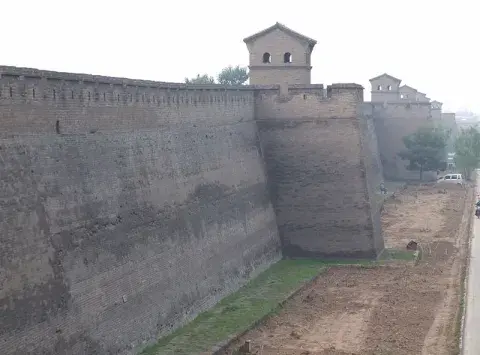
-The Ancient City Wall:  With a total length of 64 kilometers (about 40 miles), the city wall is about 12 meters (about 40 ft) tall and 3 to 6 meters (about 10-20 ft) wide on top. The wall is of compacted earth covered by bricks and stones. From a bird's eye view the rectangular wall resembles a tortoise. There are six city gates, one each on the north and south walls, and two each on the west and east walls. The south gate is the head of the tortoise, the two wells outside being the two eyes of tortoise. The north gate, the lowest place of the city, is the tail of tortoise. Traditionally the tortoise was considered a symbol of longevity, so through ancient times the hopes were that PingyaoAncientCity would be permanently secure. There are 72 watchtowers on the top of city wall and 3,000 external battlements. It is said that the 72 watchtowers represent 72 people of great wisdom, the 3,000 battlements the 3,000 disciples of Confucius.

-The Rishengchang Draft Bank: The Rishengchang Draft Bank:It was established in 1823. It was the biggest draft bank at that time and had been famous for "Hui Tong Tian Xia"(Business Connecting The Whole World).
-The Mingqing Street: the downtown thoroughfare and reserved quite well of the styles in the Ming and Qing Dynasties.