China Attractions

Sunny Night Club

       The newly remodeled (May 2008) Sunny Night Club is one of the largest, and overall the most popular club in Shenyang. It is packed with people pretty much every night of the week, and attracts Chinese customers, as well as foreigners from every p...
       The newly remodeled (May 2008) Sunny Night Club is one of the largest, and overall the most popular club in Shenyang. It is packed with people pretty much every night of the week, and attracts Chinese customers, as well as foreigners from every part of the world. 
          
       Since the 2008 remodeling project, Sunny’s has a unique layout. The club is actually separated into two bars. The larger section now attracts mostly Chinese customers and features a stage show with Chinese and Filipino singers and dancers. The smaller bar, unofficially known as “the foreigner bar”, is located near the club entrance. This bar is meant to be more suited to foreigners’ preferences, and has already become an extremely popular late-night stop for many foreigners. From about 8pm-midnight the Filipino musicians switch back and forth between the two bars. From about 11-midnight, the “foreigner bar” switches between the live music and several different DJs. After midnight it’s all dance music, and the bar can get very crowded. 
               
       The new Sunny’s is quite an improvement because the club now can appeal to a variety of different tastes. If you like techno music and late-night dancing, this is the place to be. Now, it’s a also a good place to have a relaxed drink or two if you come a bit earlier in the evening. 
           
The new bar now has a wide variety of foreign and Chinese food. 
                 
Costs: There’s no cover charge. Beers and cocktails start at 25元。   
          
                
Location: At the corner of Ba Jing Jie (八经街) and Jiu Wei Lu (九纬路), a few blocks east of Zhong Shan Square (中山广场).  All Shenyang taxi drivers know "wǔ yè yáng guāng."


Four Ancient Towers

The four towers, like most of Shenyang’s historical sites, were built around 1643 during the early Qing Dynasty. The towers symbolize the four Buddhist Heaven Kings, and originally marked the borders of the city. The four towers, aptly named “North Tower”, “Sou...
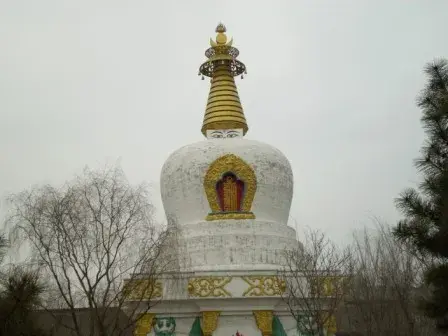
The four towers, like most of Shenyang’s historical sites, were built around 1643 during the early Qing Dynasty. The towers symbolize the four Buddhist Heaven Kings, and originally marked the borders of the city. The four towers, aptly named “North Tower”, “South Tower”, “East Tower”, and “West Tower”, do in fact appear quite similar to each other. The towers themselves are white, bulb-shaped structures, with gold decoration on the top. Each one is surrounded by a small Buddhist temple. Reportedly the North Tower is the best restored and maintained tower. 
 
The towers are pretty unspectacular, so don’t plan a whole day around visiting them. Entrance is free, however, so if you happen to be in the area of one of the towers, they are worth a look. The official operating hours are a bit unclear. The apparently sometimes close a bit early, so it’s best to go in the morning. 
 
Locations: (click on pictures for larger images)
 
North Tower 北塔 běi tǎ:
  
Useful Bus Routes:
131 to/from Beiling Park East Gate, Shenyang University
213 to/from Beiling Park, Orthopedic Hospital, Middle Street, Imperial Palace, Wu Ai Market, South Tower
245 to/from Beiling Park, Orthopedic Hospital, South Tower
 
 
South Tower 南塔 nán tǎ:
South Tower is located in Shenhe District (沈河区) on Wencui Lu (文萃路) just behind Shoe City. 
Useful Bus Routes:
113 to/from Shenyang University
135 to/from Tiexi Square, Heping Square, San Hao Street, Exhibition Center
213 to/from Beiling Park, North Tower, Middle Street, Imperial Palace
239 to/from San Hao Street, Exhibition Center, Heping Square
282 to/from Xi Ta, Fangxing Square, Nanhu Park, San Hao Street, Exhibition Center, Sports Park
286 to/from Summer Palace
  
  
West Tower 西塔 xī tǎ:
The area surrounding the West Tower is known as “Korea Town”, and is home to a large population of Koreans, as well as many Korean bars, restaurants, massage parlors, etc. click for more info on "Korea Town". The tower is at the east end of Shifu Road, at the beginning of Xi Ta Korea street. 
 
 
Useful Bus Routes:
611 to/from South Station, Taiyuan Street, South Tower, Huigong Square
  
  
East Tower 东塔 dōng tǎ:
Located in Da Dong District (大东区) on Chang An Lu (长安路). 
Useful Bus Routes:
237 to/from Wu Ai Market, Ma Lu Wan, Taiyuan Street, South Station, Tiexi Square
 

North Market--Huang Temple

The North Market is comprised of two perpendicular pedestrian-only streets. The market includes an array of food vendors selling meat sticks (肉串, ròu chuàr), dumplings (饺子), baozi (包子), beer, and other goodies. The street is surrounded by several shops, including a jade marke...
The North Market is comprised of two perpendicular pedestrian-only streets. The market includes an array of food vendors selling meat sticks (肉串, ròu chuàr), dumplings (饺子), baozi (包子), beer, and other goodies. The street is surrounded by several shops, including a jade market, while other street merchants sell books, artwork, decorations, and miscellaneous trinkets. 
   
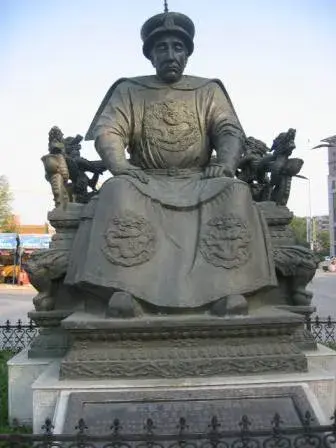
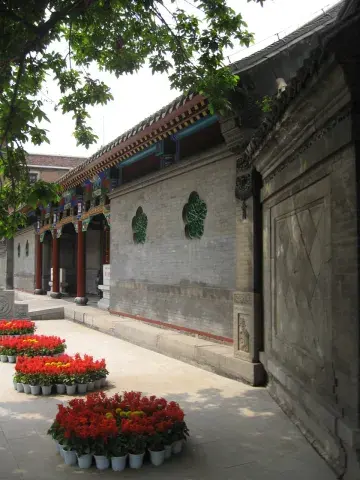
Adjacent to the market is the “True Victory” Temple (实胜寺庙 shí shèng sìmiào). This Buddhist temple was built in 1636 by the second Qing Dynasty emperor, Huang Taiji (皇太极), and is also known by the name “huáng sìmiào” (皇寺庙). The temple houses the cremated remains of a high-ranking Buddhist monk, and sometimes visitors are lucky enough to witness a performance of a traditional ceremonial Buddhist dance. Just outside the temple, there are large stone statues of all 12 Qing Dynasty emperors seated proudly upon their thrones. Entrance to the temple is 15 yuan.
 
 
     (Huang Temple from above)                                  (Emperor Nurhachi, first Qing emperor)

During the New Year’s Holiday and the October Holiday, the area holds a “Temple Fair” (庙会). Each year the area becomes crowded with people buying food, and tying red prayer-ribbons around the trees in the temple. There are also some special performances. The Fair starts about one week before Spring Festival, and lasts for 15 more days afterwards. 
    
Location: The market itself is Huang Si Lu (皇寺路), between San Jing Jie (三经街) and Nanjing Jie (南京街). From Government Square, go one block west on Shi Fu Lu (市府路) and you will see a large stone archway for the entrance.  From Xi Ta, go 1 km east on Shi Fu Lu. All taxi drivers will know "běi shìchǎng". 
 
 
      (Huang Temple from above)                                  (Statues of all Qing Dynasty Emperors)

(Photos by David de Jesus, 2007)    


Zhang Xue Liang's Mansion

Zhang Xue Liang is one of modern China’s most honored figures. He is something of a folk hero in Northeastern China. Born into a powerful warlord family at the e...


History buffs should enjoy the way in which the museum provides an interesting look at the development of northeastern China. Unfortunately, most of the signs have little or no English, so if you can’t read any Chinese you might be a bit bored. 


The museum has three main parts: The old Zhang residence, built in ancient Chinese style, a newer mansion (1930’s) built mimicking ancient Roman design, and another house for one of Zhang Xue Liang’s father’s wives. The buildings themselves are interesting, but the main focus of the museum is on Zhang Xue Liang’s life and accomplishments. 
           
If you enjoy history and can read a bit of Chinese, the museum is worth a visit. Those on the tourist circuit should be able to visit Middle Street, the Imperial Palace, and Zhang’s Mansion all in one day. 
     
Location: The Mansion is near Middle Street (中街) just two blocks south of the Imperial Palace. The main entrance is on nán shùn chéng lù (南顺城路). Look for a large statue of Zhang Xue Liang in military uniform. The following buses will take you there: 134, 237, 250, 330, 133, 168. There is another entrance on the east side of the museum on cháo yáng jiē (朝阳街). The following buses stop there:292, 294, 290, 222, 213, 296, 287, 257, 118, 132, 276, 117, 228, 环. The bus stop for both entrances is called dà nán mén (大南门). If you’re asking for directions or taking a taxi, the mansion is commonly known as “dà shuài fǔ”(大帅府). 
 
Offical Website (in Chinese)
   
 
Photos by Jerry Wang, 2007

Xinjiang Meat on a Stick on Hubei Lu

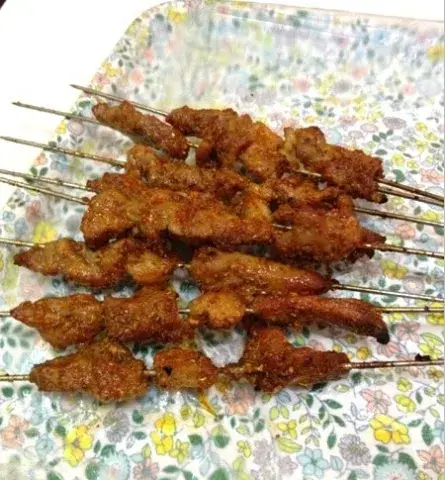
"Rou chuan", or "meat on a stick" for those that have spent less than a week in China, is surely one of the most popular street snacks in China.  Migrants from Xinjiang province serve this quick meaty treat in cities across the country.
 
...
"Rou chuan", or "meat on a stick" for those that have spent less than a week in China, is surely one of the most popular street snacks in China.  Migrants from Xinjiang province serve this quick meaty treat in cities across the country.
 
 
What makes this rou chuan better than the rest is that you get more meat, less grizzle and grease, and it’s quite spicy too.  
 
One rou chuan (one stick) costs 1 yuan, which is actually 2 or 3 times the price of the average rou chuan in Nanjing.
 
 
How to Get There
 
Follow instructions to get to Lion’s Bridge (狮子桥).  This section of Hubei Road (湖北路) stretches between the south entrance to Lion’s Bridge and Hunan Road (湖南路).
 
Second Location
 
There is a 2nd location in Mingwa Alley(明瓦廊).

China Articles

Top China Tours

$310 Per Day

3- Day Popular Tour In Zhangjiajie

Day 1    Zhangjiajie National Forest Park

Full day trip to Zhangjiajie National Forest Park,take Bailong Elevator up Yuanjiajie,Bailong Elevator is the said to be the worlds tallest full-exposure outdoor lift,double-deck sightseeing elevator.Yuanjiajie is the inspiration for Hallelujah Mountain in AVATAR , Where you will also find the aptly named First Bridge under Heaven, Lover Peaks and so on.

Continuing to Tianzi Mountain, it takes you 40 minuts from Yuanjiajie to Tianzi Mountain by public bus, after arriving in Tianzi Mountain, you will have a bird’s-eye view of all the mountains and valleys of the Wuling Mountains. Visit Western Sea, Helong Park, Viewing Terrace etc.Take Tianzi cablecar down and check in hotel for a rest.
Accommodation: Wulingyuan Downtown

Day 2    Baofeng Lake & Glass Bridge

After breaking in the hotel, we head to Baofeng Lake where is the masterpiece of nature and human beings’wisdom. Baofeng Lake is pure just like a big crystal among Bao feng mountain Range.When you cruise, you can hear authentic song from Tujia minority people,you can fully understand the harmony and peace between human beings and nature.

Transfer to Zhangjiajie Grand Canyon, have a walking on the Glass Bridge, Glass Bridge is the highlight of Zhangjiajie Grand Canyon, located in Zhangjiajie Grand Canyon, Zhangjiajie Grand Canyon Glass Bridge is the highest and longest transparent glass bridge with a length 430 meters and a width 6 meters. It is 300 meters above the ground level and it can bear 800 persons standing on it at the same time. (need to book the tickets in advance)
Accommodation: Wulingyuan Downtown

Day 3    Tianmen Mountain

Full day to explore Tianmen Mountain,take the longest cablecar in the world up Tianmen Mountain,have a walk on the mountain plank road built along the face of cliffs. You will feel like walking in a fairy land when the mist is still heavy.The must-visit scenic spots are: Tianmen Cave, Glass Road, Tianme Temple.

See you off in the airport and looking forward to seeing you again in Zhangjiajie.

$200 Per Day

CHENGDU, A PANDA CITY, A GOURMET CITY, A TEA CITY, LOOKING FOWARD TO YOUR ARRIVAL

Chengdu, with an area of 12,400 square kilometers and a polulation of about 14,170,000 is not just the biggest provincial capital in west China, but also the only city in the history of China whose name has reminded the same for 3,000 years since its establishment. In Chinese, "Cheng" means "success or successful" and "Du" means "big city or capital". This "Successful City" boasts a long history. It is believed that everything about Chengdu has their origin from "Sanxingdui Ruins", from where you can deeply discover the history story of Chengdu.

Giant pandas definitely are the best calling card and trademark of Chengdu. Every year, million of people are attracted by giant pandas to spend their holidays here, go sightseeing here, make investment here and even settle here permanently. The reason is that for people around the world, the charm of giant pandas cannot be replaced by anything else. 

Various kinds of wonderful food shall be another reason attracting you to visit Chengdu. Of the four most famous schools of culinery art in China (Beijing cuisine, Sichuan cuisine, Jiangsu cuisine, Guangdong cuisine), Sichuan cuisine boasts tongue-numbing, hot, delicate and fresh taste and a variety of flavors, as "each dish has its unique taste and no two dishes have the same flavor." Such spcial flavors as fish-flavored, gongbao (with peanuts), and water-boiled are incomparable at home and abroad.

"The teahouses in Sichuan top the world, and those in Chengdu Top Sichuan." This widespread saying not only points out the status of Chengdu's teahouses but also the inseverable ties between Chengdu culture and tea. Like bars in Paris and cafes in Vienna, teahouse add a touch of refinement and leisureliness to Chengdu, an ancient yet modern metropolis. The practice of driking tea prevailed in Sichuan as earlt as prior to the Qin and Han Dynasties.

Wish you can have a nice trip in Chengdu. You will love it.

$238 Per Day

Private Hangzhou Day Trip from Shanghai by Bullet Train

Take in the highlights of beautiful Hangzhou on a private full-day tour from Shanghai. After hotel pickup and transfer by high-speed train to Hangzhou, your private guide takes you to see some city attractions, such as Faxi temple. Moreover, enjoy a tasty lunch at a local restaurant before heading to Longjing village. There, learn about the process of farming and producing dragonwell tea, the region’s most famous product. Finally, enjoy a scenic boat cruise on UNESCO World Heritage-listed West Lake before returning to Shanghai.

This is a private, full-day trip from Shanghai to Hangzhou. After you are picked up in your hotel lobby in the early morning, you will take a bullet train to Hangzhou. This is the fastest way to Hangzhou and you can experience train speeds of up to 300 kilometers per hour. Your tour begins at one of Hangzhou's signature sites, the West Lake. Enjoy a lake cruise to see the top ten West Lake scenic views. You will then be taken to experience the wonderful cuisine of Hangzhou at a local restaurant. After lunch, you will visit Faxi temple, a well-known Temple dating back to the Jin Dynasty. See its famous wooden Buddha. Here, you will see fewer tourists and more locals. Finally, enjoy a cup of green tea when you visit the famous Longjing village to see wild fields of Longjing tea bushes where the locals produce the world famous green tea- Longjing Tea. In the village, all locals are tea farmers and you will see the entire procedure of making the famous tea and will get the chance to taste the best quality emperor tea. Afterwards, you will take the bullet train back to Shanghai and you will be returned to your hotel.