Tour Description
This trip takes you into areas far, far away from the usual tourist trail. But this means groups share very basic accommodation often with limited access to hot water, and no showers for several days. For those visiting Tibet for the first time, the gradual ascent of this route minimizes the effects of AMS (Acute Mountain Sickness) and is a good warm-up for wilder and harsher adventures!
Our journey starts at the Jade Dragon Snow Mountain and the Tiger Leaping Gorge in Lijiang, which are two of the most famous scenic spots of Yunnan Province. At the markets you get to know people of the Naxi minorities who still carry their own colourful national costumes.
We will then head towards Gyalthang (Zhongdian), which is situated at the east edge of Himalaya Ranges with an altitude of 3330m above sea level. The route leads us through the Hengduan Range to Dechen. The terrain is rough, taking us over complicated landforms towards the three river confluences, which border Sichuan, Yunnan and Tibet. It is at the Jinsha River (upper reaches of Yangtze River) that we will enter Tibet, then we will see the Lancang River (Mekong) and Nu Jiang (Salween). Continuing westwards, past by Ranwu Lake, and across Lulang forests, we will at last we reach the holy city… Lhasa.
KunMing flight to Lijiang Day 1
Arrival in Lijiang, visit the Old Town.
Free day to explore
Overnight at Lijiang Swiss Snow Inn (2*) or the Guangfang hotel (5*)
Day 2
We will ride bike to visit Baisha, Black Dragon Pool.
Altitude: 2400m
Overnight at Lijiang Swiss Snow Inn (2*) or the Guangfang hotel (5*)
LiJiang – ZhongDian Day 3
Drive 220 km to Zhongdian (also named Shangri-la, on the way visit Tiger Leaping Gorge, the First Bend of the Yangtze River. Altitude: 3300m.
Overnight at Longxiang Hotel (2*) or the Holy Palace Hotel (4*)
Day 4
Visit the Songzanlin Monastery, in the afternoon walk to the Dabao Si Monastery.
The flying streamers around the monastery and the approx. 2 km long Mani-stone will impress you deeply.
Overnight at Longxiang Hotel (2*) or the Holy Palace Hotel (4*)
ZhongDian – Deqin, 190 km Day 5
Drive 6.5 hours through parts of the Hengduan Range along the Jinsha River (upper reaches of Yangtze). Have a break in a beautiful small town named Benzilan. On the way we will visit Dongzhulin monastery, a famous monastery in Yunnan. Then a small walk around Baiman Snow Mountain and enjoy the far reaching views of Meili Snow Mountain, the highest peak in Yunnan Province, with an altitude of 6740 m above sea level. This peak is called Kawagebo by Tibetan compatriots, which means the white snowy mountain in Tibetan language. Regarded as one of the Eight Buddhist Mountains and the Divine Mountain and Holy Land, every year the Buddhist followers from Tibet, Sichuan, Yunnan, and Qinghai trek thousands of miles to pay religious homage to it. In the afternoon arrive in Deqin, situated close to the border of Yunnan and Tibet.
Overnight at Naka Hotel (2*) to see the sunrise of Kawagebo.
Deqin - Markam, 220 km Day 6
Drive 7 hours to Markam. We travel northwards along the Langcang Jiang River valley, and the upper reaches of the Mekong River. On the way we will have a break in Yanjin town, the border between Yunnan and Tibet, as it is famous all around Tibet for its salt mines. We will then walk 2 hours along the Mekong river and salt mines to Quzika hot spring. After a hotspring shower and lunch we start again! In the afternoon we reach Markam, where the Sichuan-Tibet Highway (Chengdu - Lhasa) and Yunnan-Tibet Highway meet (Kunming - Lhasa). Overnight at
ManTso Lake Hotel (2*)
Markam – Banda town via Zuogong County, 258 km Day 7
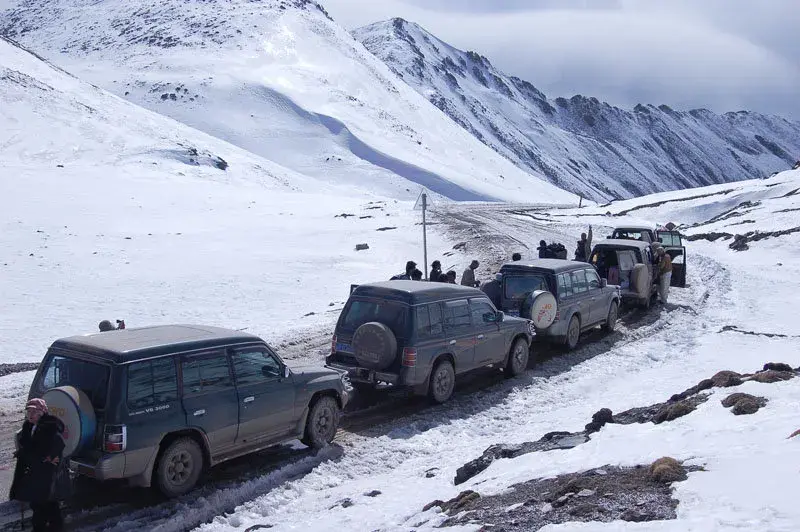
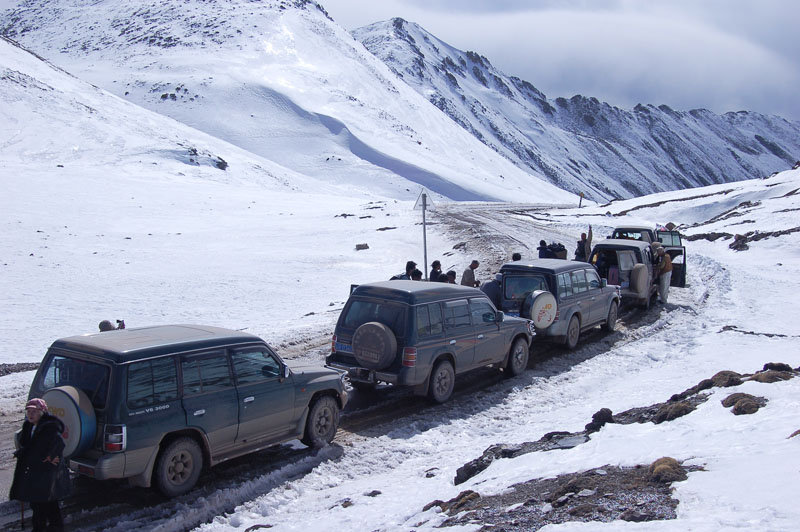
We start with a 7 hours drive to Banda town. On the way we cross the Lancang Jiang (Mekong) and overcome three passes: Joba, Lawu (4358 m) and Dongda (5008m). We drive down to Zuogong (3980 m) then drive 80km to Banda town, a town junction where Lhasa connects to the Chamdo-Kunming Highway. The Yu-chu valley lies north of the Salween gorges in the highlands of Tsawagang, where the immense geographic spatial dimensions of the land dwarf our presence. Today we will make many breaks to take photos and enjoy a few small walks.
Overnight at Banda Guesthouse (1*)
Danda – Ranwu Lake via Baxu County, 201 km Day 8
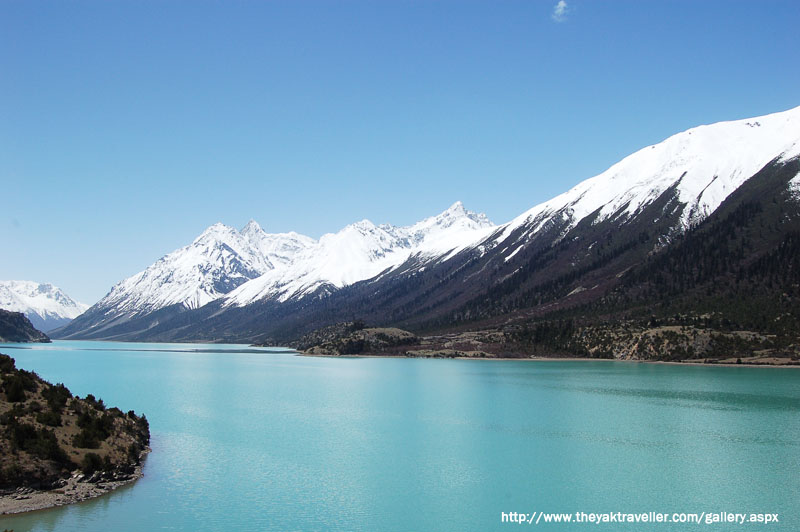
We drive 6.5 hours to Ranwu Lake. Whilst the distance covered is less than 70 km, the terrain is steep, as defined by the 180 switchbacks we will conquer when we cross Gama La Pass at an altitude of 4,618 meters. After we have lunch in Baxu county, we continue to drive for 3 hours to Ranwu lake, a spectacularly crystalblue lake cupped by snow peaks.
Overnight at Ranwu Hotel (2*)
Ranwu - Bome, 129km Day 9
In the morning we visit the Ranwu lake. After our lunch of freshly caught fish, we will drive 3.5 hours along the Poto-chu Valley at Tramog (2743m), located deep in the thickly forested gorge of Parlung Tsangpo with glacial waterfalls streaming from the mountainsides.
Overnight at Bome Jiaotong Hotel (2*)
Bome – Linzhi (BaYi), 210kmDay 10
We will drive 5 hours, on the way heading down several hundred meters in altitude as we reach the lowland jungle settlement of Tongmai, where the Tsangpo and Parlung Tsangpo rivers meet. Crossing Serkhyem La Pass (4515 m) we will have spectacular views of Mount Gyala Pelri (7150 m) and Mount Namchak Barwa (7782 m). Late in the afternoon we arrive in Linzhi (Nyingchi). Today we will take many breaks to take photographs and enjoy short walks.
Overnight at Little Swan Hotel(3*)
Linzhi – Lhasa, 390km Day 11
After breakfast we drive 7 hours along the Niyang River for Lhasa.
Afterwards we pass through scenic terrain with lush alpine forests and clear snow-melted streams, as well as over the impressing Mi La pass (4865 m) to Lhasa. Late in the afternoon we arrive in Lhasa (3650 m), capital of the Tibetan Autonomous Region. The city is situated on the bank of the Kyichu River and has long been the "Holy Land" of Tibet.
Today we will take many breaks to take photographs and enjoy short walks.
Overnight at Lhasa River Hotel (2*) or Hoshan Hotel (3*)
Lhasa Day 12
In the morning we visit Potala Palace, which was originally constructed in 637AD by Songtsen Gampo, the first king of the united Tibet, and later expanded and served as the winter residence of the Dalai Lamas as well as becoming the religious - political nexus of traditional Tibet. The crowds of pilgrims, innumerable magnificent murals, Buddhist statues, scriptures and rare treasures altogether creative a dense religious and artistic atmosphere that impresses every visitor. In the afternoon we visit Jokhang monastery, the center of the Tibetan Buddhist region and the sacred land of Buddhist followers where thousands of pilgrims come to worship every day. The temple, built in 647AD, is the earliest wood-and-masonry structure still existing in Tibet. We will then walk along the Barkhor street surrounding Jokhang, a big market with prolific stalls selling local specialties.
Overnight at Lhasa River Hotel (2*) or Hoshan hotel (3*)
Lhasa Day 13
In the morning we visit Drepung monastery, the sacred land of Gelug Sect., which was established in 1416 and the second, third and fourth Dalai Lama’s residence. In the afternoon we visit Sera monastery, which was created in 1419 and has always been an important Buddhist seminary. As roses are planted everywhere in the monastery, it is also called ‘The Court of the Wild Roses’. Today still 200 Lamas live there.
Overnight at Lhasa River Hotel (2*) or Hoshan Hotel (3*)
Lhasa – ChengduDay 14
Take flight to Chengdu, Sichuan Province. End of trip.
Extra Stay
Extra stay at LiJiang
Extra stay at Lhasa, exploring westwards to Mt. Everest Base Camp
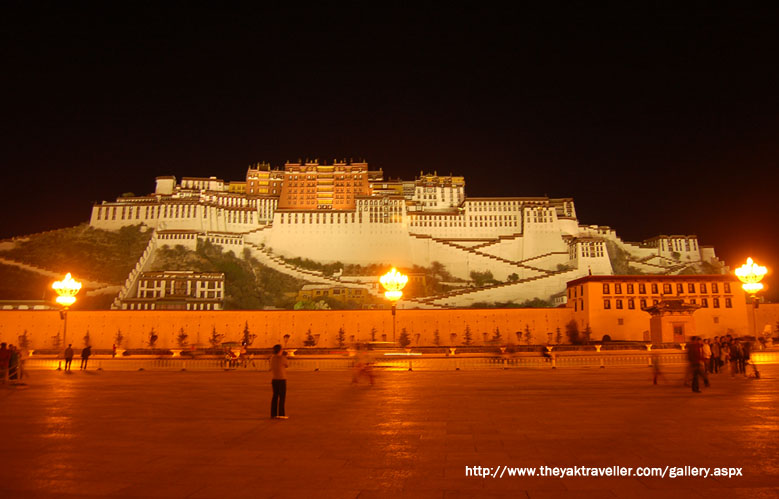
Attractions Visited in This Tour