Confucius
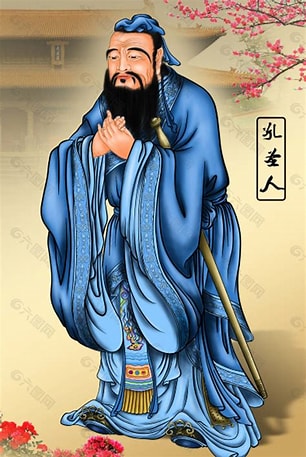
Confucius
Confucius is the most famous ancient Chinese philosopher known to the Western world. His importance could be compared with Socrates in ancient Greece, or Buddha in ancient India. They lived in similar times. Confucius (6th-4th BC). Many call this time as a period of wisdom. My understanding is that people were smart enough to have literature and logic, and a good amount of observations in life, but had not discovered scientific solutions. So, they came up with many abstract concepts to explain the world. That is called philosophy. The name Confucius was a Latinized translation of Kong Zi. Kong was his surname. Zi is a suffix for Master. Confucius lived in an era when China was not unified. Several kingdoms constantly fought against each other. War and human suffering together born many philosophers and Confucius was just one of them. When he was alive, he traveled all over China to persuade kings to adopt his advice of governance, and the people to follow his teaching to self-cultivate. Some kings paid attention to him for a while but eventually chased him away. He did have many students. Among them, 72 faithfully followed him. We do not know if he wrote any books. If so, none of them survived. Many of his stories and words were recorded by these students. This is the classic book “Lun Yu” which probably the most well read book in China. Confucius never gained much fame and definitely not any fortune. He nearly starved to death a few times. But, he managed to have a sense of humor. Once, he was lost and helpless by a road. His students asked a villager if he saw an old gentleman. The villager answered: “no, but I only saw a poor guy like an old stray dog at the end of the road”. When his students found him and complained about how rude the villager was, Confucius laughed, “Thanks to his accurate description, you find me!”.
Confucianism’s core is humanity, which includes respect, empathy, honesty, and mutual favor. This is similar to the golden rule in the west – Do not impose on others what you do not desire. He pointed out that a society, or even a family, must follow certain structures. People need to behave according to their roles to achieve harmony. He also promoted “Balance” or some may interpret as mediocracy. For example, in a forest, if a tree is taller and stronger than all others, it may be cut down first for lumber. If a tree is the weakest, it may be cut down to make room for others. So, those trees in the middle survive. If you are pessimistic, you may see this as a reason to be mediocre. If you are optimistic like me, you may think that we should not be too extreme, but to find a balance somewhere in the middle. One other important part of Confucianism is education. Life is a journey of learning. If a person is not educated, his father is the first to blame. If a student is not well disciplined, his teacher must be too lazy. The concept of self-cultivation is also from Confucius, for that the most important education is to educate ourselves. We shall self-examine three times a day to reflect and learn.
None of his teachings promote violence. You can see why his ideas were not adopted during his time when kingdoms kept fighting wars. Nearly 400 years later, after China had long been unified, the emperor picked Confucianism as the dominant philosophy to govern China. All the humanity, structure, balance, and education together served the emperor well. 1,400 years ago, when China decided to use a civil service exam system to select talents for all levels in the administration, Confucianism was picked as the testing subject. People were proud to claim themselves as students of Confucius. In fact, everyone in the administration was indeed his student. China has many different dynasties. All of them only lasted around 300 years or less. Confucianism has governed China for over 2,000 years. It is safe to say that Confucius is more powerful than any of the emperors. Furthermore, China radiated its culture to its neighboring states for thousands of years as well. People may relocate outside of China, but they always carry Confucius teaching with them. Confucianism became the common denominator for all Chinese people, and still going strong today. If you travel to Korea, Vietnam, Singapore, or Japan, you can easily find Confucius temples. If you have a China town in your home town, I bet you can find a Confucius statue there. In the end, I’d like to offer you a quote from Confucius – Everything has beauty, but not everyone sees it. You will see many beautiful things and meet many beautiful people in China. I wish you a beautiful journey.